
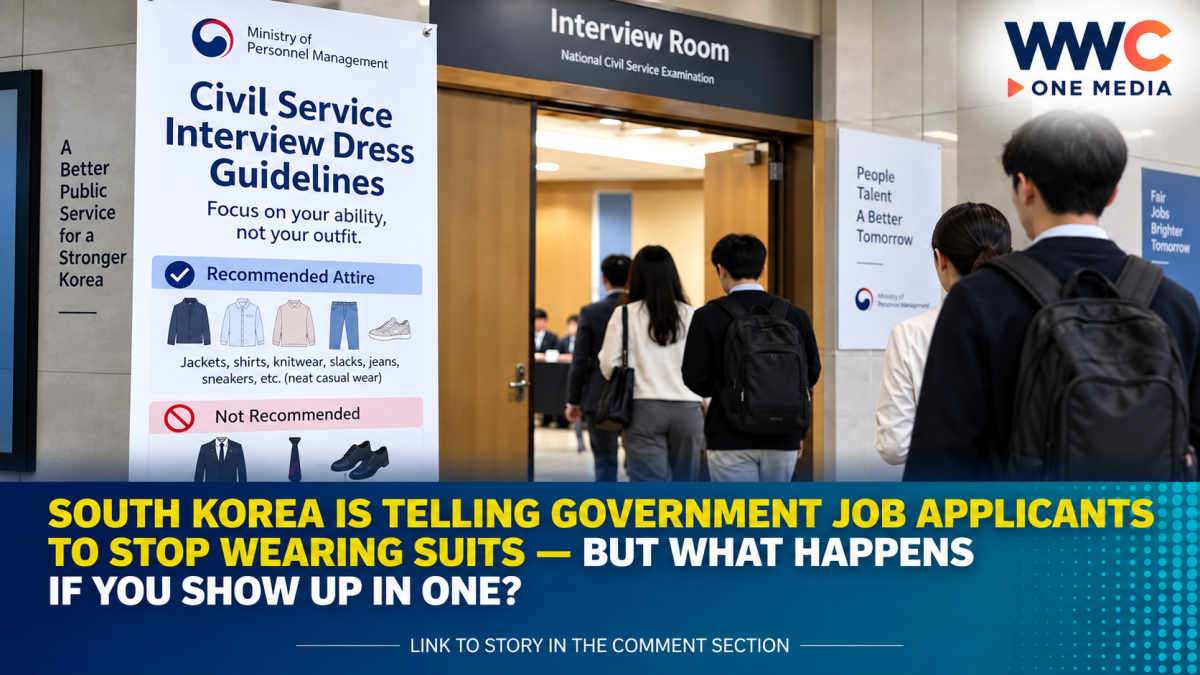
South Korea is taking an unusual step to make government job interviews less intimidating: starting in October, national civil service applicants will be encouraged to leave the traditional suit at home, while neckties and formal dress shoes will be prohibited.
The new guidance from the Ministry of Personnel Management (MPM) is aimed at creating a more natural interview environment and reducing the pressure candidates feel to dress formally.
But the policy has already sparked an unexpected question among applicants: if everyone is told not to wear a suit, how casual is too casual?
The ministry announced the new interview-attire guidance on September 10, with the Korea Herald reporting that the changes will apply to national government recruitment interviews beginning in October.
No more traditional interview uniform
Under the new guidance, both male and female candidates are advised to avoid suits and instead wear simple, neat everyday clothing that allows them to focus on demonstrating their abilities.
Recommended examples include:
- Jumpers or casual jackets
- Shirts
- Knitwear
- Slacks
- Cotton trousers
- Jeans
- Casual shoes
- Sneakers
The ministry, however, is drawing a line between relaxed and overly casual.
Hiking clothing, tracksuits, shorts, sleeveless tops and slippers are among the outfits that are not recommended. High heels are also discouraged.
And yes, there is a rule about ties and dress shoes
The policy goes further than simply saying “dress casually.”
The ministry says neckties and formal dress shoes are prohibited for the interviews covered by the guidance.
If an applicant nevertheless arrives wearing a necktie, officials will ask the candidate to remove it. If the candidate wears formal dress shoes, shoe covers will be provided.
The unusual measure reflects how difficult it has been for authorities to persuade applicants that suits are unnecessary.
For years, the government had encouraged candidates to choose comfortable, everyday clothing. Yet many applicants continued arriving in full formal wear.
Why South Korea wants applicants to dress down
The Ministry of Personnel Management says the problem is not simply fashion.
Officials say the overwhelming preference for suits has created an unnatural atmosphere during interviews.
There is also a surprisingly practical reason for the change: the sound of formal shoes.
According to the ministry, footsteps from dress shoes can interfere with the operation of interviews and examinations.
The government therefore wants applicants to feel less pressure to conform to traditional expectations and instead concentrate on showing their skills and personality.
But the new freedom may create a different kind of anxiety
The policy has received mixed reactions.
Some applicants welcomed the change, particularly because purchasing or renting a formal suit can add another expense to an already stressful job-search process.
Others argue that casual clothing can actually create more uncertainty.
A suit has traditionally provided a simple answer to the question: What should I wear to an important interview?
Now candidates have to decide what “neat casual” really means.
That uncertainty is particularly significant in South Korea, where government jobs remain highly competitive and applicants often spend considerable time preparing not only for written examinations but also for interviews.
The Korea Herald quoted applicants who worried that the relaxed dress code could ultimately create a new form of interview anxiety—trying to figure out exactly how casual the government expects them to be.
Government jobs remain fiercely competitive
The change is arriving at a time when competition for South Korea’s national civil service positions remains intense.
Official 2026 recruitment data show that 108,718 people applied for just 3,802 Grade 9 national civil service positions, producing an average competition rate of 28.6 applicants per position.
That was higher than the 24.3-to-1 competition rate recorded the previous year, according to the Seoul Economic Daily.
Competition can be dramatically higher for certain positions.
The 2026 Grade 9 recruitment included particularly intense competition for some administrative positions, demonstrating why applicants may be reluctant to experiment with their appearance—even when authorities explicitly tell them they can dress casually.
The government is trying to change more than clothing
The policy is ultimately part of a broader attempt to make the civil service recruitment process feel less rigid.
South Korea’s Ministry of Personnel Management has even released AI-generated sample images showing applicants in acceptable casual outfits, including combinations involving jeans, knitwear and sneakers.
That detail is significant because the government is not merely saying, “Don’t wear a suit.”
It is effectively trying to redefine what a professional government-job interview should look like.
Instead of using formal clothing as a symbol of seriousness, officials want the interview to focus more directly on the applicant’s qualifications and ability to communicate.
Not exactly “come dressed however you want”
Despite the headlines, candidates should not interpret the policy as permission to arrive in whatever clothing they like.
The ministry’s recommendation is for comfortable but neat everyday clothing.
That means jeans and sneakers may be acceptable, but beachwear, athletic outfits, slippers or similarly informal clothing are not what officials are seeking.
The distinction is important: the government is trying to eliminate unnecessary formality, not professionalism.
A bigger cultural shift?
South Korea’s move could ultimately become a fascinating experiment in whether removing traditional interview rituals actually reduces candidate anxiety.
The suit has long served as a visual shortcut for professionalism. But if every applicant is permitted to wear ordinary clothing, interviewers may have fewer opportunities to make assumptions based on appearance—and candidates may have fewer reasons to spend money preparing a “perfect” interview outfit.
Still, the first challenge may be psychological.
After years of believing that a government interview demands a dark suit and formal shoes, applicants may need time to trust the government when it says:
You really don’t have to dress that way anymore.
And for candidates walking into their first government interview in jeans and sneakers, the hardest part may not be answering the questions.
It may be believing that the sneakers are actually allowed.


Leave a Reply