
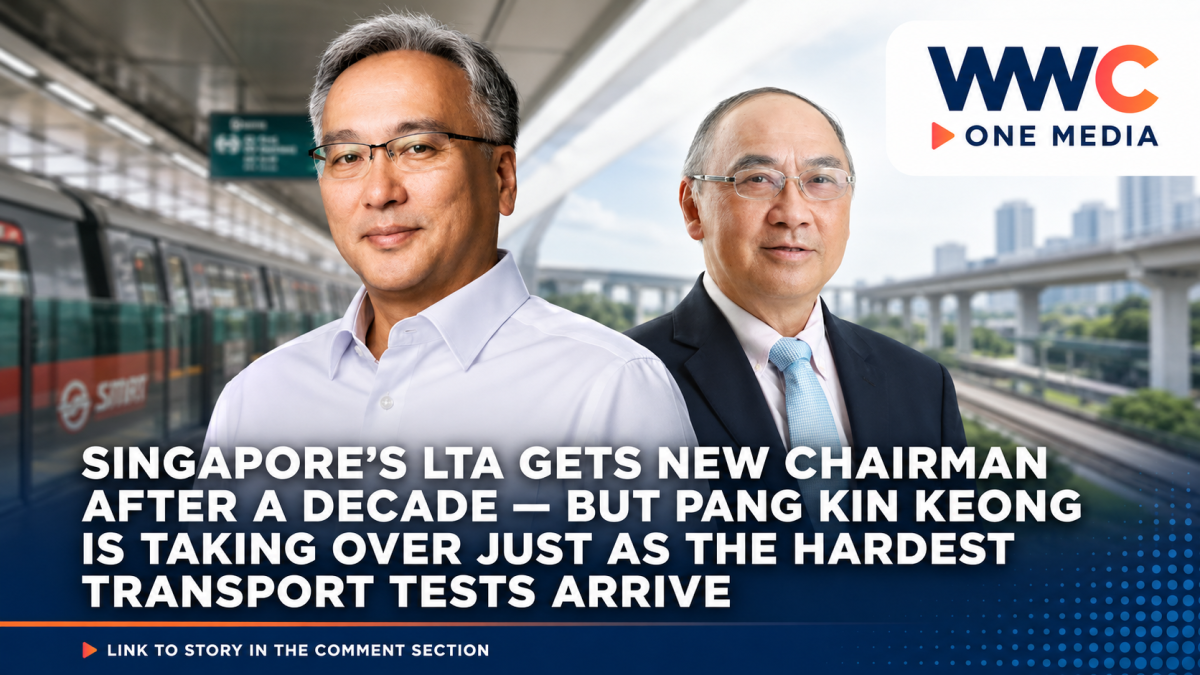
SINGAPORE — Singapore’s Land Transport Authority is getting its first new chairman in more than a decade, but the leadership transition comes at a particularly consequential moment for the country’s transport network.
Former senior civil servant Pang Kin Keong will take over from Alan Chan Heng Loon as chairman of the LTA Board on September 1, 2026, the Ministry of Transport announced on August 31.
Pang and 15 board members have been appointed for a three-year term running until August 31, 2029. Transport Minister Jeffrey Siow made the appointments, with MOT saying the board brings expertise spanning engineering, urban planning, finance, law and labour relations.
For commuters, however, the bigger question is not simply who occupies the chairman’s seat.
It is what happens next.
A Transport Veteran Returns to the Sector
Pang is hardly a newcomer to Singapore’s transport machinery.
He most recently served as Permanent Secretary at the Ministry of Home Affairs from 2017 until his retirement from the Administrative Service in June 2026. Before that, he was Permanent Secretary at the Ministry of Transport from July 1, 2012, to August 31, 2017. He has also served on the LTA Board since April 1 this year.
His earlier stint at MOT is especially significant.
According to Singapore’s Public Service Division, Pang helped lead major transport initiatives including planning for Changi Airport Terminal 5 and Tuas Port, as well as the development of the New Rail Financing Framework and Bus Contracting Framework. He was also involved in efforts to expand cycling infrastructure and covered walkways.
That background could matter as LTA now confronts a new generation of infrastructure and mobility challenges—not all of which are proceeding exactly according to their original timelines.
Alan Chan Leaves After More Than 10 Years at LTA’s Helm
Pang succeeds Alan Chan, who has chaired the LTA Board since April 1, 2016.
MOT credited Chan with overseeing a period of substantial expansion and disruption, including the COVID-19 pandemic and global supply-chain problems.
During his tenure, Singapore completed the Downtown Line, progressively opened the Thomson-East Coast Line and completed the Circle Line, while work continued on major projects including the Jurong Region Line and the Johor Bahru-Singapore Rapid Transit System Link.
LTA also expanded beyond conventional rail and road infrastructure during the period.
MOT highlighted the establishment of the Singapore Rail Test Centre, the electrification of the public bus fleet, expansion of electric-vehicle charging infrastructure, autonomous-vehicle initiatives and further development of cycling routes and Friendly Streets.
The result is that Pang does not inherit an agency starting a transformation.
He inherits one already deep inside it.
And One of His Biggest Rail Projects Is Already Behind Schedule
Among the immediate challenges is the Jurong Region Line.
In March, LTA announced that Stage 1 of the line would require about six additional months of construction, pushing its expected opening from the end of 2027 to around mid-2028.
LTA attributed the delay partly to the difficulty of recovering from earlier COVID-era disruptions and to complex engineering works, including viaduct construction over the Pan-Island Expressway and additional ground reinforcement required around a canal.
Interim shuttle bus services are expected to be introduced from the end of 2027 for areas that would have been served by the first stage.
That delay illustrates one of the central pressures facing the incoming board: Singapore’s transport ambitions are expanding while the engineering, operational and cost challenges behind them are becoming increasingly complex.
The Cross Island Line Will Be Another Major Test
The Cross Island Line, Singapore’s eighth MRT line, represents an even larger long-term undertaking.
At more than 50km when fully developed, it is planned as Singapore’s longest fully underground MRT line.
Phase 1, stretching from Aviation Park to Bright Hill, is targeted for completion in 2030. Phase 2 and the Punggol Extension are expected in 2032, while construction of Phase 3 is scheduled to start in 2027, with completion targeted for the late 2030s.
That means much of Pang’s three-year chairmanship will coincide with intense construction, procurement and preparation for one of Singapore’s biggest rail expansions in decades.
Then There Is Malaysia
An even more immediate milestone sits across the Causeway.
The Johor Bahru-Singapore RTS Link is targeted to begin passenger operations by the end of 2026.
The system will connect Woodlands North in Singapore with Bukit Chagar in Johor Bahru, with a train journey of about five minutes and capacity for as many as 10,000 passengers per hour in each direction during peak periods.
Passengers are also expected to clear both Singapore and Malaysian immigration at their departure station through co-located immigration facilities.
If the launch stays on schedule, it will become one of the most visible transport milestones early in Pang’s tenure.
LTA’s Challenge Is No Longer Just Building MRT Lines
The agency’s mandate is also broadening.
Singapore aims for electric buses to make up half of the public bus fleet by 2030, while the government’s longer-term goal is to gradually replace existing diesel buses with cleaner-energy models by 2040.
Authorities are also targeting roughly 1,300km of cycling paths by 2030, while pushing toward a transport system in which Walk-Cycle-Ride modes make up 90 per cent of peak-period journeys by 2040.
Autonomous vehicles are becoming another part of that strategy, with the government viewing them as a potential way to address manpower constraints while improving the efficiency of moving people and goods.
This makes the new chairman’s job considerably wider than supervising MRT construction.
The next LTA leadership will have to balance rail reliability, project delivery, road use, bus connectivity, electric vehicles, active mobility and increasingly automated transport—all while trying to keep daily journeys dependable for millions of commuters.
Four New Members Join the LTA Board
The leadership change also comes with a broader reshuffle.
Four people are newly appointed to the LTA Board:
Chan Tsan, chief executive of the Home Team Science and Technology Agency; Darren Teo, chief executive of the Centre for Strategic Infocomm Technologies; Professor Phoon Kok Kwang, president of the Singapore University of Technology and Design; and Yvonne Lim, chief planner at the Urban Redevelopment Authority.
Five members are stepping down from September 1: deputy chairman Richard Lim Cherng Yih, Mohd Sa’at Abdul Rahman, Professor Tan Thiam Soon, Hwang Yu-Ning and Ng Chad-Son.
The mix of technology, engineering and urban-planning expertise among the incoming members is notable at a time when transport policy is increasingly overlapping with digital systems, autonomous mobility and long-term urban development.
The Bigger Story Starts After the Handover
On paper, September 1 marks a straightforward leadership transition from one veteran public-sector figure to another.
In practice, Pang is stepping into the chairman’s role as several of Singapore’s most important transport bets approach critical stages.
The RTS Link is heading toward passenger service. The Jurong Region Line has slipped behind its earlier timetable. Construction of the Cross Island Line continues. Bus electrification is accelerating. Autonomous vehicles are moving closer to real-world deployment.
Alan Chan’s decade at LTA was dominated by expanding and strengthening the transport network.
Pang Kin Keong’s tenure may ultimately be judged by something harder: whether Singapore can deliver the next wave of that transformation on schedule—and whether commuters actually feel the difference.



Leave a Reply