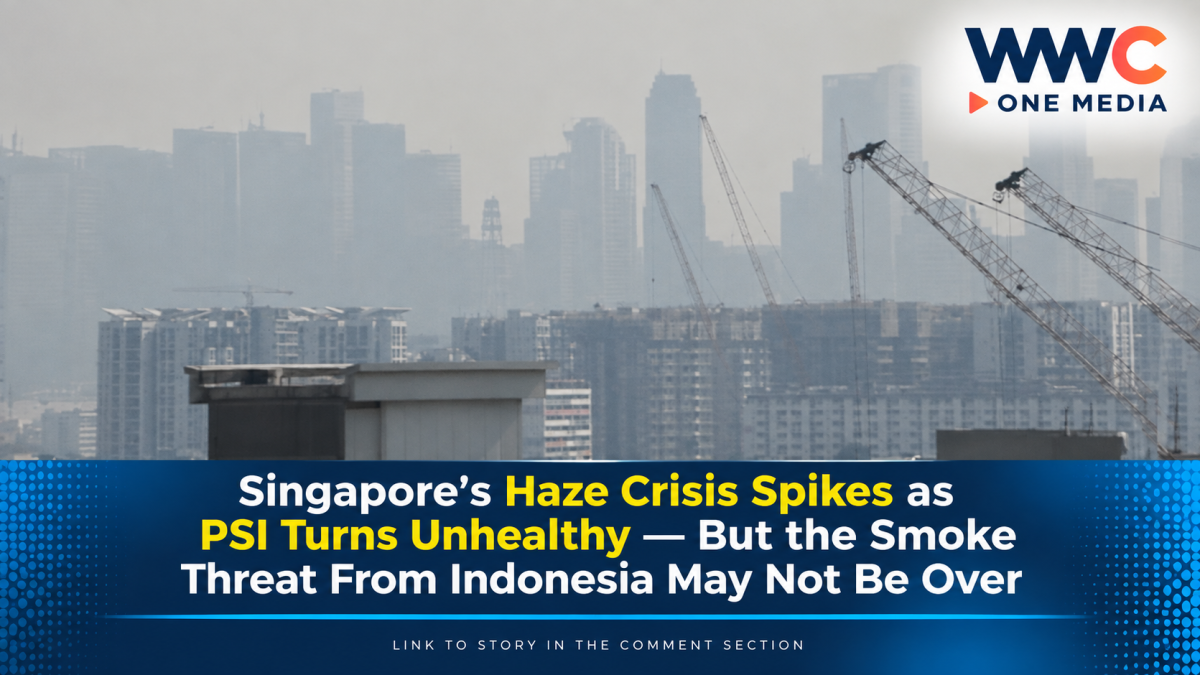
SINGAPORE — Singapore’s haze problem intensified again on Sunday as air-quality readings in three regions briefly crossed into the “unhealthy” range, sending the city-state’s latest bout of transboundary pollution back into the spotlight.
The deterioration was driven by smoke drifting from fires in parts of Indonesia, with prevailing winds carrying haze from southern and central Sumatra and Kalimantan toward Singapore.
But conditions improved later in the day.
By Sunday evening, all five regions were back in the moderate range, although authorities warned that dry conditions in the region meant the threat of haze had not disappeared.
The episode is nevertheless significant because Singapore had already experienced its first islandwide spell of unhealthy air in years earlier this month.
PSI Crosses 100 Again
Singapore’s 24-hour Pollutant Standards Index, or PSI, entered the unhealthy band in the central region on Sept. 19, before the eastern and western regions joined it early Sunday.
At around 6am on Sept. 20, the PSI reached 123 in central Singapore, 105 in the west and 102 in the east.
Under Singapore’s PSI scale, readings from 101 to 200 are classified as unhealthy, while 51 to 100 is considered moderate.
The deterioration was temporary in some areas.
The eastern region fell back below the unhealthy threshold later in the morning, followed by the west.
By 7pm, the central region had also fallen to around 100, technically returning to the moderate category, while the west was at 92 and the east at 79.
That means Singapore ended Sunday in considerably better shape than it began.
But the underlying weather pattern remains a concern.
Smoke Is Coming From Indonesian Fires
Singapore’s National Environment Agency said the current haze episode is connected to widespread hotspots and smoke over parts of Sumatra and Kalimantan.
On Sept. 19, the Meteorological Service Singapore reported that smoke haze from southern and central Sumatra was drifting toward Singapore as winds blew from the southeast to southwest. Smoke plumes were also observed over southwestern Kalimantan.
The NEA’s haze monitoring system reported widespread hotspots over Kalimantan and Sumatra, with moderate to dense smoke haze observed across portions of those areas.
That creates the basic recipe for another deterioration:
dry weather + active fires + favorable winds = renewed haze risk for Singapore.
Singapore Has Already Experienced a Bigger Spike This Month
The latest episode comes only days after Singapore experienced substantially worse conditions.
On Sept. 15, all five regions recorded unhealthy PSI levels.
That was the first time Singapore’s entire island had entered the unhealthy range since October 2023, according to Reuters reporting.
The central region reached 154 at 6am that day, while the east and west recorded 128 each. The south reached 111 and the north 104.
The latest readings therefore represent a renewed deterioration after air quality had temporarily improved.
It is also why authorities continue to monitor the situation closely rather than treating Sunday’s improvement as the end of the haze episode.
Why Central Singapore Keeps Getting Hit Harder
One unusual feature of the latest haze episode has been the relatively poor air quality recorded in central Singapore.
The central region repeatedly registered higher PSI readings than several other parts of the island.
The Straits Times reported that urban heat and atmospheric turbulence can contribute to pollution becoming trapped closer to ground level in heavily built-up areas. Haze particles arriving from Indonesia can also mix with local emissions, potentially increasing pollution concentrations in urban areas.
That helps explain why the haze can appear uneven across Singapore.
One part of the island can have significantly worse readings than another at the same time.
The Most Important Number May Be PM2.5
While the 24-hour PSI is useful for assessing broader air quality and planning activities, Singapore’s authorities also tell residents to monitor one-hour PM2.5 readings for immediate outdoor-activity decisions.
PM2.5 refers to very fine particles that can penetrate deep into the respiratory system.
On Sunday morning, the one-hour PM2.5 readings remained in the normal band across all five regions even as the 24-hour PSI in three areas entered the unhealthy range.
That distinction is important.
A 24-hour PSI reading reflects accumulated pollution conditions and is useful for planning ahead, while the one-hour PM2.5 reading provides a more immediate picture of particulate pollution.
The two measurements therefore do not always move in exactly the same direction at the same time.
What Singapore Is Advising Residents To Do
The NEA’s health guidance changes depending on the PSI level and a person’s health status.
For healthy people, normal activities are appropriate when the 24-hour PSI is moderate.
If the PSI reaches the unhealthy range, the agency advises people to reduce prolonged or strenuous outdoor physical exertion.
Children, elderly people and pregnant women are advised to minimize prolonged or strenuous outdoor activity at unhealthy PSI levels, while people with chronic heart or lung conditions are advised to avoid such exertion.
The agency also recommends using one-hour PM2.5 readings when making decisions about immediate outdoor activities.
That means residents do not necessarily need to stop going outside every time the PSI rises above 100.
Instead, activity levels should be adjusted according to the official health guidance and current air-quality measurements.
Indonesia Is Fighting a Much Bigger Fire Crisis
The haze affecting Singapore is part of a far larger wildfire problem across Indonesia.
Reuters reported that Indonesia is experiencing its worst wildfire season in more than a decade, with prolonged drought and an unusually strong El Niño pattern contributing to conditions favorable for fires.
Indonesia’s Forestry Minister Raja Juli Antoni warned that some fires could continue until early November, as the rainy season is expected to arrive later than initially forecast.
The Indonesian government has deployed more than 50 aircraft for firefighting operations, including water bombing and cloud seeding, with international assistance also involved.
That suggests Singapore’s haze problem cannot be viewed as an isolated weather event.
It is connected to a broader regional environmental crisis.
More Than 200,000 Hectares Have Burned
Indonesia’s government reported that approximately 202,000 hectares had burned between January and July.
Environmental groups have estimated that an additional hundreds of thousands of hectares may have been affected during August, although those estimates differ from official figures.
The scale of the fires helps explain why smoke can travel hundreds of kilometers across national borders.
It also demonstrates why Singapore’s air quality can change rapidly depending on wind direction and fire activity in neighboring countries.
Indonesia Is Under Pressure To Crack Down
Indonesian President Prabowo Subianto has called for tougher sanctions against those responsible for illegal land clearing and fires.
Reuters reported that Indonesian authorities had launched 219 criminal investigations, named 162 suspects and examined 95 companies in connection with the fires.
Prabowo has also called for stronger enforcement against slash-and-burn land clearing.
The Indonesian government has described the situation as a major environmental emergency, while deploying firefighting aircraft and other resources.
But enforcement is complicated by the enormous geographic scale of Indonesia’s forests and plantations and the difficulty of detecting and extinguishing fires in remote areas.
The Weather Could Determine What Happens Next
Singapore’s haze outlook will depend heavily on weather patterns.
The NEA said dry conditions were expected to persist over parts of the southern ASEAN region, while winds were expected to remain generally favorable for smoke to move toward Singapore.
Showers could temporarily improve conditions by suppressing fires and washing particles from the atmosphere.
But isolated rainfall does not necessarily eliminate the regional fire threat.
If dry conditions return, smoke levels can rise again quickly.
That is why Singapore’s official forecast remains in the moderate to low-unhealthy range rather than indicating a complete end to the haze threat.
Why This Haze Season Could Be Different
Singapore has dealt with transboundary haze for decades.
But the combination of prolonged dryness and an intensified El Niño pattern is creating unusually favorable conditions for large-scale fires this year.
Reuters reported that the Indonesian wildfire situation has already caused a rise in respiratory illnesses in affected Indonesian provinces, with more than 113,000 cases recorded between Sept. 1 and Sept. 9 in seven provinces.
The haze therefore represents more than an inconvenience.
For communities closest to the fires, it is a direct health and safety issue.
For Singapore and Malaysia, it is also a recurring cross-border environmental problem.
Singapore’s Air Is Better Tonight — But The Story Isn’t Over
By Sunday evening, Singapore had avoided another islandwide unhealthy reading.
The central region dropped to about 100, while the western and eastern regions were lower.
The north and south had remained in the moderate range throughout the episode.
That is welcome news.
But it does not mean Singapore’s haze season has ended.
The fires in Sumatra and Kalimantan remain active, regional conditions remain dry and the prevailing winds can shift.
For Singapore residents, the message is therefore straightforward:
The air has improved — but the smoke threat is still one weather change away from returning.
And with Indonesia’s wildfire season potentially lasting into November, the next haze episode may already be waiting on the other side of the wind.