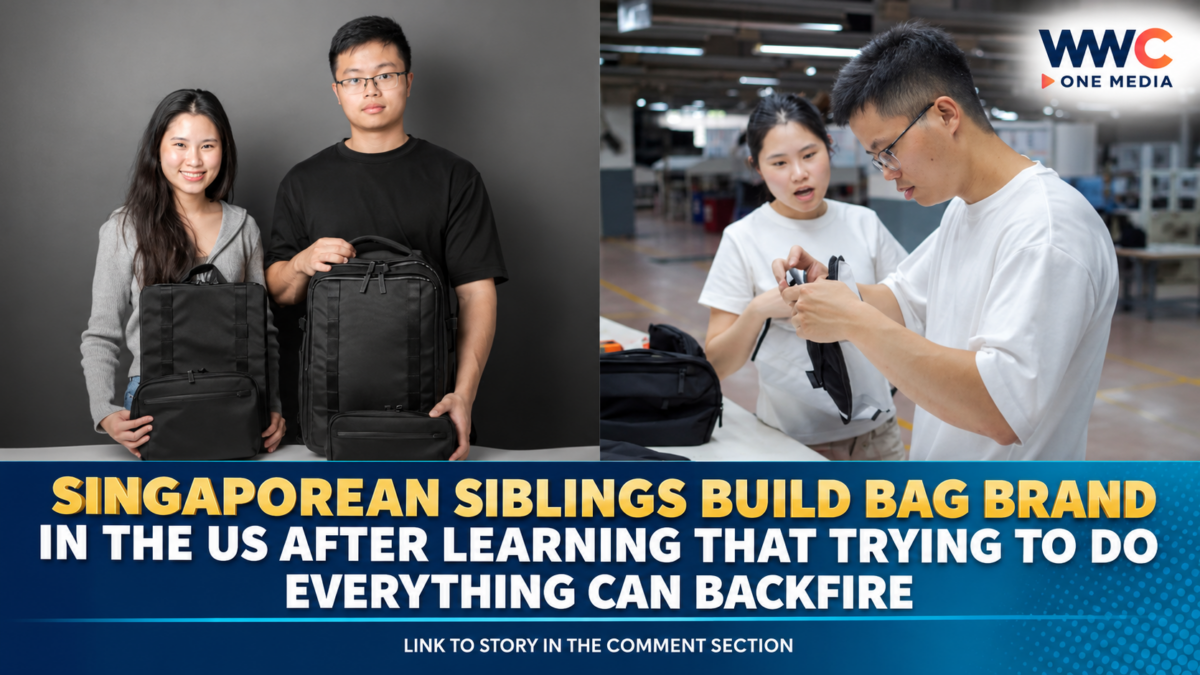
Singaporean siblings Goh Jiaying, 29, and Goh Zhiyu, 25, are building a bag business in the San Francisco Bay Area with a philosophy that challenges the industry’s obsession with premium materials and endless features: design for a clear purpose, rather than trying to do everything.
Their brand, Rework, focuses on creating practical bags that meet customers’ needs without adding features simply because they sound impressive in marketing campaigns. The siblings believe good design should prioritise usefulness, comfort and thoughtful construction over buzzwords such as “premium” and “military-grade”.
Jiaying, who has a background in data analytics, manages the business and financial side, while her younger brother Zhiyu, a mechanical engineering graduate, leads product design.
The idea for Rework began during Zhiyu’s two years of National Service in Singapore. While serving as an Air Warfare Officer at Chong Pang Camp, he became more conscious of the bag he carried during his daily commute. The experience sparked an interest in developing a better everyday carry solution.
After returning to the United States for university, Zhiyu decided to explore entrepreneurship rather than immediately pursue a conventional corporate career. He approached Jiaying, who was already working full-time but was interested in building something of her own.
Their first product was the Reset Modular Backpack System, designed to let users customise how they carried their belongings. The backpack reached its Kickstarter funding goal, allowing the siblings to fulfil orders for their backers.
However, turning the concept into a sustainable business proved difficult. Although the modular design offered flexibility, the siblings realised that trying to satisfy too many needs could prevent a product from excelling in any particular area.
Zhiyu described the challenge as creating a product that was a “jack of all trades, master of none”. The experience forced the pair to reconsider their approach and eventually shift towards more focused, purpose-built designs.
That change helped shape Rework’s identity, including products such as the Toshi Sling. Rather than adding features for the sake of differentiation, the siblings began asking what each product was intended to achieve and which design choices genuinely served that purpose.
For Zhiyu, even features marketed as luxurious deserve careful scrutiny. Soft microfibre linings, for example, may help protect delicate items from scratches but can also trap dirt and make a bag harder to clean.
The siblings do not argue that expensive materials or sophisticated construction are unnecessary. Instead, they believe customers should understand what they are paying for and whether a feature makes a meaningful difference to their daily lives.
Zhiyu’s response to shoppers who question why they should spend more than $30 on a bag reflects that philosophy. If an inexpensive bag fully meets someone’s needs, he believes there is no reason to spend more.
Jiaying, meanwhile, points to aspects such as comfort and the design of a bag’s harness system as potential differences between products at different price points. Ultimately, the decision depends on the individual user’s priorities.
The siblings’ contrasting responsibilities have also helped the business develop. While Zhiyu concentrates on product details, Jiaying oversees financial decisions and commercial considerations. Their different perspectives sometimes lead to disagreements, but those discussions can also reveal ways to improve their products.
One example involved revisions to the harness system of the Toshi Pack V2. Jiaying initially questioned whether changes were necessary because customers had not complained, but the improvements went ahead and customers later noticed the difference.
Despite their professional partnership, the siblings are candid about the challenges of working together. Jiaying joked that Zhiyu’s dry personality might have put her off working with him if they had not been related.
Their Singaporean upbringing also influences their approach to design. Zhiyu, who is left-handed, tries to make Rework’s bags more suitable for both left- and right-handed users, reflecting his belief that practical design should accommodate different needs.
The brand is currently based in the San Francisco Bay Area, and its products are available in Singapore through local bag retailer Karri. The siblings hope to establish a stronger presence in their home country in the future, although opening a physical store is not an immediate priority.
Looking back on their entrepreneurial journey, Zhiyu says aspiring founders often discover what they do not know only after starting a business. Jiaying offers another lesson from experience: an idea can be original without necessarily being profitable.
For the siblings, the evolution of Rework demonstrates that business success is not always about adding more features or pursuing the most ambitious concept. Sometimes, the more effective strategy is to identify what customers truly need, focus on doing it well and recognise when it is time to change direction.










