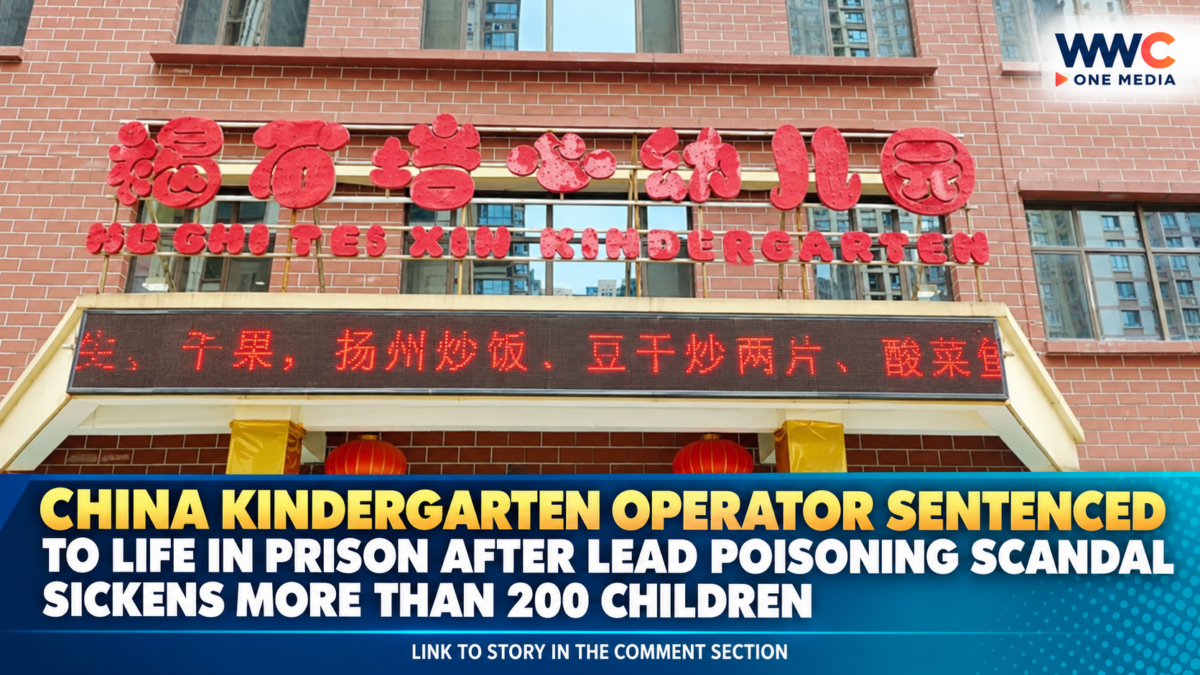
The operator of a kindergarten in northwestern China has been sentenced to life imprisonment after more than 200 children were found with dangerously elevated blood lead levels following the consumption of food contaminated with lead-containing pigments.
Li Huifang, who operated Heshi Peixin Kindergarten in Tianshui, Gansu province, received the life sentence from the Lanzhou Intermediate People’s Court on October 16. The court also ordered the confiscation of 500,000 yuan (about US$75,000) in her personal assets.
The kindergarten’s executive principal, Zhu Jinglin, was sentenced to 15 years in prison and fined 300,000 yuan. Four kitchen workers received prison sentences ranging from six to eight years.
According to Chinese state media, the court found that Li and Zhu had instructed the kitchen workers to add toxic and harmful substances to food served to children and kindergarten staff.
The scandal first emerged in July 2025, when investigations revealed that hundreds of children at the kindergarten had abnormally high levels of lead in their blood. Reports said kitchen staff had used inedible, lead-containing pigments to make meals appear brighter and more attractive, allegedly in an effort to improve the kindergarten’s appeal to prospective families.
Investigators found lead contamination in food items, including colourful breakfast cakes and sausage dishes. Of the kindergarten’s 251 students, 233 were reported to have abnormal blood lead levels, with 201 receiving hospital treatment.
The case sparked widespread public outrage, particularly after a subsequent investigation uncovered serious failures by local authorities responsible for protecting public health.
Authorities found that officials at the Gansu Provincial Centre for Disease Control and Prevention and staff at Tianshui Second People’s Hospital had manipulated testing procedures and falsified results during the investigation. Several local officials were also placed under investigation or disciplinary review over alleged oversight failures.
The revelations intensified concerns about whether the systems intended to protect children had been compromised and whether the extent of the poisoning had initially been concealed.
Lead exposure poses a serious threat to children’s development. It can damage the brain and nervous system, impair learning and behaviour, and cause other long-term health problems. Young children are particularly vulnerable, and health authorities warn that no level of lead exposure is known to be completely safe.
The sentences mark a major development in a case that exposed not only deliberate food contamination but also failures in the oversight mechanisms meant to prevent such incidents.
The scandal has renewed scrutiny of school meal safety in China and the enforcement of food hygiene regulations, with the case serving as a stark reminder of the potentially devastating consequences when the safety of children is sacrificed for appearance, enrolment or financial gain.