
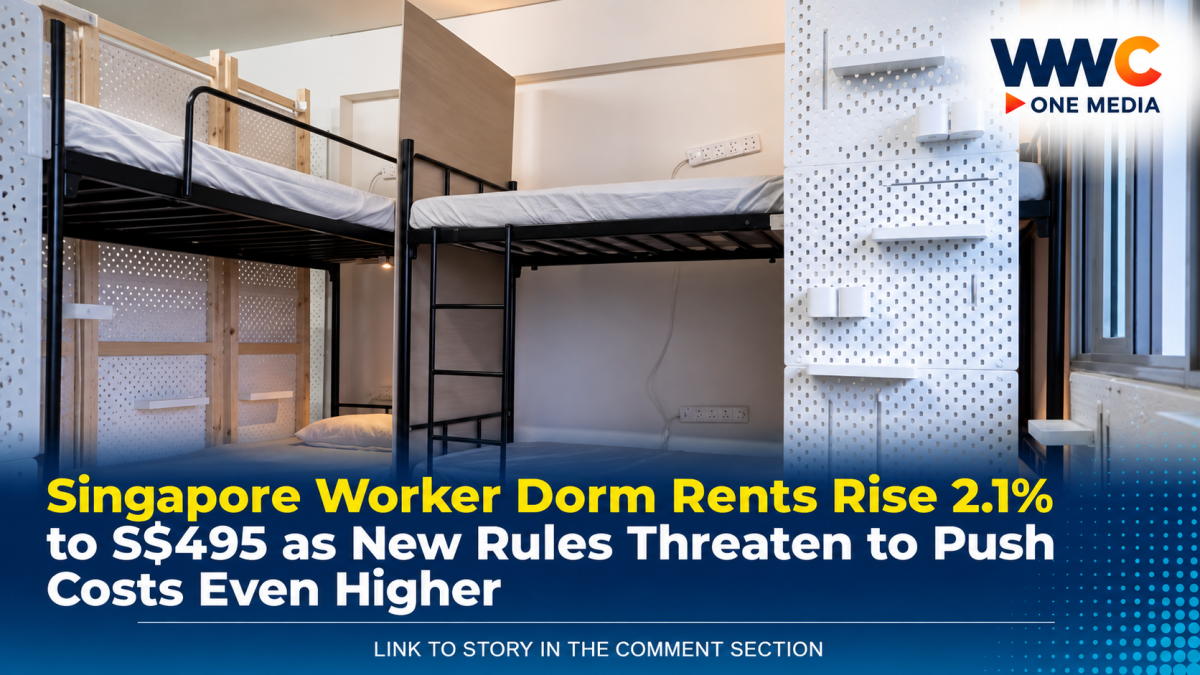
SINGAPORE — The cost of housing foreign workers in Singapore is climbing again, with average rents for beds in Class 4 worker dormitories rising 2.1% in the first half of 2026 to S$495 per bed per month.
The increase may look modest compared with the dramatic rent increases seen during the post-pandemic accommodation crunch.
But property analysts say the latest rise could be an early warning of renewed upward pressure as dormitory operators undertake major upgrades required under Singapore’s tighter accommodation standards.
According to a joint report by the Dormitory Association of Singapore Limited (DASL) and Knight Frank Singapore, the average monthly rent has now risen 83.3% from S$270 in the first half of 2019.
And the pressure could intensify as existing dormitories are upgraded and some beds temporarily become unavailable.
Average rent reaches S$495 per bed
There were 60 Class 4 dormitories operating in Singapore in the first half of 2026, providing approximately 287,837 beds.
That represents around 61.6% of Singapore’s total dormitory bed supply, according to the DASL-Knight Frank report.
Average rents increased across all three main zones:
| Region | Average rent | H1 2026 increase |
|---|---|---|
| Central | S$535/bed/month | 2.9% |
| East | S$525/bed/month | 1.9% |
| West | S$460/bed/month | 4.5% |
| Singapore average | S$495/bed/month | 2.1% |
The central region remains the most expensive, while the west recorded the fastest percentage increase during the first half of the year.
Supply is increasing — so why are rents still rising?
At first glance, the market appears to be getting more supply.
The total Class 4 bed inventory increased 6.3% year-on-year, with 13,910 new beds added between H1 2025 and H1 2026.
Three major facilities accounted for more than half of those additional beds:
- NESST Tukang Dormitory: 2,400 beds
- Westlite Toh Guan: 1,764 beds
- Westlite Mandai: 3,696 beds
Together, they added 7,860 beds.
Yet rents still moved higher.
That is because demand for worker accommodation remains substantial, particularly from the construction, marine shipyard and process industries.
The market is also undergoing a structural transformation as older dormitories are required to meet tougher standards.
Occupancy has eased — but remains extremely high
The increase in supply has taken some pressure off occupancy.
Average islandwide occupancy fell from 97.1% in H2 2025 to 95.8% in H1 2026, a decline of 1.3 percentage points.
But a 95.8% occupancy rate still means the market is operating at a very high level of utilisation.
The west remained the tightest market, with occupancy at 98.3%.
The east recorded 93.7%, while the central zone stood at 93.6%.
For operators and employers, the headline is therefore not that Singapore suddenly has an oversupply of worker beds.
It is that additional supply has provided some breathing room without eliminating underlying demand.
The west is becoming particularly expensive
The west saw average rents climb 4.5% to S$460 per bed per month.
The DASL-Knight Frank report noted that the completion of NESST Tukang, which fully complies with Singapore’s New Dormitory Standards (NDS), likely contributed to the upward movement in the western market’s average rent.
That is an important development.
Newer, higher-quality dormitories can command higher rents because they offer facilities and standards that older accommodation may not provide.
As more operators upgrade their properties, the overall cost structure of worker accommodation could therefore change.
The biggest issue may be Singapore’s dormitory upgrade programme
Singapore is in the middle of a major overhaul of worker accommodation standards.
Under the Dormitory Transition Scheme (DTS), existing dormitories are required to meet enhanced interim standards by 2030.
The New Dormitory Standards provide even higher requirements, with full implementation targeted for 2040.
The changes include stricter requirements governing room occupancy and living space.
The Ministry of Manpower said in May that Singapore has around 1,600 licensed dormitories under the Foreign Employee Dormitories Act.
Only about 30% currently meet the New Dormitory Standards and house 12 or fewer residents per room.
The remaining 70% are older dormitories that typically house between 12 and 16 residents per room.
That means a substantial part of the existing accommodation market still needs to transition.
Upgrading could temporarily remove beds from the market
This is where the rent story becomes more complicated.
When operators carry out upgrading and redevelopment work, some beds may temporarily become unavailable.
If demand remains strong while usable capacity falls, occupancy could rise again.
That is one of the reasons Knight Frank and DASL expect rental pressure to continue.
Earlier in 2026, the organisations estimated that worker-dormitory rents could rise about 5% over the full year as operators undertake upgrading works.
With rents already up 2.1% in the first six months, Knight Frank’s Leonard Tay now expects approximately 5% growth for the whole of 2026.
The government is helping operators pay for the upgrades
The cost of meeting the new standards is a major concern for dormitory operators.
In January, the government announced grants to help offset some retrofitting expenses.
Operators completing upgrades earlier — by the end of 2028 — can receive higher support than those completing the work in 2029 or 2030.
The policy is designed to encourage operators to upgrade sooner rather than wait until the deadline.
But even with financial assistance, operators face higher construction, maintenance and operating costs.
Those costs could eventually be reflected in rents.
Dormitory rents have already transformed since 2019
The long-term increase is much more dramatic than the latest 2.1% rise suggests.
Average Class 4 bed rents were approximately S$270 per month in H1 2019.
They have now reached S$495.
That is an increase of roughly 83% in seven years.
The sharpest increases occurred during the period when Singapore faced severe constraints on worker accommodation during and after the COVID-19 pandemic.
Although the market subsequently received additional supply, rents have remained substantially above their pre-pandemic level.
The market briefly softened in late 2025
The latest increase also needs to be viewed against what happened at the end of last year.
Average commercial dormitory bed rents fell 1% in H2 2025 to S$485 per month, after rising steadily for several years.
Occupancy also declined from 98.3% in H1 2025 to 97.1% in H2.
The easing was attributed partly to additional bed supply and softer demand from marine, shipyard and process companies amid geopolitical uncertainty.
That decline now appears to have been temporary.
Rents returned to growth in the first half of 2026.
More beds are coming before 2030
Singapore is not ignoring the supply issue.
According to the latest DASL-Knight Frank report, awarded dormitory sites and other developments are expected to add approximately 40,200 beds before 2030.
At least six additional purpose-built dormitories, collectively providing around 47,000 beds, are also in the pipeline, according to the Ministry of Manpower.
That additional capacity should eventually help reduce structural pressure.
But the timing matters.
If older beds are temporarily taken offline for upgrading at the same time that demand remains strong, the market could still experience periods of tight supply.
Developers are paying much more for dormitory land
Another sign of the changing economics is the amount investors are now willing to pay for worker-dormitory sites.
Several 2026 government land tenders achieved significantly higher land rates than earlier transactions.
The Terusan Edge site was awarded to S11 Ascendene Management for S$105 million, equivalent to about S$32,812 per bed.
Centurion Corporation subsidiaries secured:
- Kranji Close: S$343 million, or about S$49,000 per bed
- Lok Yang Way: S$221.7 million, or about S$44,333 per bed
Those figures compare with approximately S$24,364 per bed for the Ubi Avenue 3 site awarded in January 2023.
The rising land cost adds another layer of pressure to the business.
Operators have to recover not only the cost of running the dormitory, but also increasingly expensive land and upgrading investments.
Why this matters to Singapore’s wider economy
Worker accommodation may sound like a niche property-market issue.
It is not.
Singapore relies heavily on foreign workers across construction, marine, manufacturing, services and other sectors.
If the cost of housing those workers rises significantly, businesses may eventually face higher operating costs.
That could have wider implications for construction costs, infrastructure projects, industrial activity and other parts of the economy.
The issue becomes particularly important as Singapore continues to undertake major infrastructure and development projects.
Construction demand remains an important driver
Singapore’s construction pipeline is expected to remain significant.
Large projects such as Tuas Port and other infrastructure developments require substantial numbers of workers.
The demand for worker accommodation is therefore closely linked to the country’s construction cycle.
Earlier market analysis also pointed to projects such as Changi Airport Terminal 5 and other major developments as supporting long-term demand for worker housing.
As long as these projects continue, accommodation providers can expect a substantial underlying customer base.
A new premium is emerging for better-quality dormitories
The market is also becoming more segmented.
Older dormitories may compete primarily on price, while newer facilities meeting stricter standards can command higher rents.
That could gradually create a two-tier market:
Older, lower-cost accommodation on one side.
Newer, higher-quality compliant dormitories on the other.
As employers and regulators place greater emphasis on living conditions, the premium for compliant accommodation could become more pronounced.
The numbers tell a complicated story
The latest figures do not point to a simple shortage.
Singapore added nearly 14,000 Class 4 beds in one year.
Occupancy declined.
Yet rents still increased.
That suggests the market is being shaped by more than simple supply and demand.
Regulatory upgrades, construction costs, land prices, quality differences and strong underlying worker demand are all influencing rental rates.
And with a large number of older dormitories still needing upgrades, the transition could create additional temporary supply constraints.
What happens next?
Knight Frank expects worker-dormitory rents to rise by around 5% for the full year in 2026.
That would leave rents significantly above their pre-pandemic levels.
The long-term outlook will depend on whether new dormitory capacity can arrive quickly enough to offset both worker demand and beds temporarily removed during upgrading.
The government has a substantial pipeline of new beds.
But operators are simultaneously facing higher land costs and stricter accommodation standards.
For businesses employing large numbers of foreign workers, the issue could become increasingly important to their cost calculations.
For property investors, meanwhile, the sector is emerging as a potentially attractive alternative real-estate asset class because of its relatively high occupancy and recurring rental income.
And for Singapore’s economy, there is a much bigger question behind the S$495 monthly rent:
Can the city-state upgrade worker housing to higher standards without allowing accommodation costs to become another major source of inflationary pressure?
WWC ONE MEDIA J.M.D

Leave a Reply