
Toyota Motor Philippines | Santa Rosa Laguna plant | Philippine auto manufacturing | Toyota Vios | Innova | Tamaraw
Toyota Motor Philippines is not just selling more vehicles in one of Southeast Asia’s biggest automotive markets. Behind the numbers, a highly trained Filipino manufacturing workforce is helping turn the company’s Santa Rosa, Laguna complex into an increasingly important production hub.
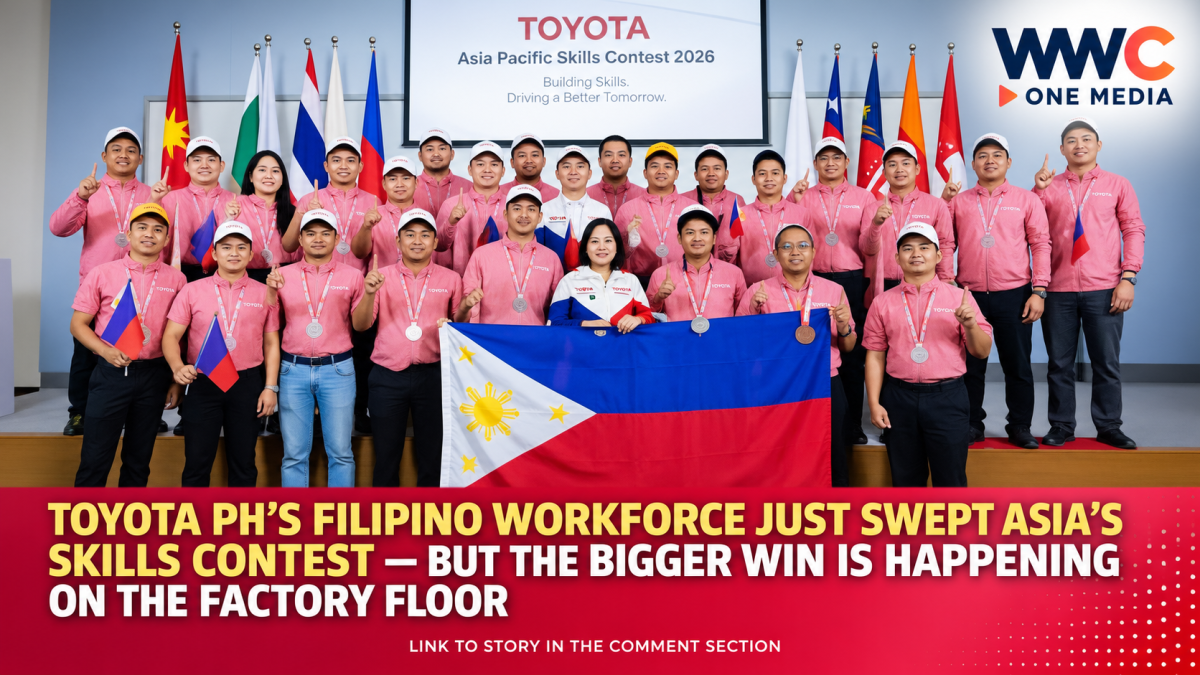
That capability came into sharper focus after six Filipino Toyota manufacturing workers won medals at the 2026 Toyota Asia Pacific Skills Contest in Thailand, delivering Toyota Motor Philippines’ first podium finish across all the categories it entered.
But the bigger story may be what those medals represent back home.
Toyota’s Santa Rosa plant officially has an annual production capacity of around 60,000 vehicles, producing locally assembled models including the Toyota Vios, Innova and Next Generation Tamaraw. Yet actual production reached a record 63,803 vehicles in 2025, up from 60,098 units in 2024 and the company’s highest annual Philippine production since local operations began in 1989.
That means the manufacturing skills showcased in Thailand are being tested every day on one of the Philippines’ busiest automotive production floors.
Six Filipino Workers Bring Home Historic Toyota Medal Haul
At the 2026 Toyota Asia Pacific Skills Contest held at Toyota Motor Thailand’s Ban Pho Plant in Chachoengsao Province, Toyota Motor Philippines emerged as one of the strongest performers among 11 participating Toyota affiliates.
Christian Cobilla, competing in Painting–Team Leader, and Wilmer Penalla, competing in Logistics–Team Member, each won silver medals.
Four more Filipino workers — Noel Elpos, Edwin Bocaya, Loreto Muyna and Ramel Sarmiento — captured bronze medals in disciplines covering logistics, assembly, quality control and welding.
The six-medal performance pushed Toyota Motor Philippines’ cumulative haul in the regional competition to 14 medals since 2006, including its fourth gold medal in 2025.
More importantly for the Philippine automotive industry, those categories are not ceremonial skills. Welding accuracy, assembly efficiency, paint quality, logistics and quality control directly affect how quickly a factory can produce vehicles while maintaining the quality standards demanded by a global manufacturer.
From 1.2 Million Vehicles to Record Production
Toyota’s Philippine manufacturing story has grown considerably since production began more than three decades ago.
The company has now produced more than 1.21 million completely knocked-down vehicles locally, including generations of the Corolla, Lite Ace, Tamaraw, Revo, Camry and other models. Today, its local manufacturing lineup centers on the Vios, Innova and revived Tamaraw.
The 63,803 vehicles produced in 2025 represented a roughly 6% increase from 2024 and set a new annual production record for Toyota in the Philippines.
That matters because local production creates economic activity well beyond Toyota’s assembly line.
Toyota said in August that its Philippine operation has a record workforce of more than 4,500 people, while its wider network of dealers, suppliers and subsidiaries supports more than 83,000 jobs.
Toyota’s supplier ecosystem also includes dozens of local parts manufacturers, meaning higher local production can generate additional demand for components, logistics, engineering and related services. Toyota’s current corporate profile lists 47 local parts suppliers.
Tamaraw Is Expanding What Philippine Manufacturing Can Do
Toyota is also pushing its Philippine operations beyond traditional vehicle assembly.
The company has established an in-house vehicle conversion facility that allows the Next Generation Tamaraw to be transformed into six body configurations.
That opens another layer of automotive manufacturing activity for Filipino engineers, designers, suppliers and body builders.
Depending on the application, the Tamaraw platform can be configured for commercial and public-service uses such as utility vans and ambulances, giving Toyota a locally adaptable vehicle platform rather than simply another mass-market model rolling off an assembly line.
The expansion follows Toyota’s ₱5.5-billion investment supporting Tamaraw production and the vehicle conversion operation, which also helped drive additional direct hiring for Philippine manufacturing.
Why Toyota’s Filipino Workforce Matters More Than the Medals
The six medals from Thailand make an attractive headline.
But they also highlight a much bigger industrial question for the Philippines: Can the country turn manufacturing skill into deeper participation in global automotive supply chains?
Toyota already has considerable scale here. The Philippines is Toyota’s third-largest market in Southeast Asia and 10th-largest worldwide, according to the company’s August 2026 anniversary disclosure.
Toyota also maintained a dominant position in the domestic market in 2025, selling 229,447 Toyota and Lexus vehicles and accounting for roughly 46% of the Philippine automotive market.
The next challenge is turning that enormous domestic market into an even stronger manufacturing advantage.
Workers capable of competing against Toyota teams from across Asia provide one part of that equation. Investment, local parts production, engineering capabilities and sustained demand provide the rest.
For Toyota Motor Philippines, the story therefore goes well beyond six medals.
The real prize is proving that Filipino workers can help make the Philippines not merely one of Toyota’s biggest consumer markets, but an increasingly valuable manufacturing base inside the automaker’s Asian production network.
WWC ONE MEDIA J.M.D




Leave a Reply