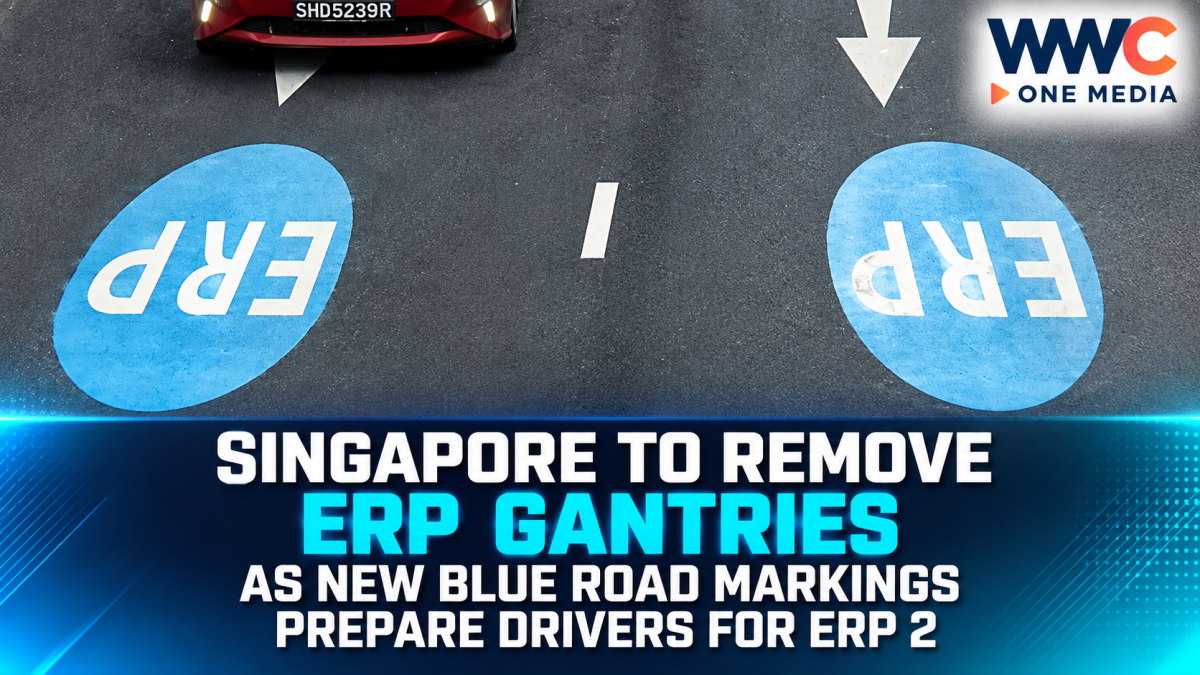
Singapore is preparing for a major change to its Electronic Road Pricing system, with physical ERP gantries set to disappear from roads as new blue markings and signs are introduced ahead of the nationwide launch of ERP 2.
The Land Transport Authority will begin rolling out the new visual cues from October, giving motorists a new way to identify ERP charging locations before the satellite-based system takes over on Jan. 1, 2027.
Under ERP 2, two blue oval “ERP” symbols will be painted on each lane of arterial and slip roads. Three symbols will be used on each lane of expressways, where vehicles travel at higher speeds and motorists need greater visibility.
A new “ERP Charge Zone” road sign will also be installed at the beginning of each charging location. The markings and signs will be introduced progressively across Singapore’s 33 existing operational ERP locations.
The change is necessary because ERP 2 will no longer depend on overhead gantries to identify charging points. Instead, the system uses Global Navigation Satellite System technology through an On-Board Unit installed in each vehicle.
The OBU will detect when a vehicle enters an ERP charging location and calculate the applicable charge. It will also alert motorists before they enter a charging zone, display the prevailing ERP rate and show the amount charged after the vehicle passes through the location.
The new markings were selected after a two-phase user study conducted between March and July 2026. Around 1,000 motorists participated in the second phase, which tested different road-marking and sign combinations across five expressways and arterial roads.
The blue oval ERP symbol emerged as the preferred design because it was found to have strong visibility under different traffic and weather conditions while remaining easy for motorists to understand.
The physical gantries will also begin disappearing from Singapore’s roads from October.
The first phase of removal will target 62 non-operational gantries. The remaining 33 operational gantries will be removed after the existing gantry-based ERP system stops charging on Dec. 31, 2026.
Some gantry frames may not disappear completely. The LTA said certain structures could be retained and repurposed with roadside units to support satellite connectivity for the new ERP 2 system.
Modification or removal of all 95 ERP gantries is expected to be completed by June 2027.
The transition means motorists will gradually stop looking for a large overhead structure as the unmistakable signal that an ERP charge is approaching. Instead, they will rely on the blue road symbols, roadside signs and notifications from their OBUs.
That represents a significant change after nearly three decades of gantry-based electronic road pricing. Singapore introduced ERP in 1998 as a tool for managing congestion on heavily used roads.
ERP 2 also expands the potential uses of the technology beyond road pricing. The LTA said the system can strengthen its ability to detect and enforce certain vehicle-related offences.
For example, ERP 2 data has already been used to identify suspicious behaviour involving foreign cross-border taxis. Between May and July 2026, authorities detected 60 instances involving 31 unique foreign vehicles. Formal enforcement against foreign cross-border taxis providing illegal ride-hailing trips in Singapore began in September.
Speeding enforcement is another potential future application, although the LTA has stressed that additional enhancements are required before ERP 2 can be used for that purpose.
Despite the technological change, the basic congestion-pricing framework is not being altered for now. ERP rates will continue to be reviewed regularly according to traffic conditions, with the next review scheduled for November.
Privacy and data security will also remain important as the system becomes more dependent on vehicle-location information. The LTA says access to ERP 2 data will be restricted to authorised purposes and subject to safeguards governing its collection, use and security.
By Jan. 1, 2027, all Singapore-registered motor vehicles must have the ERP 2 On-Board Unit installed to travel on public roads. More than 98 per cent of eligible vehicles had already been fitted with the units by late September.
For Singapore motorists, the biggest visible change will therefore be the disappearance of the familiar ERP gantries and the arrival of blue road markings in their place.
The bigger shift, however, is happening beneath the surface: Singapore is moving from a road-pricing system built around physical structures to one that uses satellite positioning, in-vehicle technology and digital notifications to manage how vehicles use the road network.