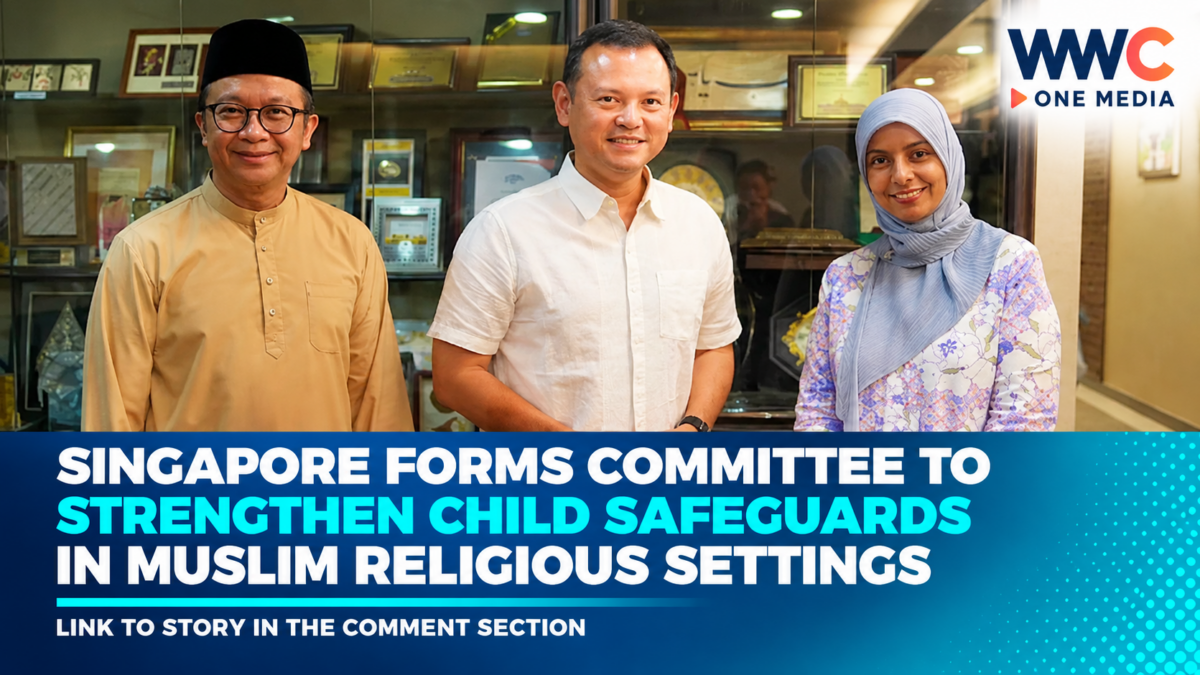
Singapore has formed a new committee to review and strengthen measures protecting children and young people in Muslim religious settings, including mosques, madrasahs and Islamic education centres.
The Committee to Strengthen Safeguards in Religious Settings was announced on Sept. 30 by the Ministry of Culture, Community and Youth and the Islamic Religious Council of Singapore. It follows the sexual abuse of two young brothers by a self-styled religious mentor, with some offences taking place at a mosque.
The committee will take a preventive and community-focused approach, examining how religious institutions can identify concerns earlier and strengthen their systems for protecting minors under 18.
Among the areas under review are the screening and oversight of staff and volunteers who work with children, professional boundaries governing interactions with minors, and practices for creating safe and child-centred environments.
The committee will also examine procedures for reporting, escalating and responding to safeguarding concerns. This includes information-sharing between institutions, immediate responses to incidents, support for victims and case-management procedures.
Another focus will be providing accessible channels for children, young people and adults to raise concerns, including whistleblowing arrangements and protections for those who make reports. The committee will also consider how leaders, staff and volunteers can be better equipped to recognise and respond to safeguarding concerns.
Religious education will also be reviewed. The committee will look at safeguards for formal and informal religious instruction, including professional conduct requirements and possible measures when serious concerns or misconduct arise. It will also consider emerging risks involving online religious influence and digital communications with young people.
The nine-member committee is co-chaired by Associate Professor Razwana Begum of the Singapore University of Social Sciences and Ustaz Fathurrahman Dawoed of Andalus Corporation. Its members include professionals from child protection, policing, psychology, education, governance, Islamic education and religious guidance.
The review builds on measures already introduced by MUIS following the abuse case. These include strengthened safeguarding education, a common safeguarding framework across mosques, clearer reporting and escalation procedures, staff training, monitoring of informal gatherings involving minors and periodic safeguarding checks.
Authorities have stressed that the goal is to strengthen protection while preserving the open and welcoming nature of religious institutions.
The committee is expected to submit its recommendations to Acting Minister-in-charge of Muslim Affairs Zaqy Mohamad by the end of 2026. Its findings and recommendations will subsequently be shared with the wider community.