
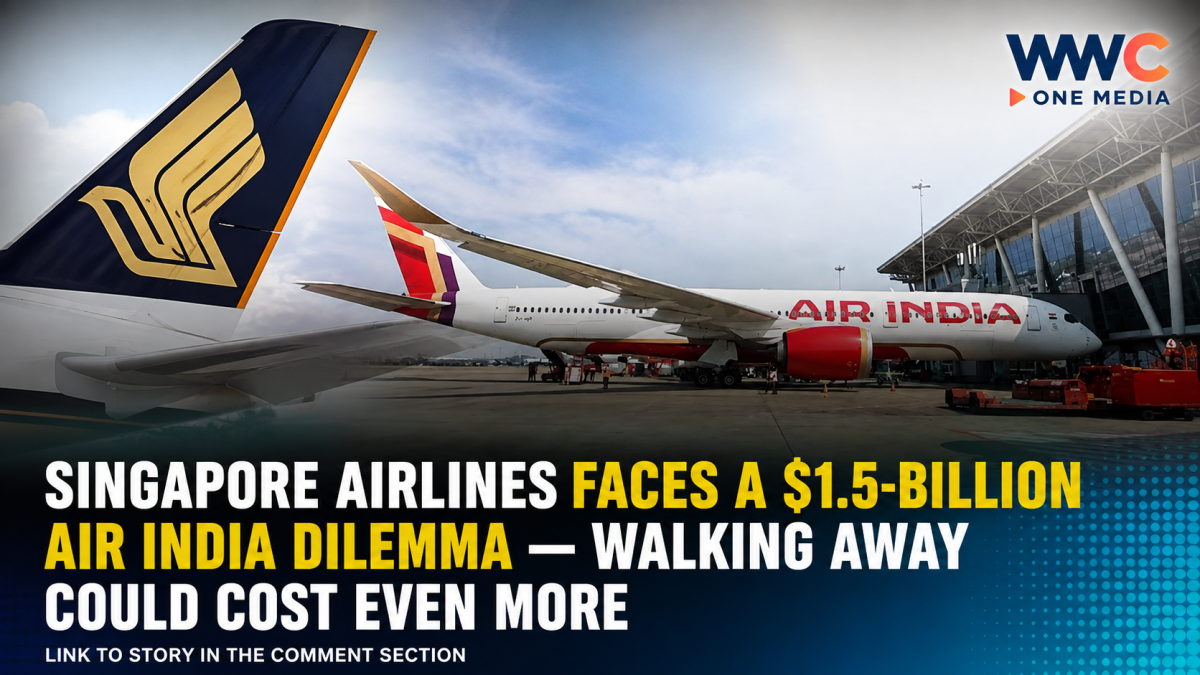
SINGAPORE — Singapore Airlines (SIA) is facing a difficult choice over its investment in loss-making Air India: continue funding a costly turnaround or risk taking an even bigger hit by walking away.
The dilemma has intensified after Air India and its budget subsidiary, Air India Express, reported combined losses of about US$2.33 billion for the financial year ended March 2026, more than double the previous year’s losses. At the same time, Air India has reportedly sought around US$1.5 billion in fresh equity from its owners, Tata Sons and SIA.
SIA owns 25.1% of Air India, while Tata Sons holds the remaining 74.9% following the 2024 merger of Air India and Vistara. If the reported US$1.5-billion capital injection proceeds on a proportional basis, SIA’s share could be roughly US$376 million, although discussions remain ongoing and no final funding commitment has been announced.
WHY AIR INDIA IS LOSING SO MUCH
Air India’s financial problems come as Tata undertakes a massive, multi-year effort to rebuild the former state-owned carrier into a globally competitive airline.
The turnaround has been hit by several major obstacles, including Pakistan’s continued airspace restrictions on Indian airlines, geopolitical disruptions affecting international routes, high fuel costs, supply-chain problems, fleet-renewal challenges and the financial and reputational fallout from the June 2025 Air India Flight 171 crash.
Tata has previously indicated that rebuilding Air India could take five to 10 years, underscoring how long investors may have to wait before the airline reaches sustainable profitability.
The financial pressure is also being felt by SIA itself. Singapore Airlines reported a S$76 million net loss in the first quarter of 2026, despite record revenue, with higher fuel costs and its share of Air India’s losses among the factors weighing on results.
WHY SIA MAY NOT WANT TO SELL
On paper, exiting could appear to be the simplest solution.
But industry analysts and the CNA commentary argue that abandoning Air India now could mean giving up a strategically important position in one of the world’s fastest-growing aviation markets after years of trying to establish a meaningful foothold in India.
India’s enormous population, expanding middle class and growing demand for air travel make the country strategically attractive to global airlines.
For SIA, Air India offers something particularly valuable: direct exposure to India’s domestic market and international traffic flows through Indian hubs, complementing Singapore’s position as a major aviation hub. SIA itself has described the investment as a way to access growth opportunities that cannot be fully achieved through a single-hub strategy.
Air India also controls valuable international traffic rights, airport slots, a large domestic network and a globally recognised brand — assets that would be difficult and expensive for SIA to replicate from scratch.
THE REAL QUESTION: HOW MUCH MORE CAN SIA INVEST?
The debate is therefore no longer simply about whether Air India is losing money.
The bigger question is how much additional capital SIA is prepared to commit before the potential long-term benefits are outweighed by the financial risk.
SIA has said its board will carefully consider any request for additional capital, taking into account the group’s own capital requirements and Air India’s business strategy.
That position has attracted scrutiny in Singapore.
Reuters reported that opposition lawmaker Kenneth Tiong questioned whether Temasek’s funds should indirectly be used to support Air India, given that Temasek is the majority shareholder of Singapore Airlines. Tiong argued that if SIA wants to continue betting on Air India, the airline should bear that financial responsibility itself.
Temasek, however, has publicly defended SIA’s investment, saying it views the Air India partnership from a long-term perspective and recognising that the transformation involves complex, multi-year operational and integration challenges.
WALKING AWAY COULD ALSO BE EXPENSIVE
There is another risk for SIA: abandoning the investment after committing billions of dollars could effectively crystallise substantial losses while eliminating its opportunity to benefit if Air India’s turnaround succeeds.
The Financial Times recently reported that Singapore Airlines has already suffered nearly US$800 million in losses on its Air India investment, illustrating the scale of the financial pressure surrounding the partnership.
That creates a classic investment dilemma.
Put in more money, and SIA risks throwing additional capital into a struggling airline.
Walk away, and it could lock in losses while surrendering its position in India’s rapidly expanding aviation market.
AIR INDIA IS NOT YET A LOST CAUSE
Despite the financial setbacks, there are signs that the transformation is continuing.
Air India has been upgrading its fleet and cabin products, investing in employee training and attempting to improve the customer experience. The airline also received a Skytrax four-star rating in 2026, according to CNA.
But progress in customer service and fleet modernisation does not automatically solve the airline’s fundamental profitability problem.
For SIA shareholders, the crucial issue will be whether Air India can eventually turn its enormous network, market position and growth potential into sustainable profits.
That means SIA will need more than assurances.
It will need measurable milestones, stronger oversight and a clear understanding of how much additional money it is willing to put at risk.
THE BOTTOM LINE
Singapore Airlines’ Air India investment has reached a critical stage.
The Indian carrier needs capital to complete its transformation, but every additional dollar committed by SIA competes with other possible uses of the airline’s money — including fleet investment, technology, shareholder returns and strengthening its own operations.
Yet walking away today could mean abandoning a hard-won position in one of the world’s most strategically important aviation markets.
The challenge for SIA, therefore, is not simply to stay or leave.
It is to prove that staying has a rational path to long-term value.
Air India’s turnaround was never expected to happen overnight. But with billions in losses mounting and another potential US$1.5 billion funding request on the table, the pressure is growing for Singapore Airlines to show exactly when the long game is expected to start paying off.
WWC ONE MEDIA MJE

Leave a Reply