
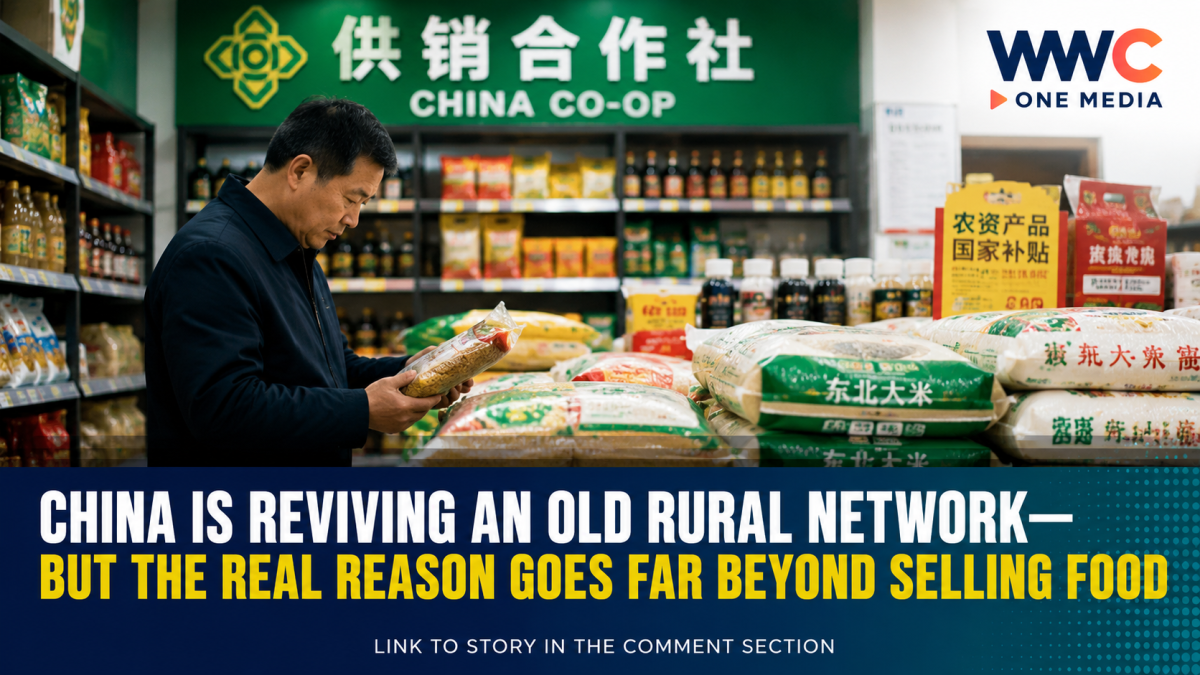
BEIJING — China is strengthening a decades-old rural supply network as Beijing seeks greater protection against food-supply disruptions caused by extreme weather, geopolitical tensions, trade shocks and vulnerable global supply chains.
The network, known as the supply and marketing cooperative system, once served as a central part of China’s planned rural economy. Today, however, it is being reshaped to work alongside private supermarkets, logistics companies and e-commerce platforms rather than replace them.
The renewed push comes under China’s new 2026–2030 five-year development plan for supply and marketing cooperatives, which puts food security and rural revitalisation among its key priorities.
From village shops to a nationwide safety net
At first glance, many cooperative outlets look like ordinary neighborhood stores selling vegetables, drinks, rice, cooking oil and other necessities.
But behind the storefront is a much larger system.
China currently has around 37,000 grassroots cooperatives and more than 856,000 operating and service outlets nationwide, according to the All-China Federation of Supply and Marketing Cooperatives. The network also operates across agricultural-input distribution, produce circulation, logistics, storage and agricultural services.
The system dates back to the early years of the People’s Republic of China, when cooperatives were a major channel for supplying farmers with fertilizer, seeds and daily necessities while moving agricultural products between rural and urban markets.
Their dominance declined after China’s market reforms beginning in the late 1970s, as private retailers, wholesalers, supermarkets and eventually e-commerce transformed rural commerce.
But Beijing has retained the network—and is now giving it a new strategic role.
China plans thousands of new distribution and storage facilities
Under the latest five-year plan, China intends to build or upgrade more than 100 national-level strategic agricultural-input reserve warehouses and about 1,000 county-level distribution centers by 2030.
The government also plans to expand agricultural services and emergency capabilities, including storage and grain-drying facilities designed to reduce post-harvest losses.
For 2026 alone, authorities have targeted roughly 20 national strategic fertilizer depots, more than 200 county-level distribution centers and 200 agricultural service centers.
The goal is not simply to sell more goods in rural China.
It is to ensure that infrastructure, inventories and distribution channels are already available when a crisis disrupts normal commercial supply chains.
Why food security is becoming a bigger concern
China remains heavily dependent on international markets for some important agricultural commodities, including soybeans and potash, while edible-oil supplies and other agricultural inputs can also be exposed to global disruptions.
At the same time, climate-related risks are putting additional pressure on domestic agriculture.
Reuters reported in late August that extreme heat and heavy rainfall had affected important agricultural regions in China, threatening the quality and yields of crops including corn, soybeans and cotton. The weather disruptions could potentially increase China’s demand for imported feed grains and other agricultural commodities.
That makes storage, transportation and emergency distribution increasingly important.
Fertilizer supplies provide a real-world test
The cooperative system already plays a major role in China’s fertilizer supply chain.
According to China’s government, the system supplied approximately 70 percent of national fertilizer supplies during the 2021–2025 period and handled a substantial portion of national commercial fertilizer reserves.
That capacity was tested earlier in 2026 when disruptions to international fertilizer trade and shipping through the Strait of Hormuz created additional supply concerns.
China released fertilizer from national commercial reserves ahead of schedule for spring planting. Authorities said early reserve releases, efforts to secure imports and domestic transportation measures helped maintain sufficient supplies and relatively stable prices.
The episode demonstrated why Beijing sees value in maintaining infrastructure that can be activated quickly when international supply chains are disrupted.
Beijing is not abandoning the private market
Despite the expansion of the cooperative system, analysts caution against interpreting the policy as a return to China’s old centrally controlled distribution model.
The latest plan calls for cooperation with postal, courier and logistics companies, creating what analysts describe as a state-anchored layer within a largely commercial economy.
That distinction matters.
Private companies may remain faster and more efficient for routine deliveries, but they may not have the same incentive to maintain low-margin infrastructure or stockpiles in remote areas.
The cooperative system can provide a backup layer—maintaining warehouses, agricultural inputs, logistics networks and rural outlets that could become critical during emergencies.
E-commerce is also changing rural China
China’s rural economy is increasingly connected to digital commerce.
A 2026 study published in the World Development journal, using data from more than 10,000 farms across 1,618 counties, found that participation in e-commerce generally increased farm income by expanding market access and sales volumes. However, the researchers also found that the benefits were uneven and that increased e-commerce penetration could put pressure on farms that remained outside digital channels.
That helps explain why China’s new model is not simply about preserving old village stores.
The challenge is to combine the cooperative system’s physical infrastructure with modern logistics, digital platforms and private-sector distribution.
Is China preparing for war?
The renewed focus on reserves and supply chains has inevitably triggered speculation about whether the cooperative expansion is connected to preparations for a potential conflict.
Analysts cited by CNA urged caution.
The current five-year plan does not explicitly link the cooperative build-out to military preparations, and the available evidence does not establish that the network is being expanded specifically for wartime use.
The more immediate explanation is broader: Beijing wants greater resilience against disruptions ranging from floods and extreme weather to pandemics, trade restrictions, shipping interruptions and geopolitical crises.
In other words, the same warehouse that could help maintain fertilizer supplies during a trade disruption could also be used during a natural disaster or emergency.
The bigger strategy: resilience, not isolation
China’s approach appears to be less about replacing markets than about creating backup capacity around them.
Government-backed cooperatives can maintain reserves and distribution infrastructure while private companies continue handling much of the country’s everyday commerce.
The strategy reflects a growing concern among policymakers worldwide: highly efficient supply chains can also become vulnerable when a critical transport route closes, a war disrupts trade, extreme weather damages crops or an important supplier becomes inaccessible.
For China, strengthening its rural cooperative network provides another layer of protection.
And as climate risks, geopolitical tensions and global supply-chain disruptions continue to reshape food markets, those seemingly ordinary village stores may be serving a much bigger purpose than meets the eye.
The cooperative may look like an old-fashioned shop—but Beijing increasingly sees the network behind it as part of China’s national resilience system.
WWC ONE MEDIA MJE




Leave a Reply