
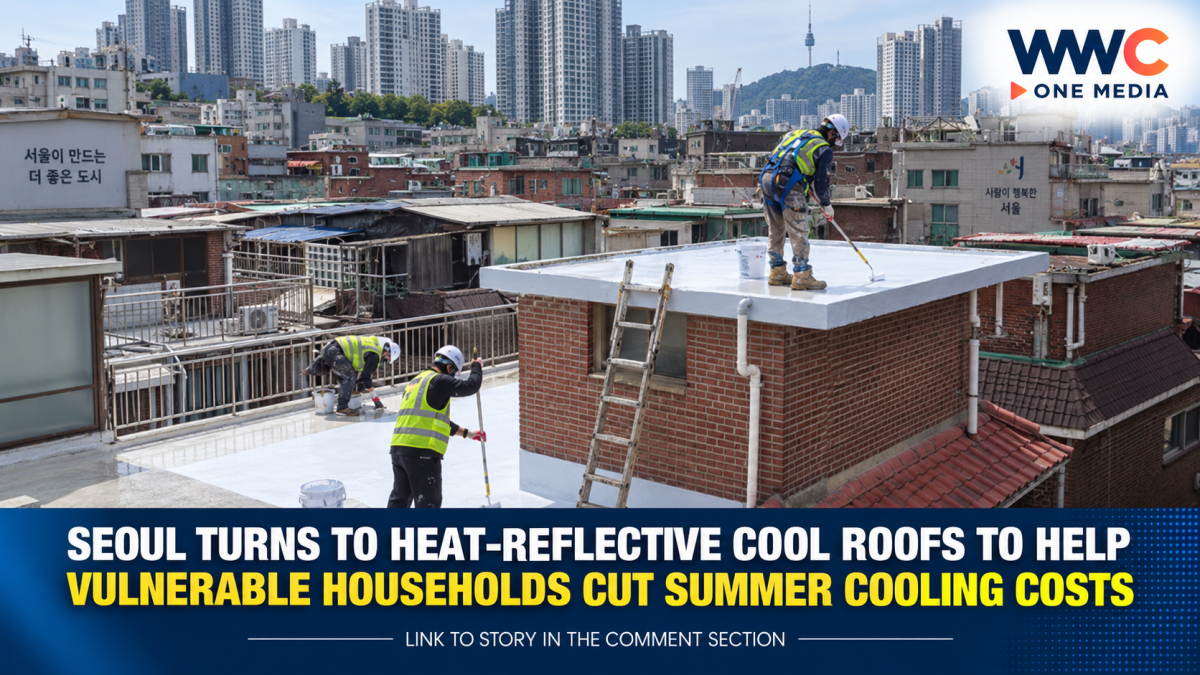
SEOUL — A simple layer of heat-reflective paint is becoming part of South Korea’s response to increasingly intense summer heat, as Seoul and other cities turn “cool roofs” into a practical climate-protection measure for households most exposed to rising temperatures.
The coatings work by reflecting more of the sun’s radiation away from a building instead of allowing the roof to absorb as much heat. That can lower the temperature of the roof and reduce the amount of heat transferred into the building.
For older homes with poor insulation or limited access to efficient cooling, the approach can provide an additional way to reduce indoor heat and potentially lower electricity consumption during the hottest months.
Seoul Targets Older Homes in Vulnerable Neighborhoods
In northern Seoul, Nowon District has designated cool-roof areas in the Gongneung 1 and Sanggye 2 neighborhoods.
The areas contain many older, small multifamily homes where dense buildings and narrow alleys can trap heat during summer.
The district’s program is specifically intended to improve living conditions for residents who are more vulnerable to extreme heat while also helping reduce the energy burden associated with cooling their homes.
The move is part of a wider expansion of cool-roof programs across South Korea as local governments search for ways to adapt neighborhoods to more frequent and intense heat waves.
Seoul Research Shows the Potential Energy Savings
The benefits are not limited to how a roof feels to the touch.
Testing by the Seoul Housing and Urban Development Corporation found that heat-reflective paint reduced rooftop surface temperatures by as much as 9.2 degrees Celsius and indoor temperatures by approximately 1.8 degrees Celsius.
The same testing found summer cooling-energy consumption fell by as much as 40.8%, with an average reduction of 26.4% in the tested settings.
Those figures come from specific testing rather than a guarantee that every household will experience the same reduction. Building design, insulation, roof condition, weather and air-conditioning use can all affect the result.
Still, the findings have strengthened interest in reflective coatings as a relatively simple retrofit option.
Seoul Is Not Alone
The cool-roof movement is spreading well beyond the capital.
In Gumi, North Gyeongsang Province, 10 public-rental apartment buildings at the Hwangsang 3 Jugong complex were coated with heat-reflective paint.
The complex contains about 600 permanent-rental units, with many residents described as older or in poor health — groups particularly vulnerable during extreme heat.
Following the work, reported exterior-wall temperature reductions ranged from 2.2°C to 15.3°C, while indoor temperatures fell by about 1.6°C.
Gumi officials said the project was financed with 400 million won in 2024 through a national grant program supporting communities exposed to climate risks.
Busan Is Painting Roofs White, Too
Busan is also expanding its cool-roof program.
The city began work in September on 36 homes and senior centers, focusing on residents and facilities considered particularly vulnerable to extreme heat.
According to Seoul Economic Daily, the city’s program uses highly reflective heat-blocking coatings and is designed to reduce indoor temperatures, air-conditioning demand and greenhouse-gas emissions. The city has completed 168 sites since 2019 and plans further expansion.
The program illustrates how reflective roofs are increasingly being treated as both a public-health measure and an energy-saving measure, rather than simply an architectural upgrade.
Why Heat-Reflective Paint Is Gaining Attention
South Korea has experienced increasingly severe summer heat, prompting local governments to explore measures beyond conventional air-conditioning and emergency cooling centers.
Heat-reflective coatings work by reflecting solar radiation, including infrared energy, and reducing the amount of heat absorbed by roofs and walls.
The technology is also attracting commercial interest.
Seoul Economic Daily reported in August that demand for heat-reflective coatings was rising among industrial facilities, data centers and other buildings with significant cooling requirements. The report cited industry data showing a sharp increase in inquiries about such products.
That means the same basic technology is being developed for two very different purposes: protecting vulnerable residents and reducing energy consumption in power-intensive facilities.
A Low-Tech Response to a Growing Climate Challenge
The appeal of cool roofs is partly their simplicity.
Unlike major building renovations, applying a reflective coating can be done without completely rebuilding a structure. That makes it potentially useful for older housing stock where extensive upgrades may be difficult or expensive.
But cool roofs are not a complete solution to extreme heat.
They work alongside other measures such as adequate insulation, ventilation, shading, efficient air-conditioning and access to cooling spaces. Their effectiveness can also vary depending on the building and the type and condition of the coating.
For Seoul’s vulnerable households, however, even a relatively modest reduction in indoor heat can matter during prolonged heat waves.
From White Roofs to Climate Protection
What began as a relatively straightforward building technique is increasingly becoming part of South Korea’s broader climate-adaptation strategy.
Seoul’s targeted programs, Gumi’s public-housing experiment and Busan’s expansion all point toward the same idea: the roof itself can become part of a home’s defense against extreme heat.
As Korean cities prepare for hotter summers, the question is no longer simply how to keep buildings cool.
It is also how to make that cooling more affordable, more accessible and more effective for the people who need it most.




Leave a Reply