
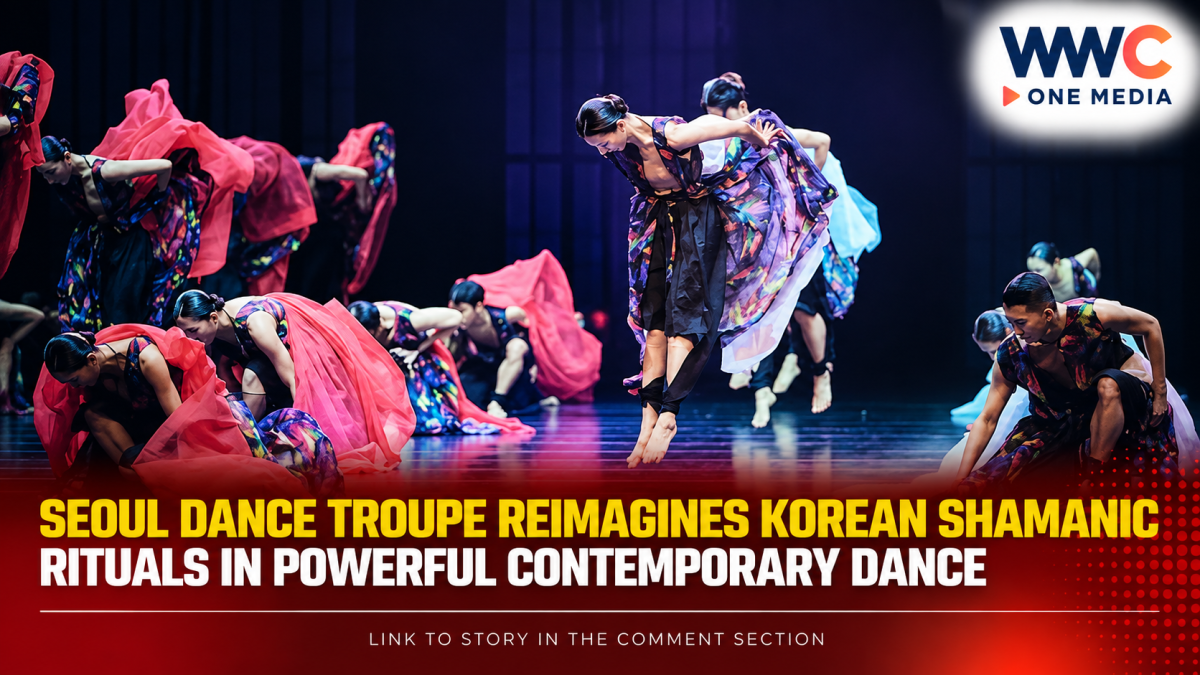
An ancient Korean ritual is taking on a striking new form on the contemporary dance stage as the Seoul Metropolitan Dance Theatre transforms traditional shamanic practices into a story about pain, healing and finding the strength to move forward.
The company’s new production, “Gut: Whispering Steps,” reinterprets gut — a traditional Korean shamanic ritual — through contemporary movement, music and visual storytelling.
The production is being staged at the Sejong Center for the Performing Arts’ Grand Theater from Sept. 10 to 13, bringing an old cultural tradition into one of Seoul’s major modern performance venues.
From ritual to contemporary dance
In traditional Korean culture, gut served as a ritual through which people sought help with issues ranging from health and hardship to luck and relationships. Shamans acted as intermediaries in ceremonies connecting the human world with the spiritual realm.
But “Gut: Whispering Steps” takes a different approach.
Rather than simply reproducing a traditional ceremony, artistic director Yun Hea-joung uses the ritual as a starting point for exploring an intensely human question: How do people overcome suffering when they cannot wait for someone else to save them?
Yun describes the production as a work about confronting pain through one’s own body and will rather than waiting for an external force to provide salvation.
Five colors, five stages of emotion
The production unfolds through five variations of tears, each connected to obangsaek — Korea’s traditional five cardinal colors: black, yellow, blue, red and white.
Each section represents a different stage of the emotional journey.
The performance begins with black tears, portraying bodies weighed down by painful memories.
Yellow represents an awareness of personal wounds, while blue creates emotional distance from memories and allows space for hope.
As the performance reaches red, suppressed emotions erupt through increasingly powerful movement and sound.
White arrives at the end as a quieter state after pain has been confronted.
The progression turns traditional symbolism into a contemporary visual language, allowing audiences to experience the ritual’s emotional themes without simply watching a historical reconstruction.
The 45-dancer finale becomes the emotional climax
The most dramatic moment arrives during the final chapter.
Forty-five dancers divide into five groups of nine, corresponding to the five colors, before coming together for a large-scale performance inspired by mugamseogi, a section of Seoul-area shamanic ritual in which the person who commissioned the ritual puts on a shaman’s clothing and dances spontaneously to the accompanying music.
In the contemporary production, that ritual becomes a metaphor for personal release.
Individual movement gradually becomes collective movement, turning private pain into a shared experience.
The effect is a powerful shift from individual healing to communal liberation.
Reclaiming a misunderstood tradition
The production also engages with the complicated modern history of gut.
Yun said the work seeks to reclaim the ritual from the stigma it acquired during the Japanese colonial period, when Korean shamanic practices were disparaged as superstition.
For the production’s creators, however, gut was not simply an isolated supernatural practice.
It was also part of communal life, bringing people together to share food, gather during difficult moments and participate in collective celebrations.
That social dimension gives the contemporary production another layer: the ritual becomes a way of thinking about how communities respond to suffering.
Traditional sounds get a modern makeover
The music also plays a central role.
Composer Lee Ha-nuri makes her first contribution to dance music by reconstructing rhythms associated with Seoul’s shamanic rituals and incorporating sounds from traditional ritual instruments into a contemporary score.
The production also incorporates media art directed by filmmaker Jang Cheol-su, creating a combination of dance, sound and visual elements designed to make the traditional material feel immediate to a modern audience.
The result is neither a conventional recreation of a shamanic ceremony nor a contemporary dance piece detached from Korean tradition.
Instead, it sits somewhere between the two.
A ritual about surviving the present
Perhaps the most striking element of “Gut: Whispering Steps” is that it does not promise an easy ending.
The dancers eventually reveal their individual movements and leave the stage, while a shaman gathers the garments left behind.
The image suggests that life continues even after moments of pain and release.
That idea is at the heart of Yun’s interpretation: healing is not about waiting for suffering to disappear magically. It is about confronting it and finding enough strength to continue.
For audiences, the production offers a fresh way to encounter one of Korea’s less familiar cultural traditions — not as a relic of the past, but as material that can still speak to modern anxieties.
“Gut: Whispering Steps” ultimately asks a deceptively simple question: when no one else can wipe away our tears, can we find the strength to do it ourselves?




Leave a Reply