LAUSANNE, SWITZERLAND — October 20, 2026 — One of African football’s most explosive championship controversies is heading toward a decisive legal showdown after the Court of Arbitration for Sport (CAS) confirmed that its ruling on Senegal’s appeal against the decision to award the Africa Cup of Nations (AFCON) title to Morocco is now expected at the end of November 2026.
The controversy has shaken African football, raising serious questions about refereeing authority, disciplinary regulations and whether a championship won on the pitch can ultimately be overturned in a courtroom.
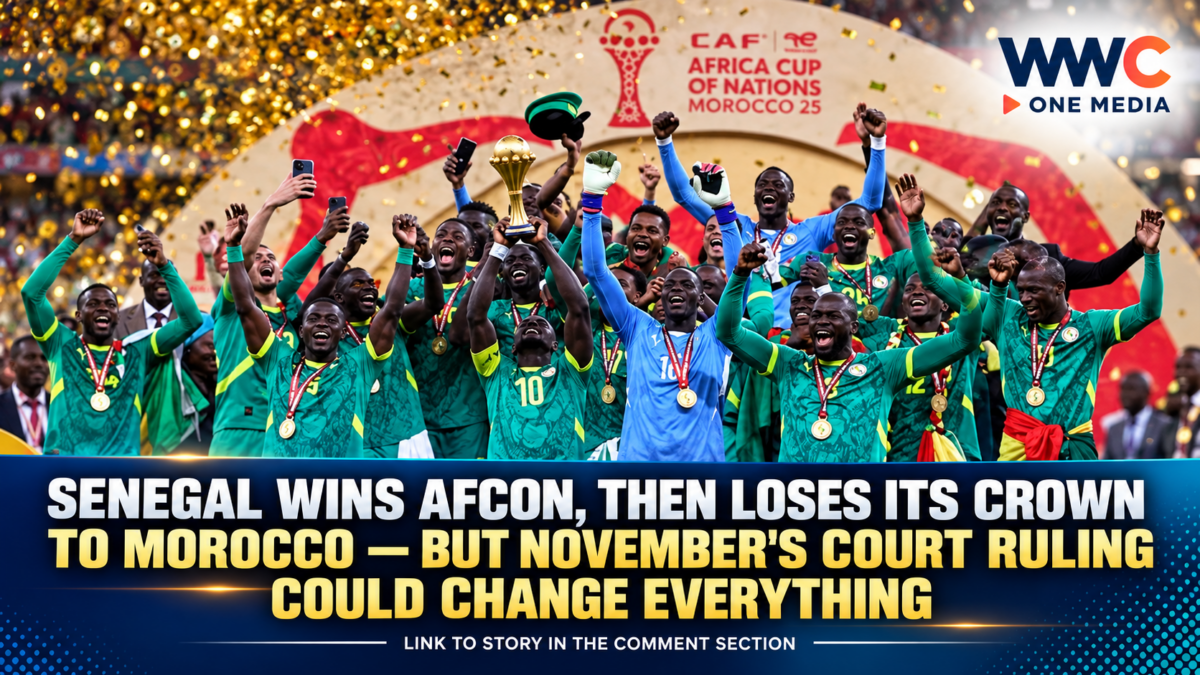
Senegal defeated host nation Morocco 1-0 after extra time in the January 18 final in Rabat. But what initially appeared to be a historic sporting triumph became the subject of a bitter legal dispute when the Confederation of African Football (CAF) subsequently ruled that Senegal had forfeited the match.
Despite Senegal’s victory on the field, CAF’s Appeal Board awarded Morocco a 3-0 win and the continental championship.
Now, months after the final whistle, Africa’s football champions remain at the center of a legal battle whose outcome could have implications far beyond a single tournament.
What Really Happened in the Senegal vs Morocco Final?
The controversy began in the closing moments of regulation time at the Prince Moulay Abdellah Stadium in Rabat.
With the match still scoreless, Morocco received a late penalty, prompting furious protests from Senegal’s players.
Several Senegalese players temporarily walked off the pitch, with some returning to the dressing room. The disruption lasted approximately 14 minutes before the players returned and the game resumed.
Morocco’s Brahim Diaz failed to convert the penalty, allowing the contest to continue into extra time.
Senegal then delivered the decisive blow.
Midfielder Pape Gueye scored the winning goal, securing a 1-0 victory that sent Senegal’s players and supporters into celebration.
Sadio Mane and his teammates lifted the AFCON trophy, seemingly confirming their place as continental champions.
But the drama was far from over.
CAF Overturns Senegal’s Victory and Awards Morocco the Title
In March, CAF’s Appeal Board delivered a stunning reversal.
The governing body’s appeals panel ruled that Senegal’s temporary withdrawal from the pitch constituted a forfeiture under the tournament regulations.
As a result, Senegal’s 1-0 victory was overturned and Morocco was awarded a 3-0 win.
The decision created a rare and highly contentious situation: the team that scored the winning goal and celebrated with the trophy was subsequently stripped of the championship.
Senegal rejected the ruling and filed an appeal with CAS on March 25, seeking to overturn CAF’s decision.
The Senegalese case centers on a crucial argument: the match referee permitted play to resume, oversaw the completion of the contest and allowed the final result to stand.
Senegal argues that the referee’s on-field authority should carry decisive weight in determining the validity of the result.
Why CAS Has Delayed Its Ruling Until November
The dispute reached CAS headquarters in Lausanne, Switzerland, where representatives of Senegal, Morocco and CAF presented their arguments on October 8.
An initial decision had been anticipated within days of the hearing.
However, CAS announced on October 19 that its three-member arbitration panel would instead produce a complete ruling, known as a CAS Award, setting out both its decision and the supporting legal reasoning.
The process is expected to take several additional weeks, with the ruling now anticipated at the end of November 2026.
The arbitration panel is chaired by French sports law expert Gérald Simon, alongside Italian international law professor Luigi Fumagalli and German-based legal scholar Ulrich Haas.
The longer timetable does not itself indicate which side is more likely to win. It reflects the panel’s decision to issue a reasoned legal determination.
The Biggest Legal Question: Can a Completed Match Be Declared Forfeited?
At the heart of the dispute is a conflict between two fundamental principles of football governance.
On one side is the authority of the match referee, who allowed Senegal and Morocco to resume playing after the temporary walk-off and permitted the game to reach its conclusion.
On the other is the authority of CAF’s disciplinary and appeals bodies to apply tournament rules governing team conduct, interruptions and possible forfeitures.
The outcome may depend on how CAS interprets the applicable regulations and the relationship between decisions made on the field and disciplinary decisions taken afterward.
A ruling in Senegal’s favor could restore the result achieved in Rabat.
A decision upholding CAF’s judgment would leave Morocco’s awarded 3-0 victory and championship intact.
A more complicated legal outcome is also possible, depending on the issues the panel addresses and the remedies it considers available.
Why the Decision Matters Beyond Senegal and Morocco
The controversy has attracted attention because it raises a broader question about certainty in international football.
Can a team complete a match, win a trophy and still lose the championship afterward because of an earlier interruption?
Tournament organizers must enforce rules and maintain sporting discipline. At the same time, players, supporters and participating federations rely on the finality of competitive results.
This tension is what makes the Senegal-Morocco case particularly significant.
The November ruling could help clarify how similar disputes involving temporary walk-offs, match abandonment and disciplinary forfeitures are handled in future international tournaments.
CAS awards can carry significant legal force and are subject to recognized enforcement mechanisms, although their precise consequences depend on the ruling and applicable law.
What Happens Next?
CAS has not announced a specific day for publication of its decision, only that the award is expected toward the end of November.
For Senegal, the objective is to recover a title its players believe they earned on the pitch.
For Morocco, the legal process will determine whether CAF’s decision awarding the hosts the championship survives international arbitration.
And for African football, the stakes extend beyond the identity of the champion.
The case presents a test of how sporting authorities balance fair competition, disciplinary enforcement and the authority of match officials.
The final whistle sounded in January. But the battle to determine who officially owns the AFCON title is still far from over.