
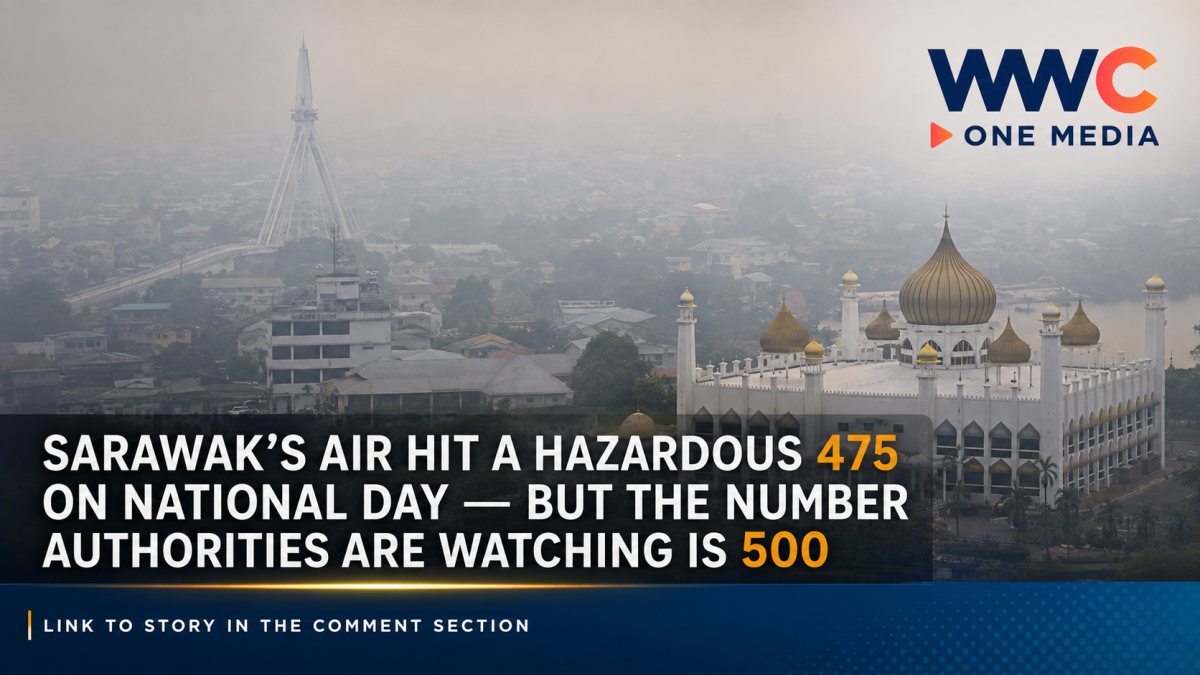
KUCHING, Malaysia — Malaysia’s National Day arrived under dramatically different skies on Monday, with celebrations continuing in Putrajaya while parts of Sarawak were swallowed by some of the worst haze the state has experienced in years.
In Serian, close to the Indonesian border, Malaysia’s national Air Pollutant Index monitoring system recorded a reading of 475 at 9am on August 31, putting the district deep inside the “hazardous” category and perilously close to the level at which authorities say an emergency could be triggered.
Samarahan registered 334, Sri Aman 330 and Kuching 324 at the same time, meaning four locations on the national APIMS network were already above the hazardous threshold of 300. Sarikei, Sibu and Mukah were classified as “very unhealthy”.
But the morning numbers did not tell the whole story.
By 2pm, Sarawak’s Natural Resources and Environment Board reported that hazardous conditions were continuing across numerous locations. Serian had eased somewhat to 451, but Kuching had climbed to 354, Samarahan to 342 and Lundu to 395. Tebedu stood at 400 and Sri Aman at 332.
The readings underline how quickly conditions can shift as winds move smoke across Borneo.
One number now matters more than the others: 500
Sarawak Deputy Premier and State Disaster Management Committee chairman Douglas Uggah Embas said an API reading reaching 500 or above could initiate the process for an emergency declaration in the affected locality.
Such an emergency would not automatically apply to the whole of Sarawak. Uggah said it would be imposed in the specific area affected, with government offices and private-sector workplaces required to close except for essential services.
That makes Serian’s peak particularly concerning.
The district reached 475 on the federal monitoring network on Monday morning, while Sarawak’s state monitoring data showed a peak of about 476 before readings eased later in the day. It placed the area only around two dozen index points below the emergency trigger authorities are watching.
Sarawak has not faced a haze emergency on the scale of its most infamous episodes for decades. The Straits Times reported that the state’s last haze emergency was declared in 1997, during the catastrophic Southeast Asian fires of that year.
National Day celebrations split by the haze
The timing could hardly have been more symbolic.
Sarawak Premier Abang Johari Openg cancelled the state-level National Day celebrations scheduled to be held in Kapit, citing the deteriorating haze affecting large parts of Sarawak.
Hundreds of kilometres away, however, Malaysia’s main National Day parade in Putrajaya was able to continue.
CNA reported that Putrajaya’s API stood at a moderate 79 at 7am, allowing crowds to gather for the federal celebration. Prime Minister Anwar Ibrahim’s National Day address had already been moved indoors a day earlier amid concern over haze conditions.
The contrast was stark: national celebrations under manageable skies in the administrative capital while parts of East Malaysia confronted air officially classified as hazardous.
Where is the smoke coming from?
Malaysian authorities say the deterioration is being driven largely by transboundary haze associated with forest and land fires in Indonesia, particularly across Kalimantan.
Malaysia’s Department of Environment, citing an August 30 assessment by the ASEAN Specialised Meteorological Centre, said satellite imagery detected 324 hotspots in Kalimantan and another 42 in Sumatra. Only two were detected in Malaysia at that snapshot in time — one in Perak and one in Sarawak.
The ASEAN centre’s latest regional assessment describes widespread hotspot activity in Kalimantan and moderate to dense smoke moving northwards from West Kalimantan into western Sarawak.
More importantly, the regional warning has not ended.
ASEAN’s haze-monitoring system is operating at Alert Level 3 for the southern ASEAN region, while its outlook says dry conditions and ongoing fire activity mean the danger of severe transboundary haze remains elevated. El Niño conditions, below-normal rainfall and warmer temperatures are expected to increase the risk of persistent fires during the coming period.
Indonesia is fighting fires on a much larger scale
The crisis extends far beyond the smoke visible over Kuching.
The Associated Press reported that Indonesia has deployed more than 24,000 ground firefighters as authorities battle forest and peatland fires across Kalimantan and Sumatra.
Firefighting aircraft and helicopters have also been mobilised for water-bombing and weather-modification operations.
Indonesian police have arrested 72 people suspected of starting fires, while four companies were under investigation over allegations that fire was used to clear land, AP reported.
Indonesia’s Forestry Ministry also reported that nearly 94,000 hectares burned during July alone, illustrating the scale of the 2026 fire season.
Peat fires are particularly difficult to extinguish because they can continue burning below the surface even after flames above ground appear to have disappeared. Prolonged drought, wind and dry vegetation can then allow those fires to flare again and continue producing smoke.
Malaysia and Indonesia turn to cloud seeding
The worsening situation has also forced an unusual level of cross-border coordination.
Reuters reported that Indonesia has granted Malaysian agencies permission to enter Indonesian airspace for cloud-seeding operations along the shared border, part of joint attempts to reduce the haze and support firefighting efforts.
Sarawak is currently targeting September 3 to 5 for cloud-seeding operations, although officials stress that the operation can proceed only when suitable clouds and atmospheric conditions are available.
Uggah said generating rain would serve two purposes: helping wash smoke particles from the atmosphere while also replenishing reservoirs and dams depleted during the prolonged dry spell.
That second problem is becoming increasingly important. The haze crisis is unfolding alongside declining water levels, meaning the same dry conditions feeding the fires are also placing pressure on water supplies.
The danger does not disappear when the skyline becomes visible
Authorities have urged residents in affected areas to minimise unnecessary outdoor activity, particularly children, older people and those with existing respiratory or cardiovascular problems.
Malaysia’s Health Ministry warns that haze exposure can cause throat irritation, coughing, breathing difficulties, irritated eyes and other symptoms, while people with conditions such as asthma and chronic lung disease face greater risks. The ministry advises reducing outdoor activity during severe haze and seeking medical attention if symptoms worsen.
The immediate question for Sarawak is whether winds, rain and firefighting efforts can pull pollution levels lower before any monitoring station reaches the critical 500 mark.
But the larger problem will remain even if the API falls tomorrow.
Indonesia’s fires are still burning. ASEAN’s regional haze alert remains elevated. Dry conditions are forecast to persist across much of southern Southeast Asia, and the strengthening El Niño pattern could make fire-prone landscapes even harder to control.
For Sarawak, the number 475 was therefore more than another grim air-quality statistic on National Day.
It was a warning of just how close this year’s haze crisis has come to forcing authorities into a measure Malaysia has rarely had to use — and how much of the fire season may still lie ahead.

Leave a Reply