
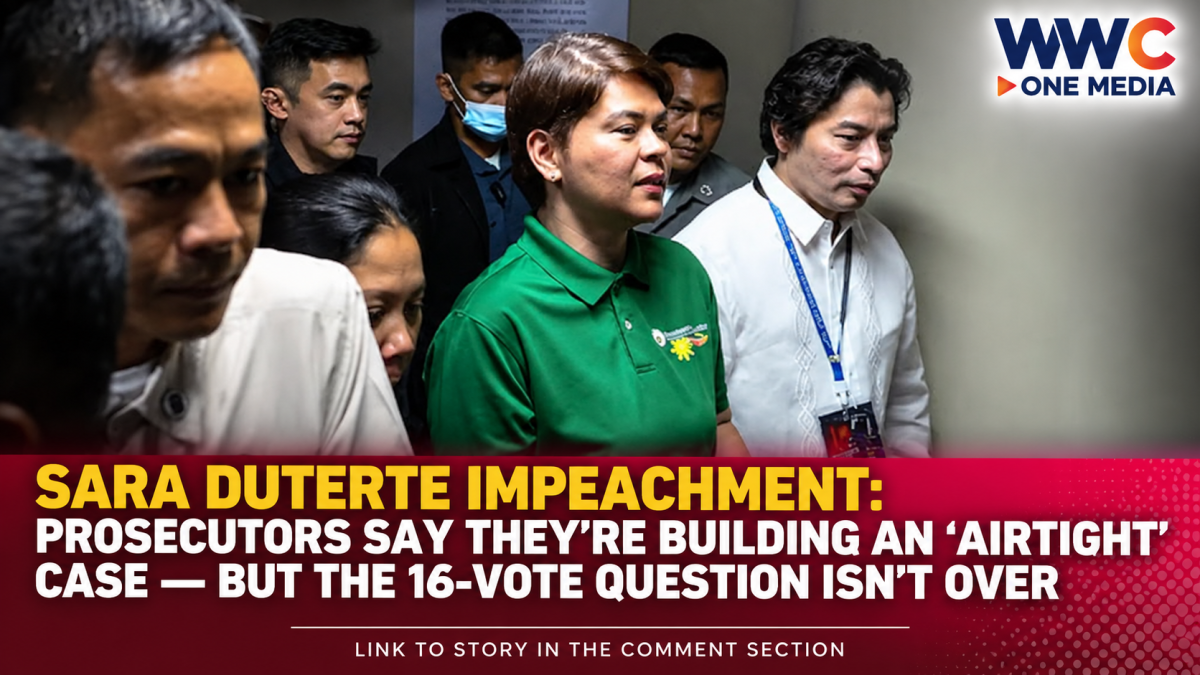
MANILA, Philippines — The House prosecution panel in Vice President Sara Duterte’s impeachment trial says it is not counting votes or trying to predict the outcome in the Senate.
Instead, prosecutors are concentrating on what they say matters most: building an “airtight” case backed by strong evidence, regardless of how the required conviction threshold is ultimately interpreted.
House prosecution counsel and legal spokesperson Benjamin “Jay” Tolosa Jr. said the panel has maintained the same strategy from the beginning of the trial.
“We never engaged in vote counting,” Tolosa said, stressing that prosecutors want their evidence to be strong enough to secure the necessary votes whether the current 16-vote interpretation remains or is later reconsidered.
The 16-vote issue remains unresolved
The Senate impeachment court has been operating under Presiding Officer Francis “Chiz” Escudero’s interpretation that two-thirds of the 24-member Senate means 16 votes are required to convict.
But that interpretation has come under renewed discussion because some senators have raised questions about how the threshold should be calculated when certain senators cannot participate in the proceedings.
Tolosa said the prosecution has not adopted an official position on whether the threshold should be changed.
He has personally described the earlier ruling as an interlocutory order that could potentially be revisited by the impeachment court. He also acknowledged that the issue could eventually reach the Supreme Court if an actual legal controversy arises.
For the prosecution, however, the immediate strategy remains straightforward: present enough evidence to win the required votes.
Prosecutors are trimming their witness list
The prosecution is also signaling that it does not intend to present every available witness simply for the sake of volume.
Tolosa said prosecutors have already stopped calling some witnesses when they concluded that the evidence presented was sufficient to establish the relevant allegation.
He cited the grave-threats article as an example, saying the prosecution decided not to call many additional witnesses after determining that the evidence already presented was enough to establish the alleged threats against President Ferdinand Marcos Jr., First Lady Liza Araneta Marcos and former House Speaker Martin Romualdez.
The same evidence-first strategy is now being considered for the confidential-funds allegations.
Tolosa said the prosecution wants to considerably reduce its witness list wherever possible in an effort to keep the proceedings from extending into next year.
Bribery article could be skipped — but no final decision yet
One of the latest developments is the possibility that prosecutors could skip the bribery allegation under Article III to help speed up the trial.
But Tolosa emphasized that there is no final decision yet.
The prosecution is still evaluating what additional witnesses and evidence are genuinely necessary to establish its case.
The consideration comes as both sides face mounting pressure over the length of the proceedings.
Rather than presenting every piece of potentially relevant evidence, prosecutors appear to be weighing whether each witness and document materially strengthens the case.
Michael Poa testimony becomes part of the evidence battle
The prosecution’s recent presentation has also focused on testimony from former Department of Education Undersecretary Michael Poa, who was declared a hostile witness by the Senate impeachment court.
Poa testified that Duterte did not instruct him to obtain military certifications that were later used by DepEd in responding to Commission on Audit questions involving confidential-fund expenditures.
The prosecution has argued that Poa’s testimony nevertheless produced admissions relevant to its case.
That testimony has become another point of contention as prosecutors attempt to establish their allegations through documentary evidence and witnesses rather than political arguments.
Separate criminal case adds another layer
The impeachment trial is unfolding alongside a separate criminal proceeding involving Duterte.
A Quezon City Regional Trial Court recently issued an arrest warrant for Duterte over three counts of grave threats stemming from her 2024 remarks involving Marcos, First Lady Liza Araneta Marcos and then-House Speaker Martin Romualdez.
Duterte subsequently posted bail, with the court setting bail at P120,000 per count. The court’s finding of probable cause means the criminal case can proceed, but it does not constitute a conviction.
Tolosa has stressed that the criminal case and the impeachment proceedings are separate legal processes with different purposes and procedures.
Former Senate President Franklin Drilon likewise said the two proceedings are different in nature: the grave-threats case is criminal, while impeachment is a constitutional political accountability process.
What happens next?
The prosecution now faces a strategic balancing act.
It wants to establish a case strong enough to withstand whatever happens to the Senate’s voting-threshold debate, while at the same time avoiding unnecessary witnesses and delays that could push the impeachment proceedings into next year.
That explains why the prosecution’s latest message has been consistent: less emphasis on counting votes, more emphasis on proving the allegations.
And with the bribery article still under review, the next major decision could be whether prosecutors continue presenting evidence on every article or begin cutting portions of their case to accelerate the trial.
The question now is not simply whether the prosecution has enough evidence — but whether it can turn that evidence into the votes needed for conviction.
WWC ONE MEDIA M.J.E
Leave a Reply