
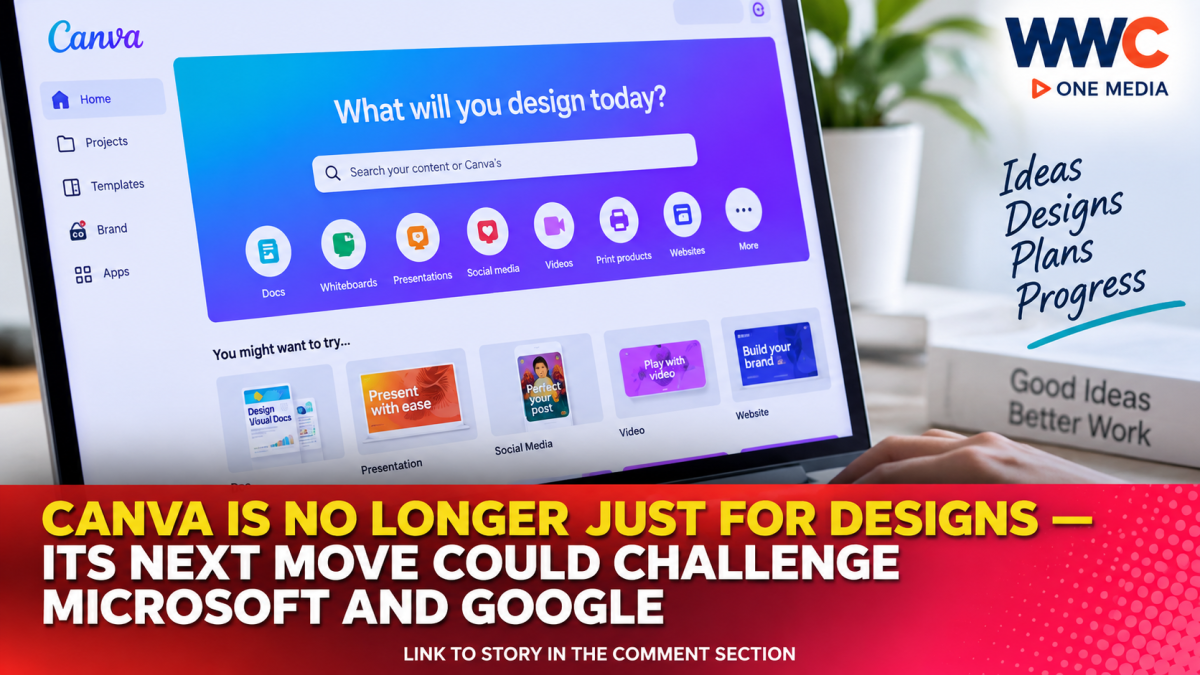
Canva is making a much bigger play for the workplace, expanding beyond its familiar design tools as businesses increasingly use the platform for documents, presentations, spreadsheets, brainstorming, websites and other everyday work.
The Australian company has rolled out more than 100 upgrades to its Visual Suite since the start of 2026, covering Docs, Presentations, Sheets, Whiteboards, Websites and other tools. The push signals Canva’s ambition to become a broader productivity platform rather than simply a place to make graphics.
From graphic design to everyday work
Canva says more than 100 million people now use Canva Presentations every month, making it one of the world’s leading presentation tools. At the same time, Canva Docs has become the platform’s third-most-used format, with usage more than tripling over the past three years.
The company also says more than 1 billion designs are created on Canva each month, including nearly 1,000 documents and around 3,000 presentations every minute.
That shift is important because Canva is increasingly moving into territory traditionally dominated by Microsoft Office and Google Workspace.
Fortune reported that Canva users have created 4.5 billion presentations and 1.4 billion documents on the platform. It also reported that enterprise use of Canva Docs and Sheets has been growing rapidly, while mobile usage is particularly strong across Southeast Asia.
Canva is betting on an all-in-one workplace
The company’s strategy is built around keeping different stages of a project inside one platform.
A team could brainstorm on a Whiteboard, develop the idea in Docs, analyze data in Sheets, turn the findings into a presentation and eventually publish a website — without repeatedly moving information between different applications.
Canva says more than a quarter of a billion multi-format designs have been created since the company introduced its newer multi-format approach. Its latest updates include AI-assisted data analysis in Sheets, automatically generated presenter notes, expanded document formatting, improved Whiteboards collaboration and enhanced website controls.
For companies trying to reduce the number of software subscriptions employees use, that could make Canva increasingly attractive.
The Philippines is becoming a key market
The shift is especially notable in the Philippines.
InsiderPH reports that the country is among Canva’s top three markets for Docs, Presentations and Sheets. Filipino users created more than 116 million presentations over the past year, while more than 72% of local users create on mobile, according to Canva data cited by InsiderPH.
Fortune separately reported that roughly three in five Canva presentations created in the Philippines start on a mobile device. Across Southeast Asia, more than half of presentations reportedly begin on mobile.
That mobile-first behavior could give Canva an advantage in markets where smartphones are increasingly used not only for communication and entertainment, but also for actual work.
AI could make Canva’s productivity push even bigger
Canva’s expansion is happening at the same time the company is investing heavily in artificial intelligence.
The company launched Canva AI 2.0 earlier in 2026, positioning conversational AI as a way for users to create and modify designs and other work through natural-language instructions. TechCrunch previously reported that Canva had surpassed 265 million monthly active users and 31 million paid users in 2025, with its business customer segment also growing strongly.
But the AI opportunity also comes with a challenge: computing costs.
Fortune reported that Canva has been working to bring down the cost of AI tasks after the company’s increasingly sophisticated AI features proved more expensive to operate than initially expected.
That makes the productivity push particularly significant. Canva isn’t simply adding AI to its existing design product; it is trying to make AI useful across the entire process of creating, analyzing, collaborating and delivering work.
Microsoft and Google are the bigger targets
Canva’s ambitions put it increasingly closer to Microsoft and Google in the productivity market.
Forbes Australia reported that Canva’s enterprise customers increased their use of Docs by 83% year over year and Sheets by 59%, according to Canva figures. The company is also targeting businesses that already rely on established productivity ecosystems.
Canva’s challenge is enormous. Microsoft Office and Google Workspace are deeply embedded in corporate workflows, and companies often have years of documents, spreadsheets, integrations and processes tied to those platforms.
But Canva is approaching the market from a different direction: make workplace productivity more visual, collaborative and connected to creative work.
The bigger story
Canva’s evolution reflects a broader change in how companies work.
Documents are becoming more visual. Presentations are increasingly interactive. Data is expected to be easier to understand. Websites, marketing materials and internal communications often need to be created by the same teams.
Canva is betting that these activities shouldn’t require a collection of separate applications.
Its latest expansion therefore isn’t simply about adding more features.
It’s about changing what users think Canva is.
The company that became famous for making graphic design accessible to almost anyone now wants to become the place where an entire project — from the first idea to the final presentation — gets done.
And if Canva succeeds, the biggest question may no longer be whether it can compete with traditional design software — but whether it can take a meaningful share of the everyday work currently handled by Microsoft and Google.
WWC ONE MEDIA M.J.E

Leave a Reply