
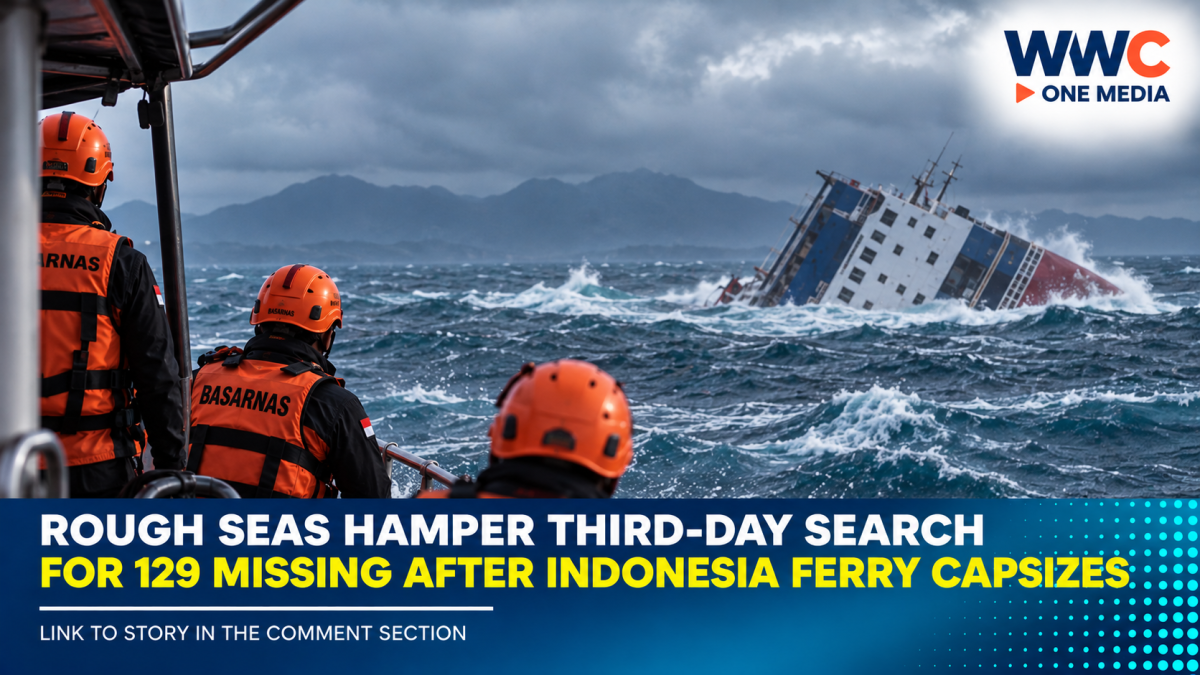
JAKARTA — A massive search operation for 129 people still missing after an Indonesian passenger ferry capsized in the Java Sea has entered its third day, but dangerous sea conditions are slowing efforts to reach the overturned vessel.
The Virgo Transport 8 was carrying 243 people — 213 passengers and 30 crew members — when it capsized early Sunday while traveling from Surabaya in East Java to Banjarmasin in South Kalimantan. Authorities have so far rescued 108 people and recovered six bodies, leaving 129 people unaccounted for.
Rough seas are blocking underwater searches
Rescuers faced waves of approximately 1.75 to 2.5 meters (5.7 to 8.2 feet) on Tuesday, making conditions too dangerous for divers to begin underwater operations around the wreck.
I Putu Sudayana, head of the Banjarmasin rescue agency, said the search effort on the third day involved approximately 1,100 coast guard and navy personnel, 17 ships and 10 aircraft and helicopters.
For now, teams are concentrating on searches from the air and the surface while monitoring weather conditions.
Officials remain hopeful that underwater operations can begin once the sea becomes safer.
Sophisticated equipment is ready
Authorities are preparing specialized technology to examine the capsized ferry, which is lying at a depth of approximately 30 meters (98 feet).
The Indonesian Navy plans to deploy the Canopus vessel, equipped with an underwater drone, a multibeam echo-sounder and a remotely operated vehicle. These systems could allow rescuers to inspect the wreck while reducing the risks faced by divers in poor visibility and strong currents.
Specialist divers from the Navy and national rescue agency are also prepared for underwater operations.
But officials warn that the wreck itself presents additional dangers because the overturned vessel could shift unexpectedly, while trapped air and changing pressure could create hazards for divers.
Authorities are also considering whether the ship can eventually be turned upright or brought to the surface.
What happened to the ferry?
The ferry issued a distress signal early Sunday after encountering severe weather.
According to earlier reports, the vessel began listing heavily in rough seas before contact was lost. A passing helicopter later located the overturned ship in the Java Sea near the Masalembo area.
The exact cause of the capsizing has not yet been determined, and an investigation is expected to examine the vessel, weather conditions and other factors.
Indonesia’s transport minister has said the ferry was not overloaded, noting that the vessel had a stated capacity of up to 500 passengers.
Survivors describe a sudden disaster
Some survivors have described a rapidly developing emergency after the vessel began to tilt in rough seas.
AP reported that the ship was also carrying 89 vehicles, while survivors described passengers trying to reach safer parts of the vessel as it overturned. Authorities are still working to establish the full circumstances surrounding the accident.
The ferry was built in Japan in 1987, according to AP reporting.
Families wait for news
As rescue crews continue searching, relatives of passengers have gathered at command centers seeking information about their loved ones.
The scale of the operation reflects the urgency of the situation, but deteriorating sea conditions remain one of the biggest obstacles.
Indonesia relies heavily on ferries and other vessels because its territory spans more than 17,000 islands, making maritime transportation essential for connecting communities across the archipelago. The latest disaster has also renewed attention on ferry safety following several other maritime accidents in the region.
Search teams refuse to give up
Despite the difficult conditions, Indonesian authorities say the search will continue.
The immediate priority remains locating people who may still be alive, while specialist teams prepare to examine the submerged portions of the ferry once weather conditions allow.
With 129 people still missing, the third day of the operation has become a race against both time and the sea.
The rescuers are ready. The technology is waiting. But until the waves calm down, the most critical search may remain just beneath the surface.




Leave a Reply