
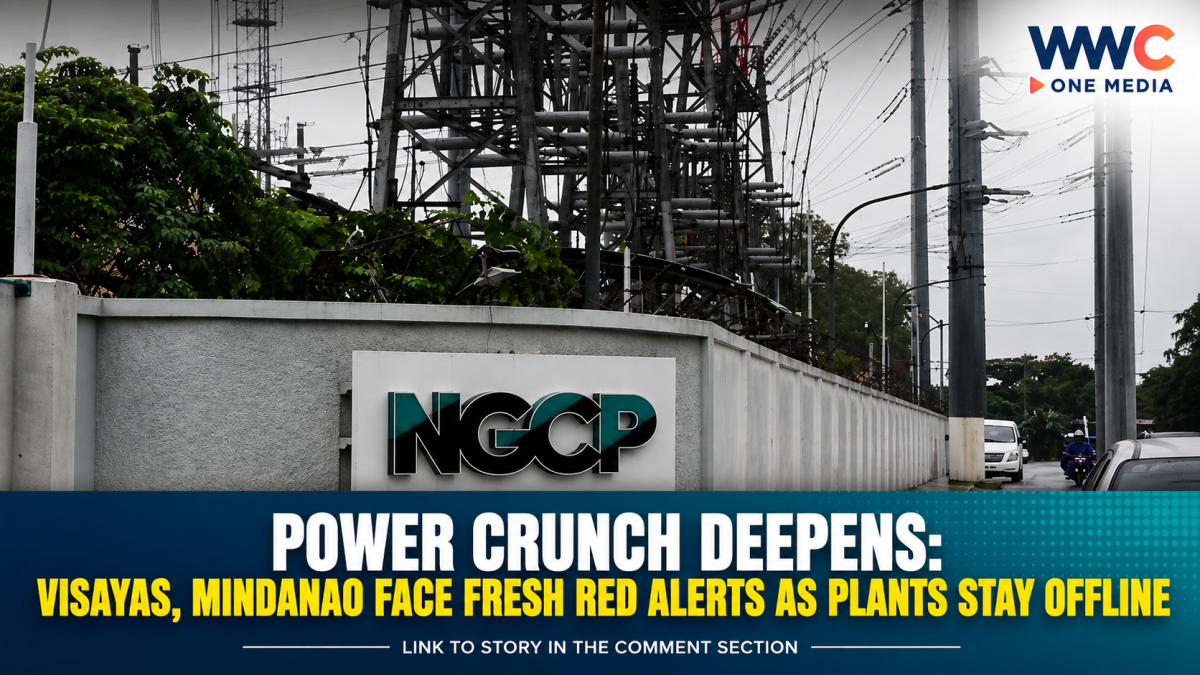
The Philippines’ power supply situation is tightening again, with the Visayas and Mindanao grids placed under red and yellow alerts on Thursday as several power plants remain unavailable while electricity demand stays high. The National Grid Corporation of the Philippines (NGCP) said the Visayas grid will be under red alert from 1 p.m. to 10 p.m., with yellow alerts before and after that period. Available capacity is estimated at only 2,187 megawatts (MW), compared with projected peak demand of 2,575 MW, leaving the grid with a significant supply gap.
The situation is particularly concerning because several generating units remain offline. NGCP said Unit 1 of Therma Visayas Inc. and Unit 3 of Panay Energy Development Corp. are still on forced outage, along with four other units that have been unavailable this month. More than 20 other generating units have also remained unavailable since as far back as 2021, while 16 power plants are operating at reduced or derated capacity. Altogether, these conditions represent about 792 MW of lost capacity in the Visayas grid.
The Visayas is also receiving limited electricity imports from Mindanao, further restricting its ability to cover demand during peak periods. The pressure has been building for weeks. On September 1, NGCP reported approximately 813.9 MW of capacity unavailable in the Visayas, while the grid repeatedly entered red-alert territory during August.
The strain is not confined to the Visayas. Mindanao is also facing a critical supply situation, with available capacity at around 2,480 MW against projected peak demand of 2,546 MW on Thursday. NGCP said the Mindanao grid will be under red alert from noon to 9 p.m., with yellow alerts before and after that period.
Several major generating facilities are contributing to Mindanao’s shortage. Six power plants are on forced outage this month, including Units 1 and 2 of GNPower Kauswagan and Unit 2 of Therma South Inc. Four additional plants have also been unavailable this month, while 21 others have been on forced outage since early 2024. Seven more facilities are operating at derated capacity, resulting in about 841.6 MW of unavailable capacity.
The latest developments follow another red-alert episode in Mindanao on September 2, when available capacity dropped to about 2,526 MW while projected peak demand climbed to 2,545 MW. That left only a narrow margin — and at one point a 19-MW shortfall against projected demand.
The Visayas has faced an equally difficult situation. Inquirer reported that the grid remained under red alert on September 2 despite the return of two generating facilities, including Unit 2 of Therma Visayas, which added about 169 MW, and a KEPCO-SPC Power Corp. facility with a generating capacity of 103 MW. Energy officials said the additional supply had not yet provided enough cushion because electricity demand remained very high and imports from Mindanao were limited.
The continuing alerts do not automatically mean that widespread blackouts will occur, but they indicate that the grid has limited reserves to absorb an unexpected disruption or further increase in demand. NGCP defines a yellow alert as a condition in which the operating margin is insufficient to meet the grid’s contingency requirement, while a red alert means available supply is insufficient to meet both consumer demand and the transmission grid’s regulating requirement.
The bigger concern is the persistence of the problem. Repeated forced outages, aging or unavailable generating units, derated facilities and strong electricity demand are leaving the country’s two major regional grids with increasingly little room for error. The latest figures show that this is no longer an isolated day-to-day fluctuation but an ongoing supply challenge that has continued from August into September.
Authorities are working on measures to stabilize supply. PNA previously reported that measures include tapping battery-powered generating sets, while the Department of Energy has been coordinating with NGCP, the Independent Electricity Market Operator of the Philippines, the Energy Regulatory Commission, generating companies and other industry stakeholders to restore affected facilities and strengthen grid reliability.
For consumers and businesses across the Visayas and Mindanao, the immediate issue is clear: electricity supply remains vulnerable precisely when demand is high. Until more generating units return to service and additional capacity comes online, the two grids will continue operating with limited breathing room.
WWC ONE MEDIA G.A




Leave a Reply