
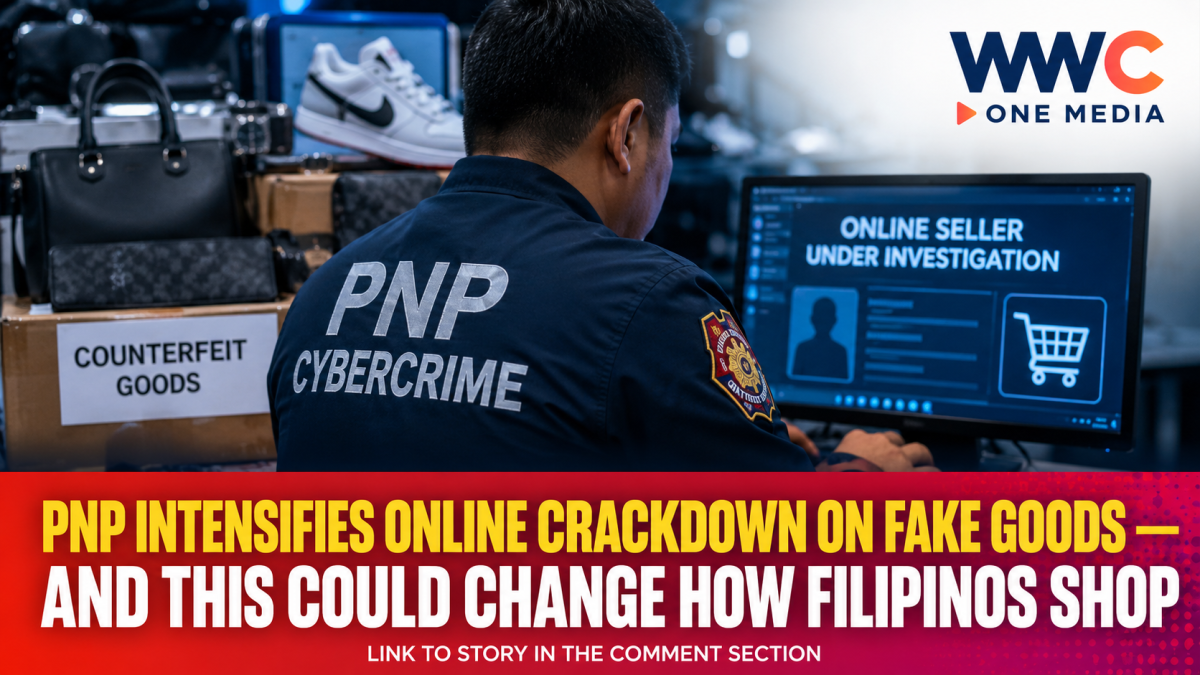
The Philippine National Police is stepping up its campaign against counterfeit goods, with authorities turning greater attention to the growing number of fake products being promoted and sold through online platforms.
The intensified enforcement comes as government agencies continue to uncover billions of pesos worth of counterfeit and illicit merchandise, while consumer groups warn that fake products remain widely accessible through digital marketplaces.
The crackdown puts online sellers, distributors and networks suspected of dealing in counterfeit merchandise under increasing scrutiny.
The Philippine National Police has been strengthening its cybercrime capabilities as criminal activity increasingly moves into the digital space. PNP chief General Jose Melencio C. Nartatez Jr. has repeatedly directed police units to improve cyber patrols, digital investigations and coordination with partner agencies to identify and pursue online offenders.
The move is particularly significant for counterfeit goods because sellers can use social media accounts, e-commerce platforms and other online channels to reach thousands of potential buyers without maintaining a traditional storefront.
Fake Goods Are No Longer Just an Intellectual Property Problem
Counterfeit merchandise is not simply an issue involving fake brand names.
Authorities have warned that some counterfeit products can create serious health and safety risks because they may be produced without the quality controls, testing and regulatory requirements expected of legitimate products.
Recent concerns have included fake medicines, health and beauty products, electronics, footwear, toys, perfumes and other consumer merchandise.
A consumer advocacy group recently urged authorities to launch a stronger and sustained crackdown on counterfeit products being sold online, warning that digital marketplaces continue to provide easy access to potentially dangerous and unregulated imitations.
According to figures cited by Malayang Konsyumer, Lazada reported an 85.5 percent proactive takedown rate for counterfeit listings between June 2024 and May 2025, while Shopee reported a 93.6 percent proactive removal rate during the same period.
Despite those efforts, the National Committee on Intellectual Property Rights reported seizures totaling P18.64 billion worth of counterfeit products in 2025.
Billions of Pesos in Counterfeit Products Already Seized
The scale of the government’s campaign shows why online enforcement has become increasingly important.
IPOPHL reported that the National Committee on Intellectual Property Rights seized P18.64 billion worth of counterfeit products from January to September 2025.
The Bureau of Customs accounted for P17.21 billion of that amount, while the National Bureau of Investigation reported P980.4 million and the Philippine National Police accounted for P456.7 million in seizures during the same period.
The enforcement campaign has continued into 2026.
In February, the NBI’s Intellectual Property Rights Division reported the seizure of nearly P246 million worth of counterfeit products in operations conducted in Metro Manila and Northern Mindanao.
The operation included thousands of suspected counterfeit sunglasses and other branded products. The NBI said the manufacture, sale and distribution of such goods may violate the Intellectual Property Code, including provisions involving trademark infringement and unfair competition.
In another major operation, PNP-CIDG personnel raided a warehouse in Imus, Cavite, in August and seized an estimated P700 million worth of counterfeit footwear.
Authorities said the operation formed part of the PNP’s intensified campaign against economic crimes and related illegal activities.
PNP Has Already Seen Complaints From Online Buyers
The crackdown is also being driven by complaints involving products purchased online.
Earlier this year, the PNP urged consumers to check, verify and report counterfeit merchandise after police operations in Bulacan and Pampanga resulted in the seizure of about P202 million worth of fake footwear and equipment.
The operations reportedly followed complaints from online shoppers who said they received defective products.
PNP chief Nartatez said authorities were determined to dismantle the entire supply chain behind illegal products, rather than simply targeting individual sellers.
That approach could prove crucial because online counterfeit operations can involve multiple layers, including manufacturers, importers, warehouse operators, distributors, online sellers and payment channels.
Online Platforms Face Greater Pressure to Remove Fake Listings
Government enforcement is also increasingly relying on cooperation between authorities, intellectual property owners and e-commerce companies.
IPOPHL said its E-Commerce Memorandum of Understanding against online counterfeiting has expanded significantly since it was launched in 2021.
By May 2026, the initiative had grown from 12 original signatories to 119. Participants reported faster coordination and increased removal of counterfeit listings, with some takedowns taking place within 24 hours to three days.
The initiative is now moving beyond simply removing individual listings.
Stakeholders have called for stronger seller verification, tougher action against repeat offenders and greater coordination between e-commerce platforms and enforcement agencies to identify the broader supply networks behind counterfeit merchandise.
What This Means for Filipino Online Shoppers
For consumers, the intensified campaign is a reminder to be more careful when buying supposedly branded products online.
An unusually low price does not automatically prove that an item is counterfeit, but consumers should be cautious when a seller claims to offer expensive branded merchandise at prices that appear far below normal market levels.
Buyers should also examine seller information, product descriptions, reviews, return policies and proof of authenticity before completing a transaction.
Screenshots of advertisements, seller profiles, conversations, receipts, payment records and delivery information can also become important evidence if a buyer believes they received counterfeit merchandise.
The Bigger Battle Is Moving Online
The Philippine government’s fight against counterfeit goods is no longer limited to warehouses, physical stores and ports.
As more Filipinos purchase products through e-commerce platforms and social media, counterfeit traders have gained another channel for reaching consumers.
That is why the PNP’s broader push to expand cyber patrols and digital investigative capabilities could become an increasingly important part of the country’s campaign against counterfeit trade. In August 2026, the PNP reported conducting thousands of cyber patrol operations and dozens of digital forensic examinations as part of its wider cybercrime campaign.
Meanwhile, IPOPHL and other government agencies are pushing for stronger cooperation with online platforms and rights holders.
The challenge now is no longer simply finding fake products.
It is finding the people behind the accounts, tracing the supply chains, identifying repeat offenders and stopping counterfeit goods before they reach Filipino consumers.
And with more counterfeit sellers moving into the digital marketplace, the next phase of the government’s crackdown may increasingly take place where millions of Filipinos shop every day: online.
WWC ONE MEDIA MJE


Leave a Reply