
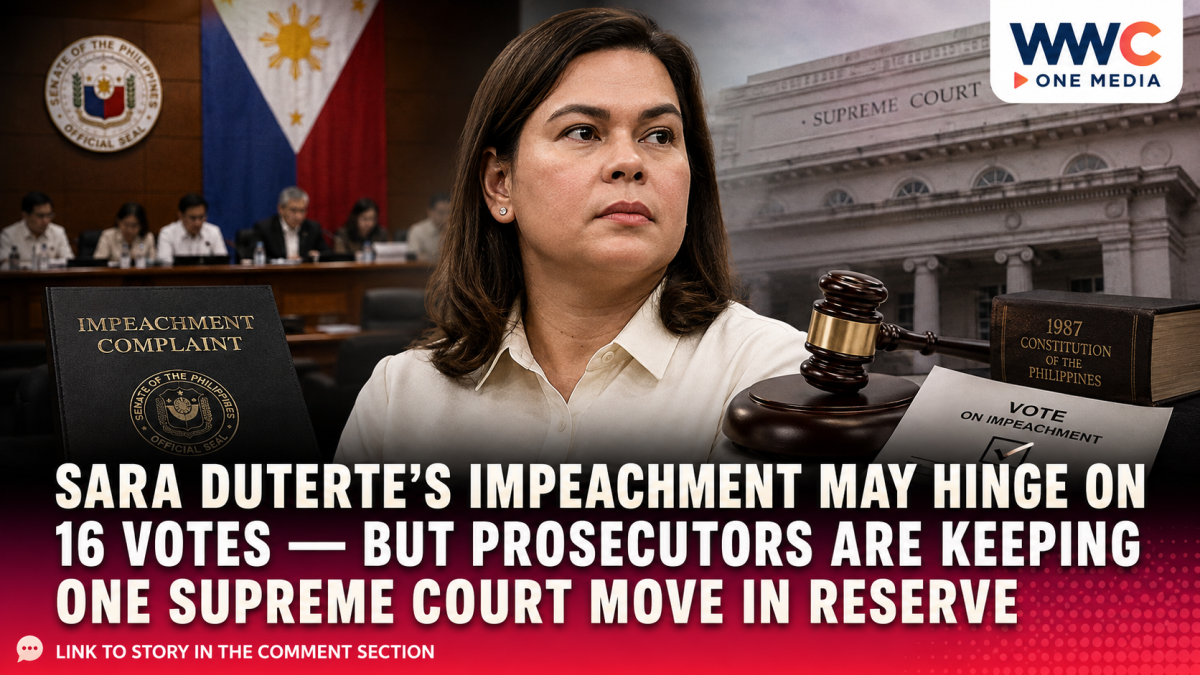
MANILA, Philippines — The battle over Vice President Sara Duterte’s impeachment may eventually move beyond the Senate floor and into the Supreme Court—not necessarily over the evidence against her, but over one deceptively simple question: How many senator-judges are actually needed to convict her?
For now, the House prosecution panel says it is working on the assumption that the answer is 16 votes, the number produced by taking two-thirds of the constitutionally prescribed 24-member Senate.
But prosecutors are leaving the door open to challenging that interpretation before the Supreme Court if circumstances surrounding the eventual verdict create an actual constitutional dispute.
The distinction matters.
House prosecutor and Bicol Saro Rep. Terry Ridon said on September 2 that bringing the issue to the Supreme Court now would be premature because there is not yet a justiciable controversy for the justices to resolve.
House trial adviser Robert Ace Barbers, however, indicated that the prosecution could itself initiate a Supreme Court case should circumstances later create an injury or legal controversy requiring judicial intervention. In other words, prosecutors are not presently seeking to lower the threshold—but they have not surrendered the legal option either.
Why 16 votes matter
Article XI, Section 3(6) of the 1987 Constitution provides that no impeached official may be convicted without the concurrence of two-thirds of all the members of the Senate.
The Senate’s own Rules of Procedure on Impeachment Trials use essentially the same standard: conviction on an article requires the votes of two-thirds of all Senate members. With a constitutionally prescribed membership of 24 senators, that has traditionally been read as requiring at least 16 votes.
Sen. Francis “Chiz” Escudero, who was elected presiding officer of the Duterte impeachment court, has taken that position explicitly.
When the formal trial opened in July, Escudero said the Constitution’s reference to “all” Senate members meant that 16 affirmative votes would be required for conviction, citing the Supreme Court’s treatment of similar constitutional voting language in previous cases.
That sounds straightforward—until the Senate no longer has all 24 members available to participate.
The problem prosecutors are watching
The impeachment proceedings have unfolded while several senator-judges have been unavailable or absent under different circumstances.
On September 2, the Senate impeachment court declared a quorum with 17 senator-judges present as the prosecution continued presenting evidence concerning Duterte’s alleged handling of confidential funds while she headed the Department of Education.
Earlier reporting also documented the absence of several senators because of detention, legal proceedings, medical leave or other circumstances, raising the possibility that the number of senators capable of participating in a final vote could become central to the outcome.
That is where an old Supreme Court case has entered the debate.
The 1949 ruling behind the argument
Members of the House prosecution have previously pointed to Avelino v. Cuenco, a landmark 1949 Supreme Court case involving the computation of a Senate quorum.
Lead prosecutor Rep. Gerville Luistro has urged lawyers to examine whether the principle in Avelino—particularly its treatment of lawmakers considered beyond the Senate’s coercive power—could have relevance if some senator-judges cannot participate in Duterte’s impeachment proceedings.
But applying Avelino to an impeachment conviction would not be automatic.
The constitutional language governing conviction specifically requires two-thirds of “all the Members of the Senate,” and the Senate’s impeachment rules repeat that formulation. Whether circumstances involving unavailable senators could legally change the denominator is precisely the unresolved constitutional question.
Rep. Leila de Lima, one of the House prosecutors, earlier argued that the dispute would become ripe for judicial determination only when the circumstances surrounding the final vote are known—for example, if fewer than 16 senators are actually able to participate.
Supreme Court intervention is possible—but not guaranteed
There is another complication: impeachment belongs primarily to Congress.
The Constitution gives the Senate the sole power to try and decide impeachment cases. The Supreme Court has also emphasized that courts generally cannot simply take control of matters entrusted to a coequal constitutional body, although judicial review remains available where grave abuse of discretion or constitutional violations are properly alleged.
The High Court has already become deeply involved in the broader Duterte impeachment saga.
In August, the Supreme Court dismissed consolidated petitions challenging the latest House proceedings after ruling that the questions had become moot because the House had already approved and transmitted the Articles of Impeachment to the Senate.
That decision allowed the current Senate proceedings to continue without resolving the separate question of how many votes would ultimately be necessary for conviction.
The prosecution’s immediate priority: evidence, not arithmetic
Despite the growing debate, prosecutors insist that their immediate strategy is not to engineer a smaller voting requirement.
Their publicly stated position remains that they are preparing to win 16 votes.
That approach echoes earlier statements from prosecution representatives who said their priority was to present an “airtight” evidentiary case rather than engage prematurely in vote counting or constitutional litigation.
The trial itself remains active. On September 2, former Department of Education chief of staff Michael Poa testified as the prosecution continued its presentation concerning Duterte’s alleged use of confidential funds. The House prosecution has said it hopes to complete that portion of its evidence presentation by September 9, while the impeachment court is considering longer trial days in October.
Duterte is entitled to contest the allegations and present her defense before the senator-judges. Impeachment proceedings determine political and constitutional accountability; the allegations themselves should not be treated as established facts unless proven through the process.
What happens next could matter beyond Sara Duterte
The dispute over 16 votes could ultimately become almost as consequential as the evidence presented during the trial.
If at least 16 senator-judges participate in the final vote, the constitutional dispute may never need to reach the Supreme Court.
But if absences, suspensions, detention or other circumstances leave fewer senators capable of voting—and the result turns on whether the threshold remains fixed at 16—the Philippines could face a constitutional question with implications far beyond Duterte’s political future.
The Senate would first have to confront what “two-thirds of all the Members” means under extraordinary circumstances.
And if that interpretation determines whether the Vice President is convicted or acquitted, the final battle may not end when the senator-judges cast their votes.
It could end at the Supreme Court.
WWC ONE MEDIA MJE




Leave a Reply