
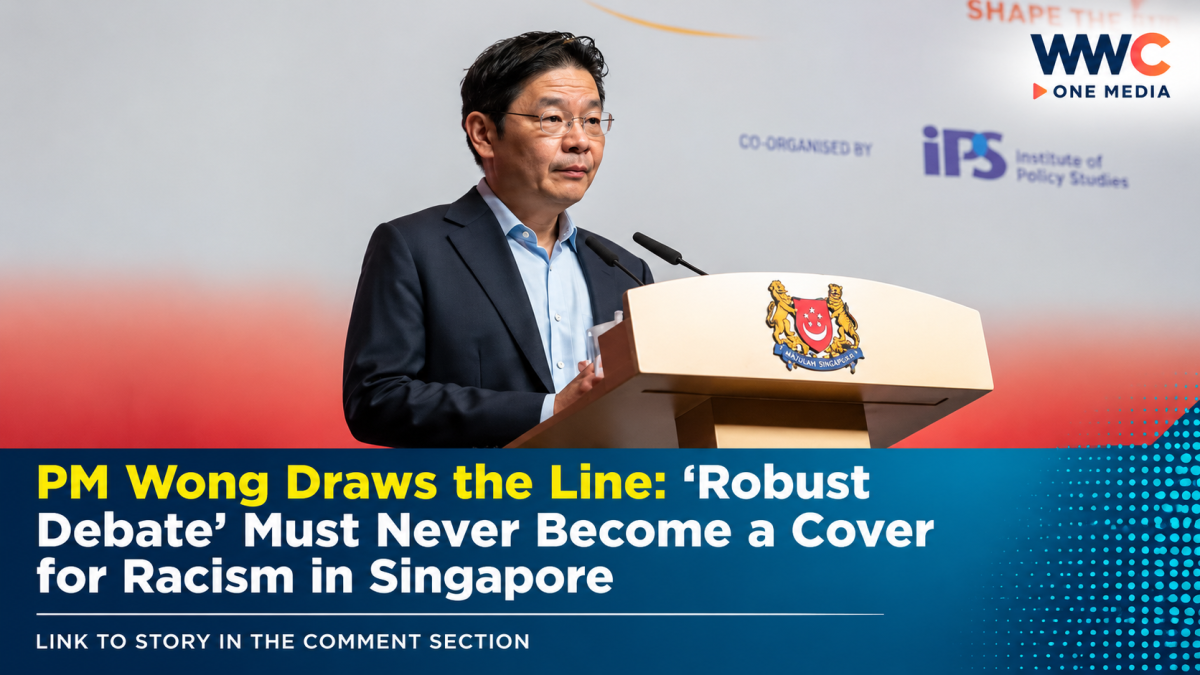
SINGAPORE — Prime Minister Lawrence Wong has issued a strong warning against allowing racism and prejudice to hide behind seemingly legitimate public debate, following a wave of anti-Indian and anti-foreigner comments that surfaced online in connection with the Nepal-Tibet flood tragedy and Singapore Airlines’ relationship with Air India.
Wong said Singaporeans should never allow prejudice against any community to become accepted or normalised, stressing that racist views do not represent the country.
His remarks came after Senior Minister K Shanmugam said police had been asked to look into racist and xenophobic online comments, some of which targeted missing Singaporeans and individuals of Indian ethnicity.
PM Wong: Debate Is Welcome, Prejudice Is Not
In his social media post, Wong made a distinction between healthy disagreement and the use of public issues to fuel hostility against particular communities.
Singaporeans, he said, should continue to have robust debates and discussions.
But those debates must not become an excuse for racism.
The prime minister warned against using “seemingly legitimate arguments” as a cover for prejudice against any community or hostility towards foreigners.
Wong said Singapore’s identity must remain open and inclusive, adding that people who embrace the country’s values and way of life are part of the nation regardless of their background.
He urged Singaporeans to hold firmly to the ideals of the National Pledge and reject attempts to divide society along racial or religious lines.
Racist Comments Emerged After Nepal-Tibet Flood Tragedy
The controversy followed the devastating Aug. 26 floods along the Nepal-China border, where more than 1,200 people were reported killed and thousands were missing, according to official remarks cited by Singapore authorities.
Nine Singaporeans were among those reported missing.
Singapore responded by sending humanitarian assistance and personnel to support affected Singaporeans and the broader relief effort.
But amid the tragedy, racist comments began appearing online about the missing Singaporeans, with some commenters questioning whether they should be considered “our own” based on their ethnicity or appearance.
Shanmugam described such remarks as “shameful, nasty and totally unacceptable” and said he had asked police to look into them.
Shanmugam Calls for Racist Commenters to Be Held Accountable
Shanmugam, who is also Singapore’s Coordinating Minister for National Security and Minister for Home Affairs, took an unusually direct stance against the online abuse.
He warned that racist comments should not simply be dismissed as anonymous internet chatter.
“These people should be unmasked and dealt with,” he said, arguing that online anonymity should not become a shield for behaviour that could damage Singapore’s racial harmony.
The Ministry of Digital Development and Information is also expected to engage social media platforms over comments that breach their guidelines, while police consider whether offences may have been committed.
Air India Debate Also Triggered Anti-Indian Sentiment
A separate wave of online hostility emerged following reports involving Singapore Airlines and Air India.
Air India reportedly sought additional equity funding from its shareholders, Tata Sons and Singapore Airlines, sparking public discussion over the commercial implications of further investment.
But Shanmugam said legitimate questions about the business relationship had, in some cases, been distorted into racist attacks.
He highlighted online comments targeting individuals associated with Temasek Holdings and Singapore’s corporate sector based on ethnicity rather than their professional decisions or the merits of the investments involved.
Shanmugam said such attacks were particularly troubling because they reduced complex commercial decisions to racial stereotypes.
He also pointed to Temasek’s publicly reported investment performance in India, arguing that facts and commercial considerations were being ignored by those driven by prejudice.
Senior Minister Lee Hsien Loong: Singapore Will Always Face These Fault Lines
Senior Minister Lee Hsien Loong also spoke out about the controversy, describing the racist and anti-Indian comments as “troubling”.
Lee warned that Singapore’s racial and religious diversity will always create potential fault lines that can be exploited.
The country’s challenge, he said, is to continuously strengthen social cohesion and reject attempts to manipulate racial fears and emotions.
When incidents like this occur, Lee said, leaders must speak out clearly and Singaporeans must stand together.
He urged the public to respond to the Nepal flood tragedy with compassion and solidarity rather than hatred.
A Political Debate Also Became Part of the Conversation
The Air India issue also drew attention after Workers’ Party MP Kenneth Tiong raised questions about the commercial aspects of Singapore Airlines’ involvement.
When asked whether Tiong’s comments crossed racist or xenophobic lines, Shanmugam said the MP should explain his own intentions.
Tiong later stated that he condemned the racist comments without reservation and said his concerns about the Air India matter were purely commercial.
He also expressed sympathy for the victims of the Nepal disaster and their families.
The episode highlighted the central message now being emphasised by Singapore’s political leaders:
Commercial and political decisions can be debated. Racism cannot be justified as part of that debate.
Why PM Wong Says Online Racism Cannot Be Ignored
Wong warned that hateful comments can become increasingly dangerous when society begins treating them as harmless.
If left unchecked, prejudice can become normalised.
That can deepen mistrust between communities and gradually weaken the social cohesion Singapore has spent decades building.
The prime minister said Singaporeans may not be able to prevent every offensive comment from appearing online.
But they can choose how they respond.
They can reject such views.
They can refuse to amplify them.
And they can refuse to give racism the legitimacy of being treated as an ordinary opinion.
That distinction may be at the heart of Wong’s message.
Free and robust debate does not mean every form of hostility deserves acceptance.
And disagreement over policy, business or politics should never become an excuse to attack someone because of race or ethnicity.
Singapore’s National Pledge at the Centre of the Message
Wong’s response repeatedly returned to one of Singapore’s most important national principles: unity across differences.
He reminded Singaporeans that the country has remained strong because it has rejected attempts to divide people according to race or religion.
Instead, Singapore has sought to build a shared national identity while recognising its diverse communities.
The prime minister said the country must continue making that choice.
“Regardless of race, language or religion,” Singaporeans must ensure prejudice does not become accepted or normal, he said.
The Bigger Question: Where Is the Line?
The latest controversy has reignited a difficult question for societies everywhere.
Where does legitimate debate end?
And where does prejudice begin?
Singapore’s leaders have made their position clear.
People can question investment decisions.
They can debate government policies.
They can challenge corporations and politicians.
But when criticism shifts from decisions and evidence to a person’s race, ethnicity or background, the argument changes.
It is no longer simply debate.
And according to Wong, Shanmugam and Lee, Singapore cannot afford to allow that distinction to disappear.
‘We Must Never Allow Prejudice to Become Normal’
The controversy surrounding the Nepal flood tragedy and the Air India debate may involve different issues.
One concerns a devastating humanitarian disaster.
The other involves legitimate questions about commercial decisions.
But Singapore’s leaders say both episodes exposed the same danger.
Racism can attach itself to almost any public issue if it is allowed to hide behind anger, fear or debate.
Shanmugam has called for racist behaviour online to be investigated and challenged.
Lee has warned that racial divisions remain a permanent vulnerability that Singapore must actively manage.
And Wong has delivered perhaps the clearest message of all:
Singaporeans can argue.
Singaporeans can disagree.
Singaporeans can have robust debates.
But they must never allow debate to become a cover for prejudice — or allow racism against any community to become normal.
WWC ONE MEDIA J.M.D
Leave a Reply