
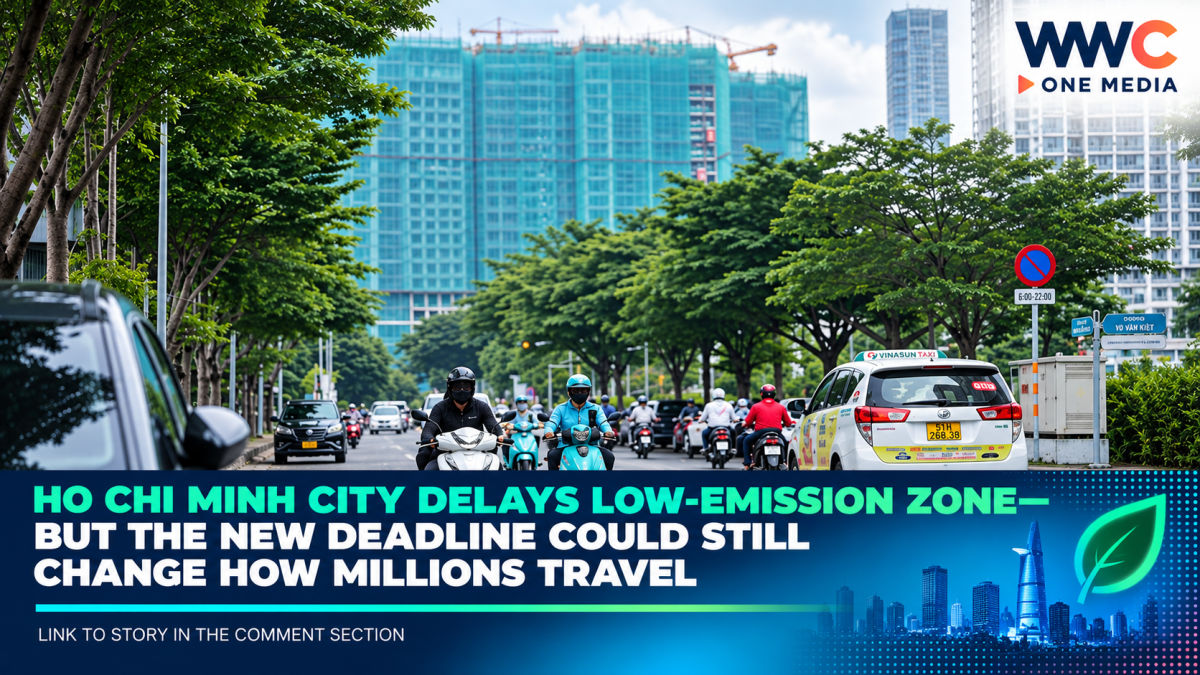
HO CHI MINH CITY, Vietnam — Ho Chi Minh City is giving residents and businesses more time to prepare for one of Vietnam’s biggest transportation changes, delaying the rollout of its planned low-emission zone (LEZ) while authorities work to put cleaner transport infrastructure and vehicle-transition policies in place.
The city’s revised timetable would move the pilot implementation to July 2027, according to recent reports citing city authorities. The proposal would initially cover the city’s central downtown area and the new Thu Thiem urban area, before expanding in later stages.
The delay does not mean Ho Chi Minh City is abandoning its clean-air ambitions.
Instead, officials are attempting a more gradual transition—one that could eventually restrict increasingly large numbers of gasoline- and diesel-powered vehicles from entering designated areas.
And for a city where motorcycles dominate everyday transportation, the consequences could be enormous.
Why Ho Chi Minh City pushed the timeline back
The original environmental roadmap envisioned an earlier start to low-emission restrictions.
The latest proposal pushes the pilot to July 2027, giving authorities additional time to coordinate the rollout of green transportation infrastructure and give residents and businesses more time to change vehicles. Reuters reported that the revised timetable also adjusts the scope and milestones of the original plan.
The proposal still requires further review and formal approval.
That means the July 2027 date should be treated as a proposed implementation timetable, rather than a final guarantee that every restriction will automatically begin on that date.
This is not an immediate ban on all gasoline vehicles
One of the most important details being lost in some online discussions is that Ho Chi Minh City is not proposing to ban every gasoline or diesel vehicle across the entire city overnight.
The strategy is based on a phased low-emission zone.
Under the current proposal, the first pilot would cover the core downtown area and Thu Thiem, an area of roughly 930 hectares. Later expansion would reach areas within Ring Road 2 after the pilot period.
The restrictions would also be introduced progressively according to vehicle type and emissions performance.
That makes the policy significantly different from an immediate blanket ban.
Which vehicles are expected to face restrictions?
The city’s proposed roadmap puts cleaner commercial and public transportation at the front of the transition.
Buses are expected to be among the first vehicle groups required to switch to electricity or other clean-energy sources when operating inside the LEZ from 2027.
Motorcycle-taxi drivers and delivery riders would follow, while other categories—including taxis—would face later deadlines under the proposed schedule.
Separate proposals reported by VnExpress outline increasingly strict standards for motorcycles and private vehicles later in the decade.
Under that plan, motorcycles would face emissions standards beginning in 2029, while private cars would face stricter requirements from 2028 and 2030. The longer-term objective is for vehicles operating inside the LEZ to transition to electricity or other green energy.
More than 300 cameras could enforce the rules
The transformation is not expected to rely entirely on traffic police.
VietnamNet reported that Ho Chi Minh City plans to use more than 300 cameras to identify vehicles and enforce emissions-related restrictions.
The city’s broader vehicle-control proposals have also contemplated linking license-plate recognition technology with vehicle-registration data to determine whether vehicles meet applicable emissions requirements.
That could eventually turn the city’s road network into a much more automated environmental enforcement system.
For motorists, the practical implication is significant: entering a restricted zone could increasingly depend not only on where a vehicle is going, but also on what type of vehicle it is and how much pollution it produces.
Why motorcycles are at the center of the debate
Ho Chi Minh City faces a particularly difficult challenge because motorcycles are deeply embedded in daily life.
They are used by commuters, delivery workers, ride-hailing drivers, small businesses and millions of residents who depend on them for affordable transportation.
That makes an abrupt transition politically and economically difficult.
The national government has already established a roadmap for motorcycle and moped emissions inspections.
Vietnam’s Prime Minister issued Decision 13/2026, setting out a phased timetable for applying national motorcycle and moped emissions standards. Hanoi and Ho Chi Minh City are scheduled to begin emissions inspections from July 1, 2027, before the system expands nationwide.
The timing is significant.
It means the HCMC low-emission-zone plan is developing alongside a broader national effort to bring motorcycle emissions under formal control.
The bigger target: a cleaner transportation system
The LEZ is only one part of Ho Chi Minh City’s broader green-transport strategy.
City authorities have been working on expanding public transportation, encouraging electric vehicles and developing charging infrastructure as fuel-powered vehicles face progressively tighter restrictions.
The city has also been pursuing policies to accelerate the transition toward cleaner transportation as congestion and air pollution become increasingly important urban issues.
The government’s longer-term vision goes beyond the central district.
A recent proposal reported by VnExpress targets a largely electric or green-energy vehicle fleet inside the LEZ by 2035, while the citywide transition target extends to 2040.
Those are long-term goals—not immediate deadlines—but they demonstrate the scale of the transformation authorities are contemplating.
Ho Chi Minh City is not moving alone
The developments in Ho Chi Minh City are part of a much larger Vietnamese push to tackle urban air pollution.
Hanoi has already moved ahead with its own low-emission-zone experiment. The capital began implementing a pilot LEZ in central areas in 2026, including restrictions on gasoline-powered motorcycles during specified periods.
Hanoi’s experience could become an important test case for Ho Chi Minh City.
If the capital can demonstrate that cleaner public transportation, vehicle restrictions and enforcement technology can work without paralyzing urban mobility, pressure for HCMC to accelerate its own transition could increase.
But Hanoi’s experience could also reveal the difficulties involved in moving millions of motorists away from conventional vehicles.
The infrastructure question could decide everything
The biggest challenge may not be writing the rules.
It may be providing residents with realistic alternatives.
A low-emission zone works best when people can still get to work, school, markets and businesses without being forced into unaffordable transportation choices.
That is why the HCMC proposal places emphasis on green transport infrastructure and support for vehicle conversion.
The city has been expanding its public transportation network, while electric vehicles and charging infrastructure are becoming increasingly important parts of the transport strategy.
The six-month delay highlighted by the latest reporting therefore buys something more valuable than additional time for motorists.
It gives the city additional time to build the system that motorists will need when restrictions eventually become tougher.
Businesses and delivery workers face a major adjustment
The transition could be particularly challenging for commercial drivers.
Motorcycle-based delivery and ride-hailing services have become a major part of Ho Chi Minh City’s urban economy. Any restriction on gasoline-powered motorcycles could therefore affect not only individual commuters but also restaurants, retailers, logistics companies and thousands of independent drivers.
That is why the current plan is designed as a gradual transition rather than a single overnight ban.
Reuters reported that motorcycle-taxi drivers and delivery riders are expected to be brought into the cleaner-vehicle transition before some other vehicle categories.
For these workers, the availability and cost of electric motorcycles, charging facilities and financial support could determine whether the transition is manageable.
A delay—but not a retreat
The six-month adjustment should therefore not be interpreted as Ho Chi Minh City backing away from its environmental goals.
If anything, the broader policy trajectory points in the opposite direction.
Vietnam has introduced national motorcycle emissions standards, Hanoi has begun implementing its own low-emission-zone measures, and Ho Chi Minh City continues to develop a phased strategy that would progressively restrict higher-emitting vehicles.
The immediate deadline may have moved.
The direction has not.
What happens next?
The crucial question is whether Ho Chi Minh City’s proposed July 2027 pilot receives final approval in its current form—and whether authorities can deliver enough public transportation, charging infrastructure and financial support before the restrictions begin.
For millions of motorists, the countdown has effectively been extended.
But it has not disappeared.
Ho Chi Minh City has bought itself more time. The real test will be whether that extra time is enough to prepare a city built around gasoline-powered mobility for a radically different transportation future.



Leave a Reply