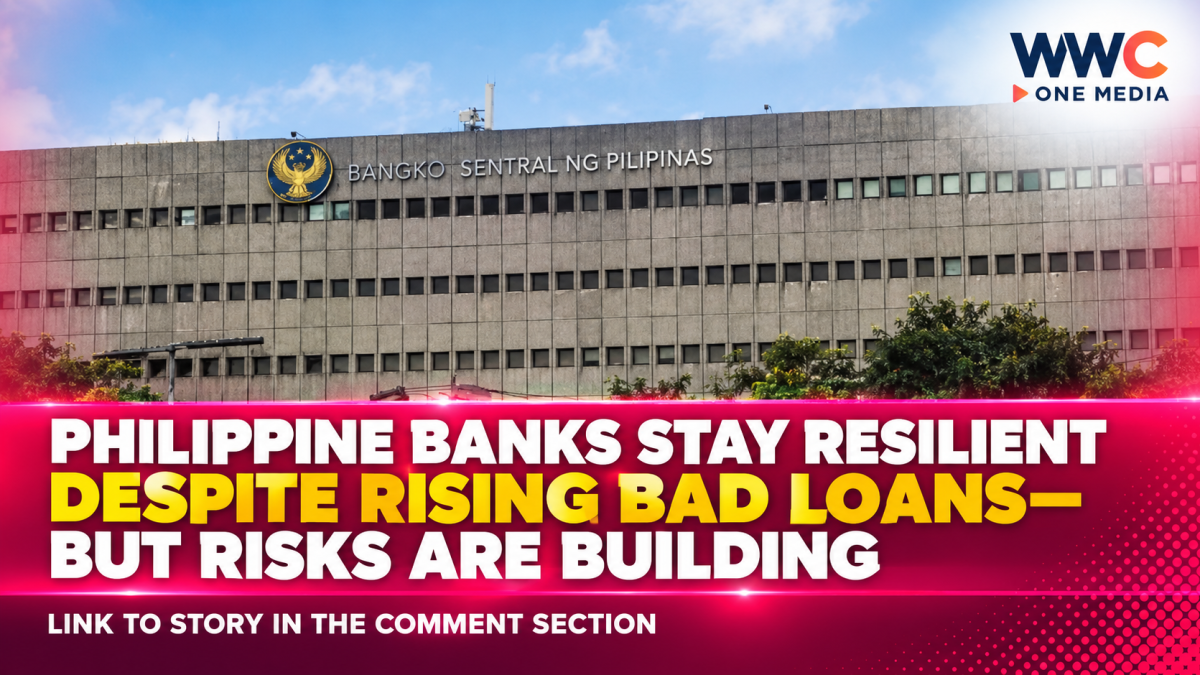
Philippine banks are continuing to show resilience despite an increase in non-performing loans (NPLs), with strong capital positions, loan-loss provisions and coverage ratios helping lenders absorb rising credit risks.
Maybank Investment Banking Group said the banking sector remains resilient as banks maintain high loss buffers, while elevated interest rates have also supported profitability. Maybank Securities Philippines Head of Research Kervin Laurence Sisayan said provisions booked by banks in the second quarter were largely pre-emptive, suggesting lenders have been preparing for potential deterioration in credit quality rather than responding only after losses emerge.
The latest Bangko Sentral ng Pilipinas (BSP) data show that the industry’s gross NPL ratio increased to 3.35% in July from 3.29% in June. Gross bad loans reached ₱585.08 billion during the month, up from the previous month but still below the 3.40% NPL ratio recorded in July 2025.
The increase points to continuing pressure on some households and businesses following a prolonged period of elevated borrowing costs and inflation. Analysts have noted that economic recovery has not been uniform across sectors, leaving some borrowers with weaker repayment capacity.
Still, the rise in bad loans has not so far translated into evidence of a broad-based banking crisis. Philippine banks remain well-capitalized and adequately provisioned, with the overall NPL ratio still considered manageable by historical standards.
The distinction between the peso value of bad loans and the NPL ratio is also important. The banking sector’s loan portfolio has continued to expand, meaning that an increase in the absolute amount of problem loans does not automatically indicate a proportional deterioration in overall asset quality.
Earlier BSP data showed that the banking system’s NPL ratio had eased to 3.29% in June, while the NPL coverage ratio—the amount of provisions available to absorb potential losses—rose to 92.53%. That compared with an 88.92% coverage ratio in May.
Risk assessments from S&P Global Ratings similarly point to resilience, although they highlight areas that warrant closer monitoring. In a September stress-test analysis, S&P said weaker credit growth and higher inflation could push weak-loan ratios significantly higher under adverse conditions. At the same time, it found Philippine banks relatively protected by strong profitability and capitalization, particularly among the larger institutions.
S&P also identified unsecured lending as an area of potential vulnerability, with some midsized banks more exposed to riskier loan segments than the largest lenders. The assessment suggests that the banking system’s current buffers provide protection, but individual institutions could face different levels of pressure if economic conditions deteriorate.
For borrowers, the direction of interest rates and inflation will remain critical. Lower borrowing costs could improve debt-servicing capacity and reduce pressure on households and businesses, while stronger economic growth would provide additional support for loan repayment.
The BSP has also reported broadly stable lending conditions. Its third-quarter 2026 survey found that most banks expected to maintain their credit standards for businesses, although lenders continued to cite economic uncertainty, reduced risk tolerance and deteriorating borrower profiles as reasons for potentially tightening standards.
The banking sector therefore enters the latter part of 2026 with a mixed picture: bad loans are rising in peso terms and some borrowers remain under pressure, but capital and provisioning buffers continue to provide protection.
The bigger question now is whether rising bad loans remain a manageable part of the normal credit cycle—or become a larger warning sign if inflation, borrowing costs and economic growth remain under pressure.