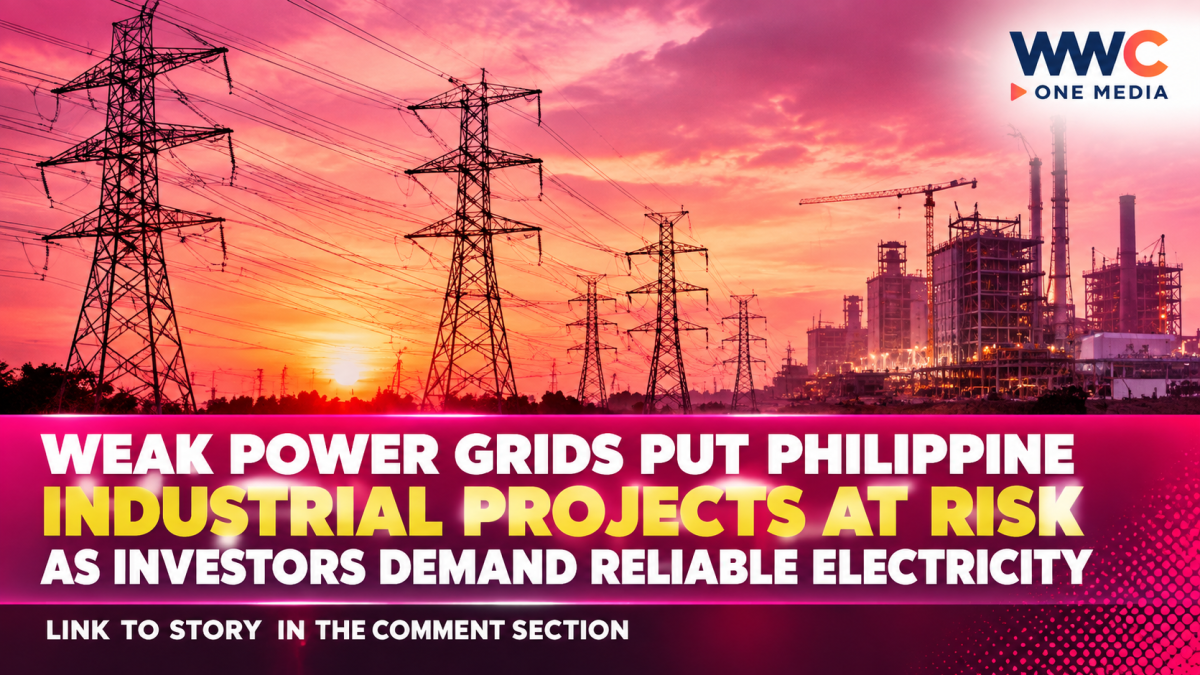
MANILA — Philippine industrial hubs with limited electricity capacity could lose major investments to competing locations as reliable and affordable power becomes an increasingly important factor in corporate site selection.
Property consultancy Savills Philippines warned that industrial estates unable to provide dependable electricity may struggle to attract manufacturers, logistics operators and other high-demand businesses, particularly as companies increasingly rely on automation, cold storage and technology-intensive operations.
Miguel Leonardo of Savills Philippines Research said power availability is becoming a decisive consideration for companies choosing where to establish operations. Traditional advantages such as land availability, transport connectivity and investment incentives are now offered by several competing provinces, making electricity supply a more important differentiator.
The concern goes beyond whether an industrial park has access to the grid. Companies are increasingly looking at whether sufficient generation and transmission capacity will be available when new projects come online, and whether the power supply can remain stable throughout operations.
This is particularly critical for semiconductor manufacturers, electronics producers and data centers, whose facilities require continuous and high-load electricity. Even short interruptions can disrupt production and create costly operational problems.
Savills said some companies are therefore favoring industrial estates with dedicated substations, on-site generation and access to stable baseload power sources, including geothermal energy. For these businesses, reliability can be as important as the price of electricity.
Power costs are also becoming a competitive issue. Savills said grid electricity rates in the Philippines had increased by around 17% to 18% year on year by mid-2026 and were the highest among Southeast Asian markets it tracked. Higher electricity costs can directly squeeze manufacturers’ margins, while unreliable supply can result in production interruptions.
The pressure comes as companies reassess their total operating costs before committing to new industrial locations. If two areas offer comparable land, infrastructure and incentives, the location capable of providing more dependable electricity could have an advantage in attracting new projects.
Renewable energy is emerging as one potential way for industrial parks and large power users to manage those risks. Savills noted that industrial parks participating in the Green Energy Option Program have reported power-cost reductions of about 30% to 40% for their locators. Large electricity consumers can also pursue long-term power supply agreements with renewable energy producers.
Lower electricity expenses could help offset higher rents or other occupancy costs, giving industrial estates with more diversified power strategies another potential advantage when competing for locators.
The electricity challenge also comes as warehouse development is slowing. Savills expects about 152,000 square meters of new warehouse space to be completed in 2026, sharply below the roughly 450,000 square meters delivered in 2025. Higher construction-material costs and broader economic headwinds have contributed to the smaller development pipeline.
South Luzon remains the Philippines’ dominant industrial corridor, with Cavite, Laguna and Batangas accounting for about 72% of the country’s warehouse supply, according to Savills. At the same time, logistics demand is expected to remain supported by e-commerce growth and the continued expansion of fulfillment operations closer to consumers.
That could eventually create more opportunities for industrial hubs outside the traditional centers, including regional locations in the Visayas and Mindanao. But those areas will also need sufficient electricity infrastructure if they want to compete for power-intensive investments.
The issue highlights a broader challenge for the Philippines: attracting factories, logistics facilities and technology investments requires more than available land and tax incentives. Power generation, transmission infrastructure, reliability and cost increasingly form part of the investment equation.
As companies plan larger and more electricity-dependent facilities, the industrial estates that cannot keep pace with power requirements could find themselves competing for projects against locations that can guarantee supply.
The bigger question is whether the Philippines can expand and modernize its power infrastructure quickly enough—or whether electricity constraints will become the next major obstacle to the country’s industrial investment ambitions.