
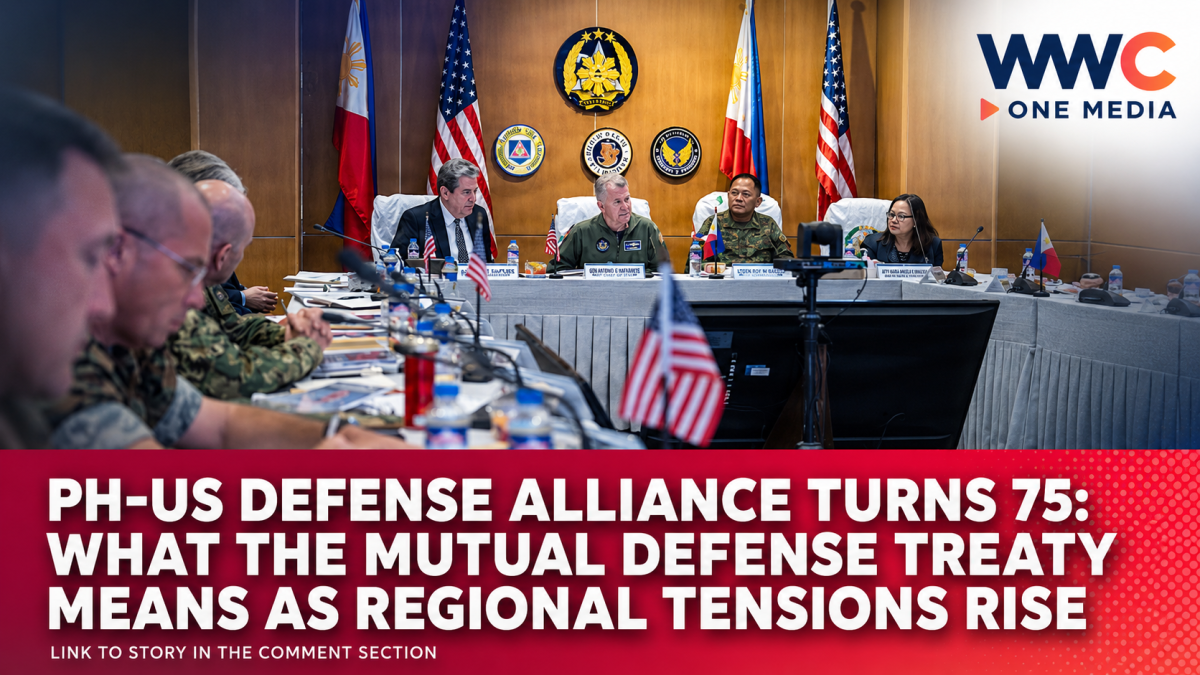
MANILA, Philippines — The Armed Forces of the Philippines (AFP) has reaffirmed its commitment to the country’s longstanding defense alliance with the United States as the historic Mutual Defense Treaty (MDT) marks its 75th anniversary on Sunday, August 30.
Signed in 1951, the Philippines-US Mutual Defense Treaty remains the foundation of the two nations’ military and security partnership, committing both allies to support one another in the event of an armed attack under the conditions outlined in the agreement.
The anniversary comes at a critical time for regional security, with the Philippines strengthening its defense posture and expanding military cooperation with allies and partners amid continuing challenges in the Indo-Pacific.
A Defense Alliance Built Over 75 Years
The AFP said the milestone highlights the enduring importance of the alliance between Manila and Washington, which has evolved over decades through military exercises, defense engagements, humanitarian operations and efforts to improve the interoperability of both armed forces.
Earlier this month, AFP Chief of Staff Gen. Antonio G. Nafarrete and U.S. Pacific Command chief Adm. Samuel J. Paparo co-chaired the annual Mutual Defense Board-Security Engagement Board meeting at Camp Aguinaldo.
During the meeting, the two military leaders signed an “8-Star” memorandum that approved guidance and activities for continued defense cooperation. Officials also approved future joint engagements aimed at strengthening military readiness in areas including maritime security, humanitarian assistance and disaster response.
The latest defense planning follows Balikatan 2026, described by U.S. Pacific Command as the largest and most expansive edition of the annual Philippine-US military exercise to date. The 19-day drills, held from April 20 to May 8, brought together about 17,000 personnel from the Philippines, the United States and partner nations, reflecting the growing multinational dimension of regional security cooperation.
Why the Mutual Defense Treaty Still Matters
For 75 years, the MDT has served as a central pillar of Philippine-US security relations. While the treaty was signed in a very different geopolitical era, its relevance has continued to be tested by evolving security challenges in the region.
The United States and the Philippines have repeatedly emphasized their commitment to strengthening cooperation and interoperability, while Philippine defense officials have continued to pursue the modernization of the country’s armed forces and closer coordination with security partners.
The AFP’s reaffirmation of the alliance underscores that the treaty is not simply a historical agreement. Its significance today is reflected in continuing joint exercises, defense planning and military engagements designed to improve the ability of allied forces to respond to a range of contingencies.
Looking Ahead: An Alliance Entering a New Chapter
As the Philippines and the United States commemorate the MDT’s 75th year, attention is increasingly focused on how the alliance will adapt to modern security challenges.
Recent defense engagements have expanded beyond traditional bilateral activities, with partners such as Australia, Japan, Canada, France and New Zealand participating in major exercises and regional security initiatives. This growing cooperation highlights the broader effort to strengthen preparedness and stability across the Indo-Pacific.
For Manila and Washington, the anniversary is both a moment to look back on a seven-decade partnership and an opportunity to define what comes next.
Seventy-five years after the treaty was signed, one question now stands out: How will one of Asia’s oldest defense alliances evolve in an increasingly complex and unpredictable region?



Leave a Reply