
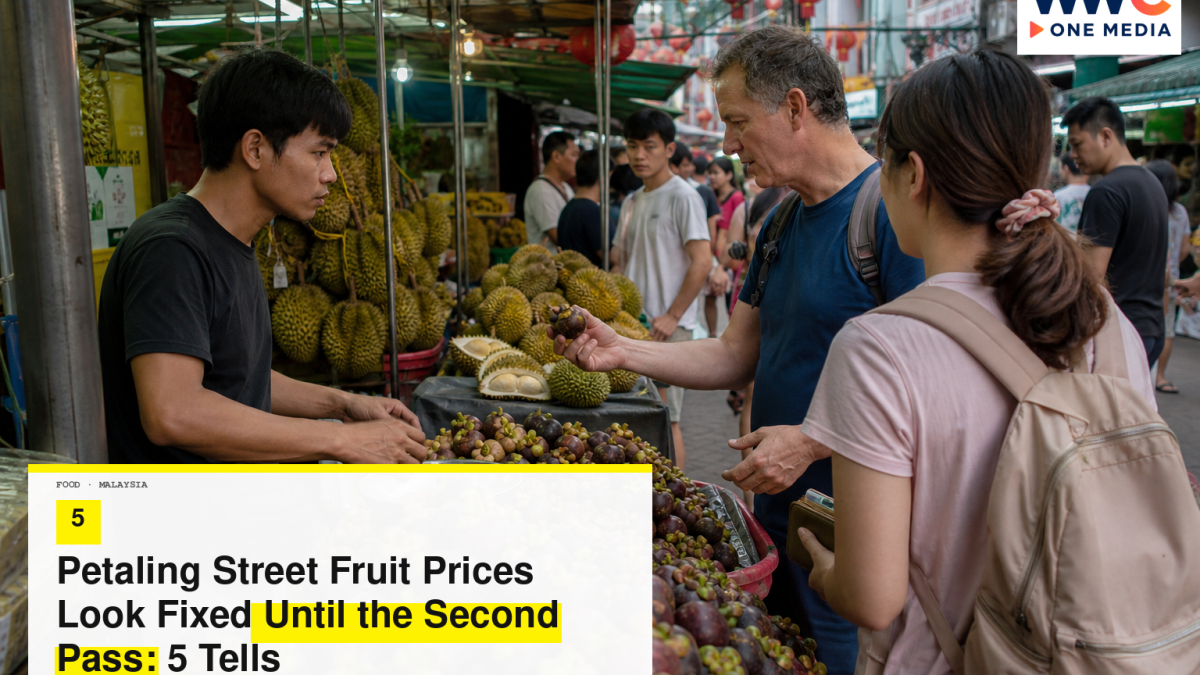
KUALA LUMPUR, Malaysia — Petaling Street fruit prices look fixed until the second pass. That is the whole trick, and it is not a trick so much as a street that has two jobs. The first job is the display: Jalan Petaling under the covered stretch of KL’s Chinatown, the boards, the pyramids of mango and durian energy, the uncle who quotes a number before you have put your bag down, the tourist who pays because the number sounded like a fact. The second job is the market: the same fruit, ten metres on, a stall still selling to people who came from Pasar Seni or Maharajalela on the way to Kota Raya, a second pass after you have seen the same rambutan three times, a willingness to walk, and a rain that rearranges everything because wet fruit and wet tarpaulin are a different clock.
This is not a list of official stall rankings. Chinatown KL does not owe you a league table. Petaling Street is a strip that still sells clothes, souvenirs, and fruit to people who live here and people who are only here until the next Grab to Bukit Bintang. The five tells below are how fruit prices that look carved into a board start moving once you stop treating the first quote as a municipal rate. No ringgit figures as “the market price.” Prices move with season, rain, how ripe the fruit already is, how many boxes are left, and whether you look like you will buy a bag or a photograph.
Walk from the Pasar Seni side or from Jalan Sultan. Do not arrive hungry for a bargain as a personality. Arrive with a bag that can take juice, shoes that can take a slick floor, and a plan to eat or fridge the fruit the same day. KL heat does not store a show mango for you. The second pass is not a hack from a forum. It is how households already shop a street that performs for cameras and still feeds dinners in nearby flats.
1. The first quote is a greeting: Petaling Street fruit prices look fixed until the second pass starts with your feet
The first stall is a greeting. The number you hear is not a gazette. It is an opening, a test of whether you will nod, a way to see if you are buying one showy mango or a bag for a family table in Pudu. If you stop at the first pyramid because it is the first pyramid, you have paid for geography. Jalan Petaling is long enough, even in the tourist core, that the same fruit appears again. Walk it once without buying. See the mango, the durian (if it is that season and you actually want it), the watermelon, the grapes that travelled, the local fruit that is actually moving.
A tell: the stall that quotes before you ask, loud enough for the walkway. That stall is working the first pass. The stall that is weighing for someone with a trolley bag and a shopping list is working the second job. You can still buy from a loud stall. You should not buy because it was loud. Keep walking toward Jalan Tun H.S. Lee, toward the edges where the street is still a street, and then walk back. The second pass is when you already know who had the ripe papaya and who had the hard one painted as ripe by confidence.
What not to do: argue the first quote as if you were in a movie. You are not in a movie. You are in Chinatown on a hot morning or a late afternoon when the light makes fruit look better than it is. Smile, say you are looking, and move. If they call a better number at your back, you now have information. If they do not, you still have the rest of Petaling Street. Fixed is a look. Feet are the correction.
Carry nothing yet except water. Hands free. The first pass is eyes. The second pass is a bag. People who buy on the first stall because they are tired from Central Market have already spent the discount they think they are about to win.
2. Piece prices are theatre; weight is how a household buys fruit
One mango for a number that sounds like a souvenir is theatre. Two kilos of something you will eat is a market. Ask for a price on a bag, a kilo, a weight you can name, not on the single fruit at the front that was chosen to be the face of the stall. Sellers know the front fruit is the ambassador. The fruit behind it is often the same season and a more honest shape. You are allowed to point at the box, not the pyramid.
This tell has nothing to do with a fake RM board we would invent for you. It has to do with units. Piece prices exist to make the conversation small and the margin large. Weight makes the conversation a bag. If you only want one pineapple for a hotel room near Pudu, say one pineapple and pick it. If you want fruit for a few days in a short-stay in Bukit Bintang, buy what you will eat before it ferments in a mini-bar fridge. Hotel aircon is not a wet market. Overbuying is how Petaling Street becomes a smell in a backpack.
Watch the scale. Watch it zero. Watch the bag. This is ordinary. It is not an accusation. If the stall does not like being watched, you do not like the stall. There is another stall. KL Chinatown is not a monopoly. Grapes and imported apples have a different logic from local papaya and pineapple; they travelled, they sit, they are still a weight conversation if you are buying more than a snack.
Durian is its own weather. If you do not already know how you buy durian in KL, do not learn as a stunt on Jalan Petaling with a camera crew you do not have. Buy from a stall that is opening fruit for people who are eating, not only posing. If you do not eat durian, skip the show. The street will still be a street.
3. Who is buying: aunties with bags vs phones with the fruit in the frame
A stall serving people with other errands — Kota Raya, a bus, a flat toward Petaling Jaya they still call “going back,” a shopkeeper ducking out for fruit — is a different tell from a stall serving a line of phones. Phones are allowed. Fruit is photogenic. Petaling Street has been a postcard for a long time. The tell is whether the stall can do both jobs or only the postcard.
Stand aside and watch two transactions. If the seller’s hands are still in the same rhythm for the household and for you, you are in a market. If the rhythm changes when the camera comes up — bigger smile, bigger fruit, bigger number — you are in a show. You can still buy a small bag from a show if you like the fruit. You should not confuse the show with a price that “looks fixed” as if the city had printed it.
Locals are not a magic badge. Plenty of KL people overpay because they are in a hurry between Pasar Seni LRT and a meeting they already hate. Hurry is a price. The second pass is the opposite of hurry. If you only have ten minutes, buy a piece you pick, pay, leave. Do not perform a negotiation you do not have time to finish. The five tells include knowing when you are not in the market clock.
Language: Bahasa, Cantonese, English, a mix. Use what you have. Polite and clear beats a script you found that treats every uncle as a boss fight. Petaling Street fruit prices move more for a person who will actually take the bag than for a person who wants a story about winning. Winning is fruit you eat. A quote you brag about in a group chat is not lunch.
4. Rain is a clock: afternoon tarps, wet floors, and fruit that wants to leave
KL rain does not care about your itinerary. When it hits Petaling Street, tarps come down, floors go slick, and fruit that was already ripe becomes a problem the stall would rather not store overnight. That is a tell, not a guarantee of a number we will not invent. Rain can mean a better conversation on the second pass because boxes need to move. Rain can also mean you should not be picking through grapes with wet hands while someone is trying to keep a wire from dropping into a puddle.
If the sky is already iron toward the Klang River side, do the first pass faster, step under cover, and buy on the second pass before the street becomes a river of shoes. Afternoon rain is common enough that regulars already shop earlier. Tourists shop when the light is nice. The light is nice when the fruit has been out. Morning is for households. Late afternoon is for leftover boxes and people who came from a mall.
Wet fruit bruises. Watermelon on a wet tile is how you drop a day’s plan. Wear shoes with grip. Do not run for a Grab pin in the middle of Jalan Petaling while holding pineapple. Wait. The rain in KL often moves. The fruit will still be there in twenty minutes, or it will have been sold to someone who waited under the same tarp without making it a content moment.
Heat after rain is a steamer. Get the fruit into aircon or into a mouth. Papaya does not want a bus tour of Bukit Bintang after a downpour. If you are heading to a hotel, go. If you are heading to a friend’s flat in Cheras, go. The second pass is not an excuse to loiter until the fruit pays for your indecision.
5. The step away is the negotiation; the second pass is when you take it
Be willing to leave. That sentence is the fifth tell and the one that makes the other four work. Petaling Street fruit prices look fixed until the second pass because the stall has to believe you have somewhere else to put your feet. Walk toward the next pyramid. Pause at a drinks stall. Look at the clothes you will not buy. If they call you back, you have a conversation. If they do not, the next stall has mango too. Either outcome is fine. The worst outcome is standing in front of the first board performing disappointment so the seller can perform generosity.
On the second pass, buy. You have seen the street. You know which papaya was actually ripe, which stall was selling to bags instead of cameras, whether rain is coming, and what a weight conversation sounds like. Pick the fruit. Watch the scale. Pay. Move. Do not add a second bag because you felt you “won.” Winning twice is how you carry fermenting rambutan onto the LRT at Pasar Seni.
If you are with someone who hates bargaining, split the jobs: one person walks the first pass and remembers, the other person holds the cash and the line. Do not bargain as a couple’s sport in the middle of the walkway. Chinatown is already narrow when the tour groups hit. Be a person with a bag, not a blockade.
Night on Petaling Street is a different market. Lights make fruit glow. Glow is not ripeness. If you buy at night, the second pass still applies, and so does the rain tell if a storm is sitting on the city. Eat more of it the same night. Hotel rooms and night fruit are a short marriage.
How to walk KL Chinatown like fruit is lunch, not a dare
Start at Pasar Seni or Maharajalela. Decide whether this is a fruit trip or a “we are in Chinatown” trip. If it is both, do fruit first, souvenirs never, clothes only if you already knew the size. Central Market is adjacent and will eat an hour. Jalan Petaling will eat another. You do not need both plus a mall. Heat is the tax KL charges on indecision.
Bring small notes. Cards and e-wallets exist in this city; stalls vary. Fumbling a payment after a weight conversation is how the conversation cools. A tote that can take a wet bag inside a dry bag is useful. Juice travels.
Do not ask us for a best stall. There is no official ranking here, and a newspaper that invents one is doing tourism, not a newsdesk. Your tell is the five above, used on the day you are standing there. Season changes. A good mango week is not a law.
If you live in KL, Petaling Street is optional. Wet markets and morning pasar nearer your house will beat a Chinatown fruit run for weekly cooking. This strip is what it is: a place where fruit prices look fixed until you walk it twice. Visitors treat it as the market. Locals treat it as one option on a day they already had a reason to be in the old city.
What not to turn into folklore
Do not invent a standard ringgit per kilo and call it Petaling Street. Do not repeat a blog’s “secret price” as if the street had a back room. Do not shame a seller in English for a crowd. Do not touch every fruit with the same hand you used on a railing. Point, ask, pick a few, buy.
Do not buy a mountain for a social post and leave it in a bin. That is not a flex. It is fruit that someone grew. Buy what you will eat. Give extra to the people you are staying with if they want it. Durian in a hotel corridor is how you meet a manager. Know the house rules.
Bargaining is not a personality. Some stalls have less room than the performance suggests, especially on imported fruit. If the number does not move, you still have feet. The second pass includes the right to pay the number if the fruit is the fruit you want. Paying is allowed. Performing a fight for RM that will not change your month is optional and often ugly.
If it is Saturday and the tour groups have already arrived
Saturday on Jalan Petaling is denser. The first pass takes longer. The second pass still works if you keep to the edges and buy before the mid-afternoon lull-and-storm. Go earlier. Eat something that is not only fruit so you do not buy a bag because your blood sugar made the pyramid look like fate.
If you hate crowds, this is not your fruit room. Go to a neighbourhood pasar, a supermarket for the one apple you will eat, a stall on a side street off Jalan Sultan that is still doing household work. Petaling Street is famous because it is famous. Fame is a crowd. The five tells are how you stay a shopper inside the crowd.
Weekdays after morning rush can be kinder. Evenings are theatre. Pick the clock that matches whether you want fruit or a story. The newsdesk position is fruit.
After you buy: hotel fridge, Grab, and the fruit that does not travel
The second pass ends when the bag is closed. What you do next is how Petaling Street fruit stays food. If you are walking to a hotel toward Pudu or Bukit Bintang, go there before you add Central Market, a tea, and a detour into Kota Raya for a shirt. Heat plus time is how a good papaya becomes a bag of syrup. If you are meeting a Grab on Jalan Tun Tan Cheng Lock or near Pasar Seni, stand where the driver can actually stop. Do not make a driver idle in the tourist crawl while you buy a second watermelon you will not lift into the boot.
Hotel mini-fridges are small and aggressive. They also smell like everything else in the room. Put fruit in a bag, not loose on top of a shirt. Eat the ripest piece the same afternoon. Save the firmer pineapple for tomorrow if tomorrow exists. If you are on a night bus or a flight, do not board with durian or a leaking watermelon. Other people did not buy your second pass.
Households in nearby flats already know this: wash, cut, plate, share. Visitors forget that fruit is a meal component, not a trophy. Slice the pineapple. Eat it with a cheap bun from a kopitiam if you are hungry. That is lunch. That is allowed. You do not owe Jalan Petaling a picnic aesthetic on a dirty kerb if the kerb is a crowd.
If a piece was wrong — hollow watermelon, mango that was only orange on the cheek — you learned a tell for next time. You do not need a scene. You need a knife and a memory of which stall rushed you. The five tells include going back another day only if you will be in Chinatown anyway. Do not cross the city for revenge fruit.
Bottom line
Petaling Street fruit prices look fixed until the second pass. Use five tells: the first quote is a greeting so walk before you buy, piece prices are theatre and weight is lunch, watch who is actually buying, treat rain as a clock that moves ripe boxes, and step away so the second pass is a choice. No fake RM boards, no official stall ranking, no souvenir mountain you will not eat. Jalan Petaling, Pasar Seni, Kota Raya, a bag, feet. KL Chinatown will still perform. Your ringgit does not have to applaud the first pyramid.




Leave a Reply