
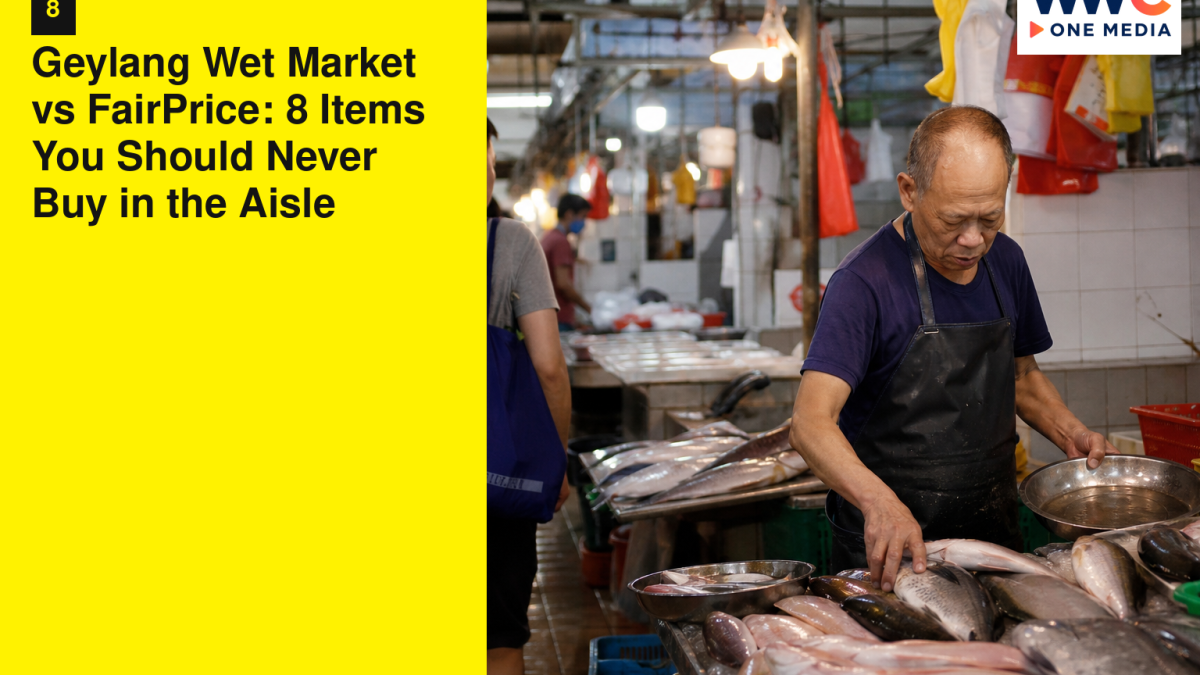
SINGAPORE — Geylang Wet Market vs FairPrice is not a loyalty test. It is a map of two rooms that sell food for different reasons. The wet market at Geylang Serai, the stalls that still open while Aljunied is yawning, the ice that is actually ice and not a supermarket fog — that room is for living food you will cook tonight. The FairPrice aisle, whether you walk it in a neighbourhood store off Paya Lebar, a bigger Xtra with a car park, or the kind of Finest that smells like imported cheese, is a chain type built for shelf life, labels, and 9 p.m. when the market has already hosed down. The eight items you should never buy in the aisle are not a dunk on the supermarket. They are the plants and proteins that die under fluorescent light, wait in foam, or cost you a worse version of something Geylang still turns over before lunch.
This is not a review score. FairPrice is the default supermarket many households already use for milk, paper, frozen peas, canned tomatoes, and the cleaning aisle. Geylang is not “more authentic” as a personality. It is closer to the morning, closer to the knife, closer to the auntie who will tell you the chye sim is from yesterday if you look like you might believe her. Take the East-West line to Aljunied or Paya Lebar. Walk toward Geylang Serai Market, or the wet-market pockets along the Geylang Road lorongs if that is your Saturday. Bring bags that can take ice melt. Do not bring a plan to photograph every stall as if the fish asked to be content.
The week goes wrong when you reverse the rooms. You buy sad herbs in a plastic box at 8 p.m. because the market felt like a project. You buy a giant sack of something heavy at Geylang and then remember the bus. You treat the aisle as a wet market and the wet market as a souvenir. The eight items below are the ones that belong in Geylang if you can get there while the floor is still wet. FairPrice still wins the rest of the trolley. Use both. That is the whole story, told slowly, because Singapore groceries punish people who want one building to be every building.
1. Leafy greens: the first item Geylang Wet Market vs FairPrice should never leave in the aisle
Chye sim, xiao bai cai, kangkong, kai lan, spinach that still looks like a plant — these are the first things the FairPrice chiller apologises for. The supermarket is not evil. It is a cold room with a schedule. Leaves sit in bags, drip, yellow at the stem, and wait for you to decide you will cook on Thursday. By Thursday they are a science experiment. Geylang wet market greens are a same-morning product if you arrive like a household instead of a tourist. You see the bunch, you see the cut, you see whether the stall is restocking or just misting what has already given up.
Walk the vegetable row once. The stall that is still cutting and tying is the stall. The stall that has a pyramid for the camera is a pyramid. Buy what you will wash tonight. Two or three bunches, not a week of optimism. Singapore heat does not care about your meal-prep personality. If you live in a walk-up near Joo Chiat or a flat toward Eunos, get the greens home, soak, spin or towel, and cook or bag them the same day. The aisle version looks convenient because it is already bagged. Convenience that wilts is not convenience. It is a bag of water and regret next to the eggs.
What not to do: buy the pre-washed salad mix as a moral substitute for kangkong. If you want a salad, buy a salad, eat it that night, and stop pretending it is the same plant as the bunch the market still has dirt on. Dirt washes. Limp does not reverse. If you only have a FairPrice after work, you can still buy greens — pick the bag with the latest date and cook that night — but do not make the aisle your greens room if Geylang is on the Saturday route. The first of the eight items you should never buy in the aisle is the leaf that still remembers the farm when the market has it, and remembers the fluorescent tube when the supermarket has kept it.
Kangkong especially hates the wait. It goes from crisp hollow stem to tired rope. Kai lan stems go woody. Xiao bai cai yellows at the heart. You can see all of this under market light. You can miss all of this in a fogged bag. That is not a statistic. It is what the vegetable does in this climate. Geylang is built for that climate. The aisle is built for a trolley.
2. Fresh herbs you will cook tonight, not a plastic coffin of coriander
Coriander, mint, laksa leaf, curry leaf, Thai basil, spring onion that still has a white root — the FairPrice herb box is a small funeral. The lid looks tidy. The leaves look like they travelled. Sometimes they are fine for one night. Often they are already slime at the stems, or so dry they taste like the plastic. Geylang sells herbs as bunches you will actually use in a pot of soup, a sambal, a bowl of laksa you are making because you live here, not because a reel told you to.
Buy a bunch you can name a dish for. If you cannot name the dish, you will put the herbs in the fridge door and find them next week. Market herbs are cheaper in the only sense that matters: you use them. Aisle herbs are a tax on the idea of cooking. The box exists so you can feel like a person who cooks without walking into a wet market. FairPrice as a chain type is allowed to sell that feeling. You are allowed to walk past it if Geylang is open.
Laksa leaf and daun kesum go black fast. Curry leaf wants to be fried in oil the day you buy it, or frozen in a bag you will actually open. Mint in a supermarket box often tastes like a hotel garnish. Market mint still smells like mint when you bruise it. Spring onion from the market can go into porridge, noodles, steamed fish, egg. Spring onion from the aisle can go into the same dishes if it is firm. Check. Do not buy the one that has gone slimy in the bag because it was on the list.
Carry herbs in a separate bag from the fish. Ice melt and coriander are not friends. If you are taking the MRT from Aljunied, keep the herbs up, not under the chicken. This is not romance. This is how the bunch survives the ride toward Paya Lebar or the bus down Geylang Road.
3. Tofu, tau kwa, and the soy that should not live in a long-life brick if you have a market
Soft tofu, firm tau kwa, tau kee, fried tau pok you will stuff or braise — Geylang still sells these as a morning product from stalls that know you will cook them today or tomorrow. The FairPrice aisle version includes refrigerated tubs that can be fine, and also the long-life boxes that taste like the box. If you are making mapo tofu on a Tuesday at 10 p.m., the supermarket tub is the right tool. If you are shopping Saturday morning and you want tofu that still tastes like soy, do not default to the aisle because the tub has a cartoon.
Press tau kwa if you are frying. Buy what you will finish. Tofu is not a souvenir. The market stall will sometimes have a queue of households, which is a better tell than a stack of identical boxes under a supermarket light. Smell. Look at the water. If the water is cloudy and the stall looks like it has been sitting since yesterday’s last hour, walk. Geylang is a set of stalls, not a brand with one quality. You still have to look.
What the aisle is for: silken tofu you want for a late supper when the market is closed, and the boxed stuff for an emergency. What the aisle is not for: stocking a week of tofu because it looked protein-coded. You will forget the second tub. It will sour. You will blame tofu. Blame the plan.
If you live alone in a small unit toward Kallang or a room near Joo Chiat, buy less. The market will still be there next Saturday. The fridge will not make the extra tau kwa younger.
4. Whole fish and prawns: never the foam tray if Geylang still has ice
The supermarket seafood case is a compromise for people who need fish at 9 p.m. Eyes, gills, smell, ice — you can still use those checks in FairPrice. You should. But if you are doing Geylang Wet Market vs FairPrice as a Saturday habit, whole fish and prawns belong at the market stall that is still selling to people who will cook lunch, not at the foam tray that has been photogenic since noon. Ice should be ice. The fish should look like it might have been swimming on a timetable that is not theoretical.
Name the fish you know how to cook. Pomfret, batang, red snapper, tilapia, the fish your household already knows how to steam with ginger and soy. Do not buy a show fish because it is large. You have to carry it. You have to clean it, or pay to have it cleaned, and then you have to cook it before the smell becomes the room. Prawns: shells should be firm, heads not blackening into a warning. If you only want a few for noodles, buy a few. Market uncles will sell you a small bag. The aisle sells you a tray sized for a party you are not throwing.
Ask for cleaning if you do not want scales in a HDB sink. That is a normal market sentence. It is not a tourist stunt. Then bag it twice. Ice melt on the MRT is how you become a story other commuters tell. Walk toward Aljunied with the fish low and separate. Get home. Cook or freeze the same day. Frozen at home after a market buy is still a market buy. Frozen in the supermarket aisle as your only seafood personality is a different dinner, and sometimes that dinner is fine. It is not this item.
Do not buy the pre-cut “fresh” cubes that have been sitting in a tray of juice. That juice is the fish leaving. Geylang will cut you a steak from a fish you saw. That is the difference. Not a ranking. A knife in front of you.
5. Chicken you will cook, not a tray that has been waiting under a light
Fresh chicken — whole bird, thigh, drumstick, the bones you want for soup — turns over faster in a wet market that sells to households before lunch than in a supermarket meat case that has to look full at 8 p.m. FairPrice chicken is labelled, dated, and useful when you need a tray after work. That is a chain-type strength. It is not a reason to skip Geylang when you are already there for greens and fish.
Look at the colour, the smell, the way the stall is chopping for people with lists, not for a display. Buy what fits the pot you actually own. A whole bird is a commitment. Thighs you will braise tonight are a plan. Wings for one air-fryer evening are a plan. The aisle will sell you a family tray because the family tray is the unit. You do not have to be a family. You have to be a person who will cook chicken before it becomes a science project.
Offal and feet and bones for soup: market, if you eat them. The supermarket may stock some of this. The market is where those parts still look like they belong to a bird that was recently a bird. If you do not eat offal, do not buy it because Geylang “feels real.” Real is what you will cook. Leave the rest for the next stall’s regulars.
Skin-on pieces dry out in a bad case. They also pick up the smell of everything else in a bad bag. Keep chicken away from herbs and from the pineapple you should not have bought cut. Get it into a fridge. If your Saturday continues into Joo Chiat for lunch, do the market last on the way home, or take the chicken home first. A walk with chicken in the sun is not a flex.
6. Fruit that is still a fruit, not a chilled sculpture
Pineapple, papaya, banana, watermelon, the fruit that Geylang and the surrounding stalls still sell by the piece and by the season you can see — this is the item the FairPrice aisle most likes to turn into a plastic box of cubes. Pre-cut fruit in a supermarket is a tool for an office fridge and a kid’s snack. It is not how you buy pineapple if you are already in a wet market. Cut fruit weeps, ferments, and costs you the skin and the smell that told you it was good.
Buy whole. Smell the pineapple at the base. Papaya should yield a little, not collapse. Bananas in Singapore are a clock; buy the stage you will eat, not a green bunch you will ignore until they are a fly problem. Watermelon is heavy. If you are on the bus, buy a slice the stall cuts now, eat it, and do not perform a whole melon on the MRT. Geylang is allowed to sell you a slice. The aisle is allowed to sell you one apple you will actually eat at a desk. Those are different jobs.
Show fruit — the giant display, the pyramid, the fruit that exists to be photographed on Geylang Road — is a tax if you do not have a table and a knife and a plan. Market fruit for households is often uglier and better. Aisle fruit is often prettier and older. Imported berries in a FairPrice Finest chiller are a treat with a label. They are not a wet-market product. Do not compare them as if Geylang failed to be Japan. Geylang is Geylang. Buy the local fruit that is moving. Leave the berries for the chain if you want berries.
If it rains, fruit stalls still sell. Ice and rain both make floors lethal. Wear shoes you do not love. That is not a style note. That is Geylang Serai on a wet Saturday.
7. Dried shrimp, ikan bilis, spices, and the sack goods the aisle turns into dusty jars
Ikan bilis, dried shrimp, dried chilli, white pepper, candlenut, the spices you actually cook with in a Singapore kitchen — FairPrice will sell you a small plastic bottle that has been on the spice aisle since a previous festival. Sometimes the date is fine. Often the aroma is a rumour. Geylang and the dry-goods stalls around a wet market still sell these by weight, from sacks or bins you can smell. Smell is the whole test. If the dried shrimp still smell like the sea and not like dust, buy a small bag. You do not need a year of belacan energy in a HDB cupboard. You need this month’s cooking.
This is one of the eight items you should never buy in the aisle on autopilot. The aisle is where spices go to become decoration. A wet-market dry stall is where they still get used by people who will make sambal this week. Buy small. Label nothing with a fantasy. If you do not make nasi lemak, you do not need a kilogram of anything. If you do, you already know which stall you trust, and you do not need a newspaper to invent a ranking.
FairPrice still wins when you need a sealed bottle of something you use twice a year, a reliable salt, a vinegar, a ketchup the kids will actually eat. That is a chain-type job: sealed, labelled, still there at 10 p.m. Dried shrimp is not ketchup. Do not shop them with the same brain.
Watch for stalls that will mix a little extra dust into a bag because you did not look. Look. That is the market. It is not a scam documentary. It is a bag you should see filled.
8. Eggs: buy the queue that looks like households, not the brightest carton in the aisle
Eggs can be fine at FairPrice. They are dated, stacked, and easy. They are also a product that sits. Geylang egg stalls that sell to households in the morning turn over in a way a quiet supermarket carton shelf does not always match. This is not a lab result. It is a queue. If the egg stall has people with other market bags, buying tens and trays, that stall is in the food system. If the FairPrice carton is the last sad one in a torn box, leave it.
Never buy eggs in the aisle as a trophy. Buy eggs as a number you will eat. A tray is heavy and breakable on the MRT. A ten is a week for two people who actually eat eggs. If you only want four for tomorrow’s nasi lemak leftover breakfast, buy four if the stall will sell four, or buy the ten and cook. Do not put a tray on top of the tomatoes.
The aisle trick is the “value” carton you did not plan. You came for milk and leave with thirty eggs and no plan for thirty eggs. Geylang makes you carry them, which is a natural limit. FairPrice puts them in a trolley, which is how eggs become a smell in the vegetable drawer.
If you need eggs at 9 p.m., the supermarket is the room. That is the point of a chain. If you are already at Geylang Wet Market vs FairPrice as a Saturday split, eggs are the eighth item to take from the market queue, not from the brightest carton under a promotional wobblersign.
What the FairPrice aisle is still for
UHT and fresh milk, toilet paper, detergent, frozen peas, frozen edamame, canned tomatoes, oil you do not want to carry dripping from a market, biscuits you should have put on a list, the medicine aisle, the stuff that should be boring. FairPrice as a chain type exists so a household can restock without a wet floor. Use it. The people who turn Geylang into a personality still buy bleach somewhere. They buy it at a supermarket.
Go with a list. The register will try to sell you chocolate. Geylang will try to sell you a second fruit. Lists are how Singapore groceries stay a map instead of a mood. Do the market first if the greens and fish are the point, then the supermarket for the shelf — or split the week: Geylang Saturday morning, FairPrice on a weeknight for milk and paper. Do not do both as a six-hour outing with a toddler unless that is the outing. Heat is a tax.
City Plaza, neighbourhood FairPrice stores toward Paya Lebar, the bigger stores you need a trolley for — they are the same chain type with different floorplates. None of them is a score. None of them replaces ice and a knife at Geylang Serai. None of them should be where you buy the eight living items if you have a choice in the morning.
How to do Geylang without turning it into a shoot
Arrive earlier than your brunch instinct. The market is a morning machine. Late morning is still possible. Afternoon is leftovers and a floor that has been through a thousand shoes. Bring bags, small notes, an EZ-Link that works, a plan for the bus or MRT that does not involve a giant watermelon and a whole chicken in one hand.
Do not block a stall with a phone. Do not ask a fishmonger to pose the pomfret. Do not treat the Malay, Chinese, and Indian stalls as a food tour caption. Buy, bag, move. If you want nasi campur or mee rebus after, eat after the perishable bags are in a fridge or at least in a shade-and-rush plan toward home. Aljunied station is not a kitchen.
Lorongs off Geylang Road are a different weather after dark. This piece is about the wet market hours. Do the market, leave, cook. The rest of Geylang is another map.
Rain: slow down. Tiles and wet vegetable matter are how people fall while holding eggs. There is no prize for speed.
The carry, the bus, and the 9 p.m. problem
If you cannot carry it home, you did not buy it. You rented a problem from Geylang. Rice sacks, giant melons, too much frozen anything that will thaw on the East-West line — skip. FairPrice delivery and a supermarket trolley exist for bulk and boring. The wet market exists for the eight items that hate the aisle.
9 p.m. is FairPrice’s hour. The market is not a moral failing because it closed. Cook the market food on Saturday and Sunday. Use the chain on Wednesday when you need milk and a tray of eggs because you miscounted. Geylang Wet Market vs FairPrice is a week, not a dare.
If you live far — Jurong, Woodlands, a parent’s flat that is not East — Geylang is a trip. Do not make it a weekly personality unless the trip already exists. Use a wet market closer to you for greens and fish. Use FairPrice for the aisle jobs. The eight items are about the aisle, not about forcing every household through Geylang Serai as a pilgrimage.
Bottom line
Geylang Wet Market vs FairPrice is two rooms. Never buy in the aisle the eight things that still belong on ice and a wet floor: leafy greens, herbs, tofu that is actually tofu, whole fish and prawns, chicken you will cook, fruit that is still whole, dried goods you can smell, eggs from a household queue. Leave milk, paper, frozen peas, cans, and late-night emergency trays to the supermarket chain. Lists, bags, morning hours, no foam-tray romance. Singapore will still sell you both. Cook tonight’s food from Geylang. Restock the shelf at FairPrice. That is the split that keeps the week edible.




Leave a Reply