
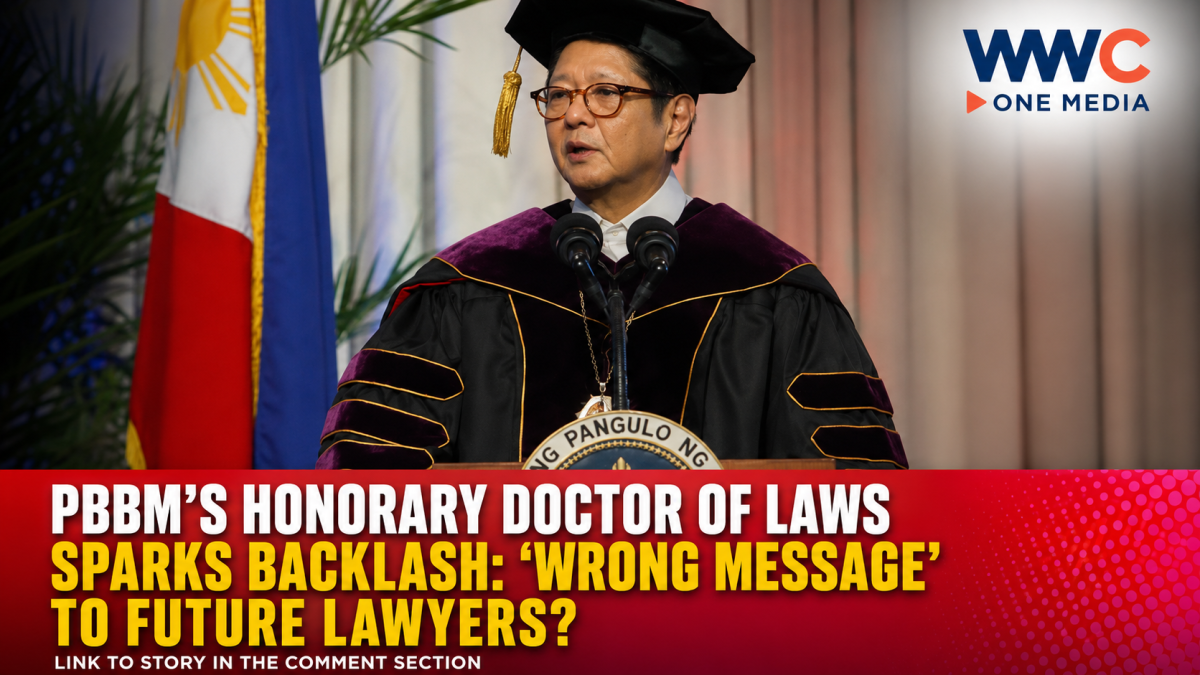
MANILA, Philippines — President Ferdinand “Bongbong” Marcos Jr.’s receipt of an honorary Doctor of Laws degree from the Pamantasan ng Lungsod ng Maynila (PLM) has triggered criticism from a Kabataan party-list lawmaker, who questioned whether the prestigious recognition is consistent with the principles of accountability and the rule of law.
Marcos received the Doctor of Laws, Honoris Causa, PLM’s highest honorary degree, during the university’s 58th Commencement Exercises at the Philippine International Convention Center (PICC) in Pasay City on August 27, 2026.
The recognition was presented as an acknowledgment of Marcos’ administration and his reported efforts involving economic development, access to education, public health services and social equity.
Marcos accepted the distinction with gratitude, saying he was mindful of the responsibility attached to the honor.
He also highlighted the connection between his family and PLM, noting that First Lady Liza Araneta-Marcos previously taught at the university’s College of Law.
But the celebration quickly became a political flashpoint.
‘Wrong message’ to future lawyers
House Assistant Minority Leader and Kabataan party-list Rep. Renee Co criticized PLM’s decision, arguing that the conferment could send the wrong message to law students and aspiring lawyers preparing for the 2027 Bar examinations.
Co questioned whether Marcos should be held up as an example of respect for the rule of law while allegations involving corruption and accountability surrounding his administration and family remain politically contentious. Her criticisms were also reported by Inquirer and other Philippine media outlets.
The lawmaker further described the recognition as an affront to lawyers and law students who spend years studying and preparing for the profession, particularly those who see the law as a tool for protecting vulnerable sectors.
She also invoked PLM’s historical association with students who suffered or died during the dictatorship of Marcos’ late father, Ferdinand Marcos Sr., adding another layer to the controversy.
What PLM and the Palace say
The criticism contrasts sharply with the official explanation for the award.
According to the Philippine News Agency, the honorary degree recognized Marcos’ efforts in advancing the rule of law, economic development, education access, public health and social equity.
The Presidential Communications Office similarly said the recognition reflected what the Marcos administration and PLM regard as a shared commitment to education as a pathway to opportunity, progress and nation-building.
Marcos himself said the honor should be understood alongside the responsibilities that come with public service. He cited PLM’s values of wisdom, progress and greatness and said these should translate knowledge into excellence, development and service.
News5 likewise reported that PLM cited the administration’s efforts in economic development, social equity, education and public healthcare, as well as what it described as Marcos’ service to Manila and the country.
Why the honorary degree is controversial
The controversy centers less on whether Marcos has received an academic qualification and more on what an honorary Doctor of Laws represents.
An honorary degree is a distinction conferred by a university to recognize a person for achievements, service or contributions; it is not the same as completing the university’s regular doctoral program.
That distinction is particularly significant in this case because PLM awarded Marcos its highest honorary degree specifically in law, making the symbolism of the recognition central to the political debate.
For supporters, the award represents recognition of the President’s work and the policies of his administration.
For critics such as Co, however, the issue is whether a university whose mission includes the promotion of law and public service should confer its highest legal honor on a sitting president while serious political disputes over governance and accountability continue.
The bigger question now
The dispute puts PLM at the center of a much larger conversation: What standards should universities use when awarding honorary degrees to sitting politicians?
The official rationale emphasizes governance, development, education, health and social equity. Critics, meanwhile, argue that the honor carries a symbolic responsibility that extends beyond political achievements.
For now, the degree stands.
But the backlash ensures that Marcos’ honorary Doctor of Laws will be remembered not only as a highlight of PLM’s 58th commencement exercises, but also as a fresh debate over political recognition, academic institutions and the meaning of the rule of law in the Philippines.
The question left hanging is perhaps the most consequential one: when a university confers its highest legal honor on a sitting president, what exactly is it choosing to honor—and what message does that send to the next generation of Filipino lawyers?

Leave a Reply