
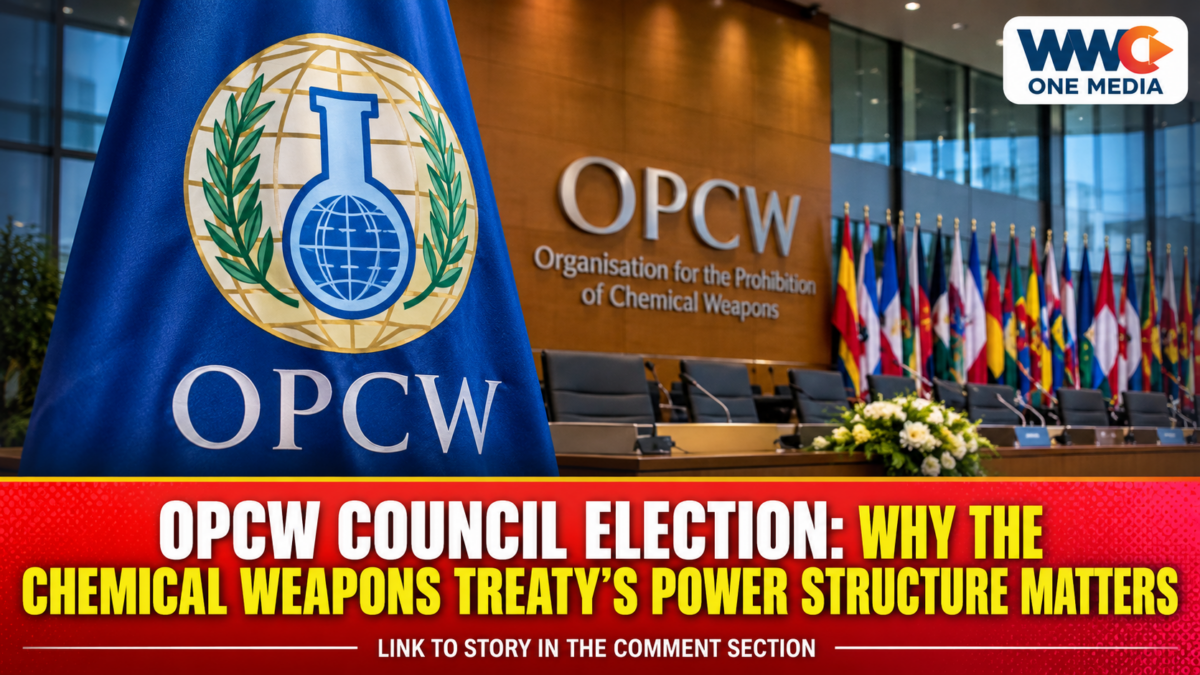
The Organisation for the Prohibition of Chemical Weapons (OPCW) is holding its 31st Conference of the States Parties in The Hague from November 23 to 27, 2026, with the election of members to its Executive Council among the central items on the agenda. The process will determine which member states serve on the organisation’s 41-member governing body for the next rotation beginning in May 2027.
The election is more than an institutional appointment. The Executive Council helps oversee implementation of the Chemical Weapons Convention, considers compliance concerns and influences the organisation’s programme and budget. Its composition therefore matters to governments seeking to shape how the international chemical-weapons prohibition is administered.
The immediate issue is how the organisation balances regional representation, national interests and its treaty obligations. That distinction is important because political disagreements among member states do not automatically change the legal responsibilities established by the Convention.
What the OPCW Council election will determine
The election is part of the 31st session of the Conference of the States Parties, the OPCW’s principal plenary body. The organisation’s published agenda requests the Conference to elect 21 member states to the Executive Council for two-year terms beginning May 12, 2027.
The seats are distributed across five regional groups:
- Africa: five seats
- Asia and the Pacific: six seats
- Eastern Europe: two seats
- Latin America and the Caribbean: three seats
- Western Europe and Other States: five seats
This distribution reflects the Convention’s requirement for geographical representation within the Council. The arrangement is designed to ensure that the organisation’s governing structure is not controlled solely by a small group of countries or regions.
The OPCW’s published agenda identifies the election as a formal item of the current conference. However, the public records reviewed for this report do not yet provide a complete official result listing all elected members and vote totals. Those details should not be treated as confirmed until the organisation publishes an authoritative record.
Why the 41-member Executive Council matters
The Executive Council is not simply an advisory committee. It has responsibilities directly connected to the implementation of the Chemical Weapons Convention.
The OPCW identifies it as the organisation’s governing body, consisting of 41 member states elected by the Conference of the States Parties. Members rotate every two years, with the Council supervising the activities of the Technical Secretariat and helping promote compliance with the treaty.
Its responsibilities include considering potential cases of non-compliance and submitting recommendations to the Conference when action may be necessary. It also reviews and forwards the organisation’s draft programme and budget, considers implementation reports and recommends candidates for appointment as Director-General.
The Council also has a role in resolving concerns about compliance, including matters involving challenge inspections and investigations into alleged chemical-weapons use.
In plain terms, the Council helps connect the treaty’s legal requirements with the organisation’s day-to-day oversight. Its decisions can influence how compliance concerns are handled, how verification arrangements are managed and what resources the organisation receives.
This is why the composition of the Council attracts diplomatic attention. Governments have different security interests, alliances and interpretations of international disputes. Those differences can influence discussions, although the Council remains bound by the Convention and the decisions of the Conference.
Regional representation is part of the treaty’s design
The Council’s membership is structured to account for more than political alliances.
The OPCW says the Convention requires equitable geographical distribution while also considering the importance of chemical industry and political and security interests. The organisation’s current membership structure allocates seats among Africa, Asia, Eastern Europe, Latin America and the Caribbean, and Western Europe and other states.
That system creates a balance between representation and institutional capacity. Countries with substantial chemical industries may have particular technical and regulatory concerns, while other states may prioritise regional security, verification and international cooperation.
The election process also follows specific rules. Under the Conference’s Rules of Procedure, Executive Council members are normally elected by acclamation after designation by their regional groups. If a regional group cannot agree on a complete slate, the Conference fills the remaining seats through a secret ballot.
This is different from a simple contest in which every country competes for every available position. Regional nominations and the treaty’s seat allocation are built into the process.
For that reason, claims that a particular political bloc has gained control of the Council require careful examination. A country’s membership, regional grouping or diplomatic alignment alone does not establish that it will vote as part of a unified bloc on every issue.
The Council’s authority does not replace the Convention
The Chemical Weapons Convention remains the central legal framework governing the OPCW’s work.
The treaty prohibits states parties from developing, producing, acquiring, stockpiling, retaining, transferring or using chemical weapons. It also establishes declarations, verification and inspection arrangements intended to support compliance.
The Executive Council exercises its powers within that framework. It does not have unrestricted authority to rewrite the treaty or disregard the Conference’s decisions.
The Council’s role in compliance matters is particularly significant. It can consider concerns, facilitate consultation and clarification, and make recommendations to the Conference. These responsibilities provide a mechanism for addressing disputes without turning every disagreement into an immediate political confrontation.
The broader importance of verification is also visible in other international security debates. WWC has examined how official records distinguish chemical and biological weapons concerns from unverified allegations. The same principle applies to the OPCW: allegations, government positions and independently verified findings should not be treated as interchangeable.
Why political divisions could test chemical weapons oversight
The OPCW operates in a difficult international environment. Member states can disagree sharply over conflicts, alleged weapons use, sanctions and the credibility of investigations.
Those divisions can make consensus more difficult. They may also affect how governments approach questions involving access to information, technical assistance, inspections and the organisation’s budget.
However, political disagreement does not itself demonstrate that the verification system has failed. The organisation’s effectiveness must be assessed through its documented activities, inspection work, decisions and ability to carry out its mandate.
That distinction is important when interpreting statements by national representatives. A government may criticise the composition of an international body or question the conduct of an election, but such criticism does not automatically establish that the body’s legal procedures were violated.
The debate is part of a wider challenge facing multilateral arms-control institutions. WWC has also examined Russia’s position in negotiations over lethal autonomous weapons, where procedural disagreements have affected efforts to move discussions forward. Separately, the international debate over nuclear weapons in space shows how competing security positions can complicate efforts to maintain shared rules.
The OPCW faces a different treaty and a different set of technical responsibilities, but the institutional question is similar: whether governments can preserve cooperation when their political relationships are strained.
What happens next
The 31st Conference of the States Parties is scheduled to continue through November 27. Its agenda includes the Executive Council election, the organisation’s 2025 implementation report, the proposed revised programme and budget for 2027, and other institutional matters.
The next important public record will be the official election outcome identifying the incoming Council members and their terms. The organisation’s published decisions and conference report should provide a firmer basis for assessing the final composition than political commentary alone.
For now, the confirmed point is that 21 Council positions are being filled under a regional allocation system established by the Convention. The broader test will be whether the incoming membership can carry out its responsibilities while maintaining confidence in the organisation’s verification and compliance work.
The OPCW’s authority ultimately rests not on which political group claims influence, but on whether member states continue to support the treaty framework and allow its oversight mechanisms to function.
Frequently asked questions
What is the OPCW Executive Council?
It is the 41-member governing body of the Organisation for the Prohibition of Chemical Weapons. It supervises the Technical Secretariat and helps promote implementation of and compliance with the Chemical Weapons Convention.
How many countries are being elected to the OPCW Council in 2026?
The agenda for the 31st Conference of the States Parties provides for the election of 21 member states to serve two-year terms beginning May 12, 2027.
How are seats allocated in the OPCW Executive Council?
Seats are distributed among five regional groups: Africa, Asia and the Pacific, Eastern Europe, Latin America and the Caribbean, and Western Europe and Other States.
What powers does the OPCW Executive Council have?
Its responsibilities include considering compliance concerns, making recommendations to the Conference, reviewing the organisation’s proposed programme and budget, and recommending candidates for Director-General.
Does the OPCW Council control the Chemical Weapons Convention?
No. The Convention provides the legal framework. The Council exercises responsibilities under that treaty and must act consistently with the Conference’s decisions and guidelines.










