
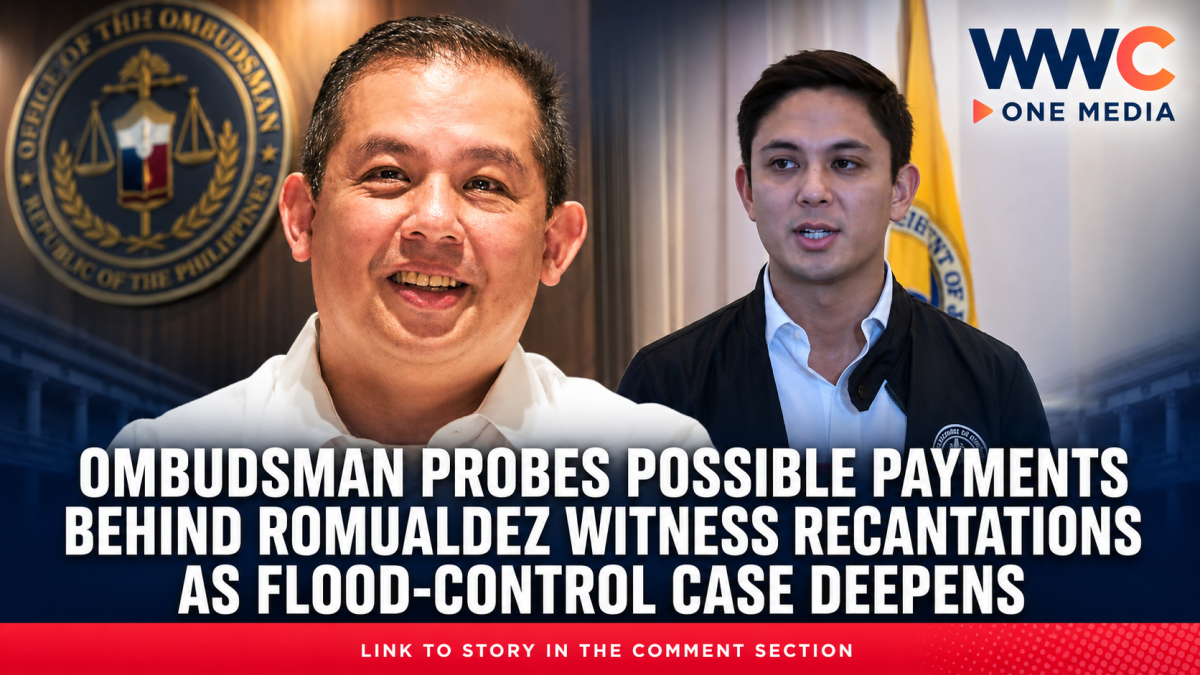
MANILA, Philippines — The battle over one of the Philippines’ biggest alleged flood-control corruption schemes has entered a potentially decisive new phase: investigators are now looking into whether money or other inducements influenced witnesses who reversed statements implicating former House Speaker and Leyte Rep. Martin Romualdez.
The Office of the Ombudsman is examining the circumstances surrounding the recantations rather than automatically treating the witnesses’ new statements as proof that their original allegations were false, Assistant Ombudsman Mico Clavano said.
And the investigation may be getting broader rather than smaller.
The Ombudsman said on August 28 that it now considers 42 witnesses available in connection with complaints involving alleged plunder, graft, bribery and money laundering against Romualdez arising from the controversial flood-control projects.
Romualdez has repeatedly denied wrongdoing and is seeking the dismissal of the complaints.
Ombudsman: A Recantation Does Not Erase the First Affidavit
At the center of the latest dispute are witnesses who previously gave statements concerning alleged deliveries of cash linked to government flood-control projects but later withdrew or changed their accounts.
Clavano said investigators must examine both versions.
The crucial question, according to the Ombudsman, is not simply whether a witness recanted but why the witness changed his story and which account is supported by the wider body of evidence.
The anti-graft office has also said it has information suggesting that some individuals may have been paid to recant, although Clavano declined to publicly identify who allegedly offered the money or who may have been involved.
That allegation has not been proven in court, and the Ombudsman has not publicly disclosed evidence establishing who, if anyone, financed or arranged the alleged inducements.
The Panay News report similarly quoted Clavano as saying investigators would examine whether money, incentives or other considerations influenced the reversals.
From the ‘Maleta Boys’ to 42 Witnesses
Much of the controversy has centered on a group of 18 men described in media reports as former security personnel of former Ako Bicol party-list Rep. Elizaldy “Zaldy” Co.
Several had previously alleged that suitcases containing cash—referred to in some testimony as maleta or basura—were delivered in connection with alleged kickbacks from flood-control projects.
Four members of the original group were reported to have recanted their statements.
But Clavano said the Ombudsman still considers the 14 remaining members of that group as witnesses and has identified 28 additional witnesses, bringing the number cited by investigators to 42.
“We don’t want it to become a number’s game,” Clavano said, emphasizing that investigators are focused on the quality and credibility of testimony rather than simply which side can produce more affidavits.
Earlier, the Ombudsman said the 28 additional witnesses could provide direct and material information concerning transactions being investigated. Some were described as active uniformed personnel.
Romualdez Camp Says the Case Has Lost Its Key Witnesses
Romualdez’s lawyers see the recantations very differently.
Attorney Ade Fajardo, a lawyer and spokesperson for the former Speaker, has argued that the changing testimony undermines the credibility of the case and has urged the Ombudsman to dismiss the complaints.
One of the most significant reversals came from former Marine Orly Guteza, who had earlier testified that he was involved in deliveries of suitcases containing alleged kickback money.
Guteza later recanted, saying he had no personal knowledge of some of the alleged deliveries and claiming that he had been pressured into making accusations.
Romualdez’s legal team included Guteza’s recantation in a supplemental counter-affidavit submitted to the Ombudsman.
The defense has also pointed to a collection of 32 sworn statements that it says weakens the allegations.
However, describing all 32 as witnesses who simply “recanted” would be misleading.
Reports on Romualdez’s filing indicate the group includes recantations, affidavits denying knowledge or participation, supporting statements and other sworn accounts challenging the allegations. Twenty-five former drivers and security personnel associated with Co were among those who provided affidavits disputing claims involving cash deliveries.
Why the Recantations Could Become a Case Within the Case
The increasingly complicated witness battle means investigators face two questions at once.
First, they must determine whether evidence is sufficient to support criminal charges over the alleged flood-control scheme.
Second, they must determine why several witnesses changed their accounts.
Ombudsman Jesus Crispin Remulla had earlier alleged that Romualdez’s camp was behind some of the recantations. Romualdez’s camp strongly denied that accusation.
That dispute is significant because the credibility of the witnesses—and the circumstances surrounding their conflicting affidavits—could become central to determining whether the complaints move forward.
The Ombudsman has previously indicated that former security personnel who recanted could themselves face legal consequences depending on investigators’ findings.
What Happens Next
The controversy remains part of an ongoing preliminary investigation.
That means the allegations against Romualdez have not resulted in a finding of guilt, and the Ombudsman still has to determine whether the evidence meets the legal threshold for filing cases in court.
Investigators have alleged that Romualdez, Co and others were connected to a scheme involving approximately ₱56 billion allegedly accumulated from flood-control projects between 2022 and 2025, with some of the alleged proceeds purportedly transported in suitcases. Romualdez denies the accusations.
For Romualdez’s defense, the recantations are evidence that the allegations are collapsing.
For the Ombudsman, they have created another investigative trail.
And that could make the next question even more consequential than how many witnesses remain:
Who was telling the truth the first time—and what, if anything, caused som
Leave a Reply