
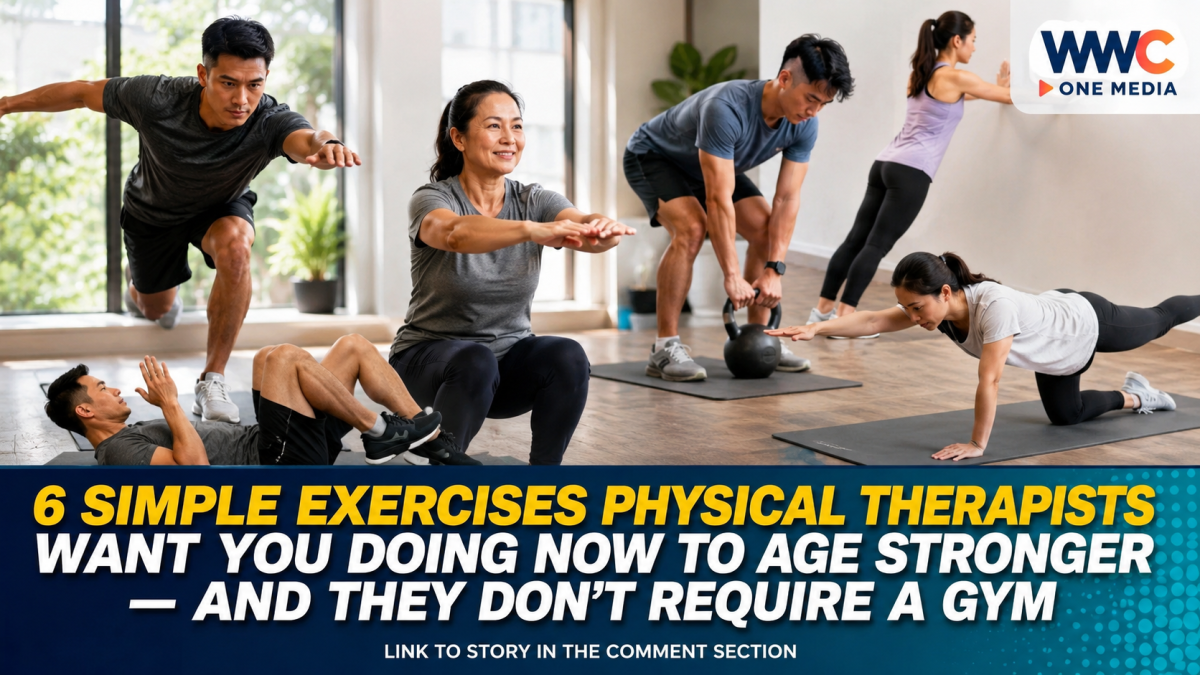
Getting older doesn’t automatically mean becoming weaker, stiffer or less mobile. Physical therapists say a handful of simple movements can help build the balance, strength, core control and mobility needed to keep moving confidently as the years go by.
Aging is inevitable. Losing the ability to move well, however, is not necessarily something people simply have to accept.
Physical therapists say many of the aches, stiffness and movement difficulties people experience later in life can be influenced by everyday habits — including prolonged sitting, looking down at phones and repeatedly moving the body in limited positions.
The good news is that maintaining basic movement skills doesn’t necessarily require an expensive gym membership or complicated workout routine.
A recent report highlighted six exercises physical therapists repeatedly recommend because they target abilities people rely on in everyday life: balance, bending, getting up from a chair, core stability, pushing strength and spinal mobility.
And the broader health guidance backs up the underlying principle.
The U.S. Centers for Disease Control and Prevention recommends that adults 65 and older combine aerobic activity, muscle-strengthening exercises and balance activities each week. The agency recommends at least 150 minutes of moderate-intensity aerobic activity weekly, muscle-strengthening activity on at least two days, plus activities that improve balance.
Here are the six movements physical therapists say are worth keeping in your routine.
1. Stand on one leg — train your balance before you need it
Balance can become more difficult with age, and physical therapists say it is something that needs to be deliberately practiced.
Standing on one leg is one of the simplest ways to challenge the muscles responsible for stability in the feet, ankles, legs, hips and pelvis.
If you’re unsteady, start beside a sturdy chair, countertop or wall and use it for support. As your balance improves, gradually reduce your reliance on the support.
One recommendation from the physical therapists featured in the report is to work toward holding each leg for about 30 seconds daily.
Balance work is particularly important because falls can have serious consequences for older adults. The CDC specifically recommends strength and balance exercises as part of fall-prevention efforts.
2. Hip hinges — relearn how to bend safely
Picking something up from the floor sounds simple — until your back, hips or knees make the movement difficult.
The hip hinge teaches the body to bend primarily through the hips while keeping the spine controlled. It is useful for everyday movements such as picking up objects and also forms the foundation of exercises such as deadlifts.
Physical therapist Dhara Shah noted that many people tend to round their backs and lock their knees when bending forward. Practicing the hip hinge can instead teach better movement mechanics while strengthening the glutes and hamstrings.
A basic version involves pushing the hips backward while bringing the chest forward, keeping the back relatively straight and the knees slightly bent.
3. Sit-to-stands — the everyday movement that becomes crucial with age
Standing up from a chair may not look like exercise, but it is one of the most practical strength movements you can practice.
The motion recruits the quadriceps, glutes, hamstrings, calves and core while mimicking something people perform every day.
As people age, difficulty getting out of a chair can become an important indicator of declining lower-body strength and physical function.
To practice, sit down and stand back up slowly and under control. If the movement is difficult, use your hands for assistance or choose a higher seat. If it becomes easy, slow the lowering phase or use a lower surface to increase the challenge.
The National Institute on Aging also includes standing from a sitting position among useful balance and functional exercises for older adults.
4. Dead bugs with diaphragmatic breathing — strengthen the core without heavy weights
Core strength is about more than getting visible abdominal muscles.
A strong, well-coordinated core helps the body stabilize during movement and can reduce the tendency for other areas, including the neck and shoulders, to compensate.
The physical therapists featured in the report recommend combining the dead bug exercise with diaphragmatic breathing.
Lie on your back with your legs raised and knees bent at roughly 90 degrees. Extend one leg while lowering the opposite arm, then return to the starting position and switch sides.
The key is control rather than speed.
Slowly exhaling while extending the limbs can help you engage the deeper abdominal muscles while maintaining control of your trunk.
5. Wall push-ups — build pushing strength without starting on the floor
Push-ups can become difficult if you haven’t trained the movement regularly.
That doesn’t mean you need to abandon them.
Physical therapists recommend starting with wall push-ups or another elevated surface, such as a sturdy countertop, before gradually progressing to a lower surface.
Wall push-ups work the chest, shoulders, arms and core while also teaching the body how to push against resistance.
As strength improves, you can increase the difficulty by moving your feet farther from the wall or progressing to a lower surface.
The idea is not to prove how many traditional push-ups you can perform. It’s to maintain the pushing strength required for everyday tasks — including helping yourself off the ground.
6. Cat-cow — a simple mobility exercise for a stiff body
The final movement is one many people may already recognize: the cat-cow stretch.
Performed on hands and knees, the exercise alternates between rounding and gently arching the spine.
Physical therapists recommend it as a way to counter some of the stiffness associated with spending long periods sitting or standing.
It can help people move their spine through different positions while also encouraging mobility around the shoulders and hips.
The movement can also be modified by reaching one arm forward or extending one leg backward to incorporate additional mobility challenges.
The bigger lesson: don’t train only for appearance
What makes these six exercises interesting isn’t that they form a magical anti-aging workout.
They don’t.
Rather, they target movements that have practical value in everyday life.
You need balance when stepping off a curb. You need a strong hip hinge when picking something up. You need leg strength to get out of a chair. You need core stability to control your body. You need pushing strength to move yourself or an object. And you need mobility to move comfortably through different positions.
That philosophy closely matches guidance from the National Institute on Aging, which says older adults benefit from combining aerobic, muscle-strengthening and balance activities. Physical activity can improve physical function and make everyday tasks such as getting out of bed, rising from a chair and moving around the neighborhood easier.
The CDC likewise says regular physical activity can help older adults maintain independence, improve quality of life and prevent or manage chronic disease.
You don’t have to wait until you’re older
One of the biggest misconceptions about healthy aging is that these exercises are only for seniors.
They’re not.
Training balance, strength, mobility and movement control earlier in life can help establish habits that remain useful later.
The goal isn’t simply to add more years to your life. It’s to preserve the physical capacity to actually use those years.
And that may be the most important takeaway from these six exercises: aging well is less about finding one miracle workout and more about continuing to practice the basic movements that allow you to live independently.
Important safety note
These exercises should be adjusted to an individual’s fitness level, injuries, medical conditions and mobility. If you have significant pain, balance problems, a recent injury or a health condition that affects exercise, consult a doctor or qualified physical therapist before starting or changing a routine. The NIA specifically advises people who are unsure about a movement to seek guidance from a doctor or physical therapist and to use stable support when practicing balance exercises.

Leave a Reply