
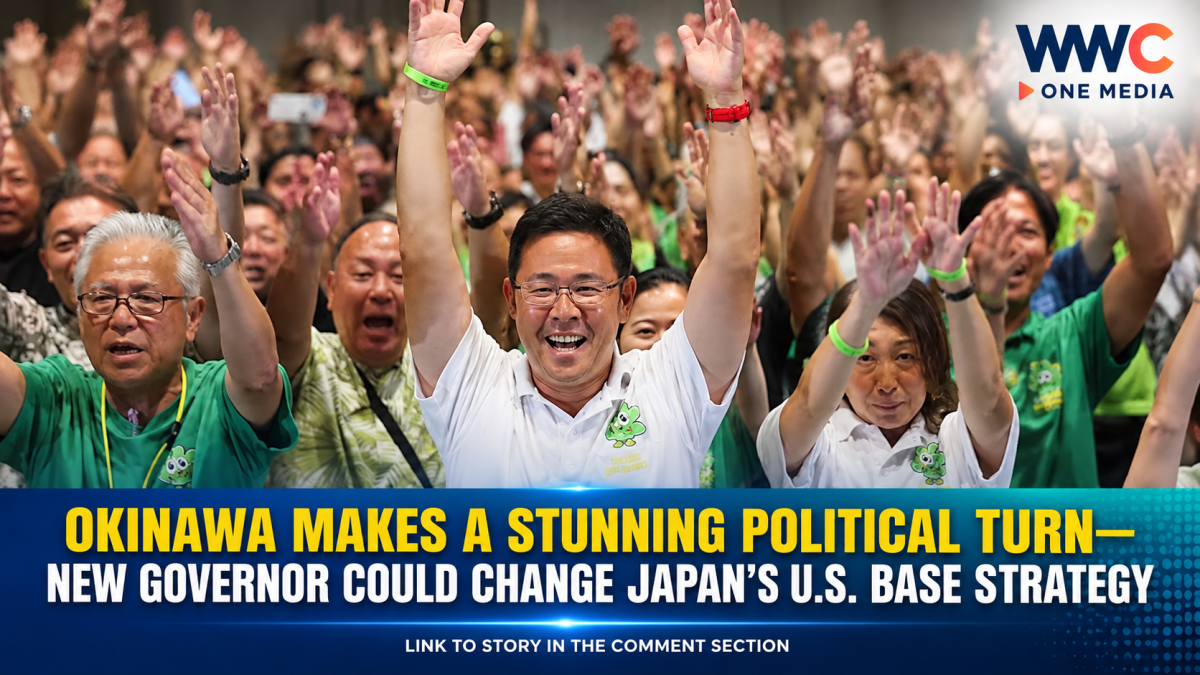
TOKYO — Okinawa has taken a major political turn after Genta Koja, a 42-year-old former deputy mayor of Naha backed by Prime Minister Sanae Takaichi’s ruling camp, defeated two-term incumbent Denny Tamaki in the prefectural gubernatorial election on September 13.
Koja secured 423,124 votes, compared with Tamaki’s 276,060, according to figures reported by the Okinawa prefectural government and cited by multiple international news organizations. His victory returns the Liberal Democratic Party-backed camp to power in Okinawa after 12 years and could significantly reshape the long-running dispute over the U.S. military presence on the strategically important Japanese prefecture.
The result is particularly significant because Koja supports Tokyo’s controversial plan to relocate the U.S. Marine Corps’ Futenma Air Station from the densely populated city of Ginowan to the Henoko area of Nago, rather than moving the facility completely outside Okinawa.
Tamaki, by contrast, had spent years opposing the Henoko relocation and calling for the U.S. military facility to be moved out of the prefecture.
A major shift after 12 years
Koja’s victory marks a political break from Okinawa’s recent history.
Since 2014, Okinawa’s governors have generally been at odds with Tokyo over the U.S. military presence and the proposed Futenma relocation. Koja’s election gives the central government a governor who is broadly aligned with its position on the base issue.
Reuters reported that the result could give Tokyo greater room to pursue its military and security agenda in Okinawa, including the Futenma-to-Henoko relocation and potentially expanded military access to civilian airports and ports.
That does not mean every issue surrounding U.S. bases has suddenly disappeared.
Okinawa remains home to a disproportionately large share of the U.S. military footprint in Japan. Residents have repeatedly raised concerns over aircraft noise, pollution, accidents and crimes involving U.S. personnel. Those grievances have been central to Okinawan politics for decades.
Why Koja won
The campaign was not solely about military bases.
Economic concerns increasingly dominated the election, with voters focused on household finances, wages, childcare and tourism.
Koja campaigned on an ambitious economic platform, including promises to double Okinawa’s average income, increase childcare-related spending and double tourism-related spending. His campaign also emphasized economic modernization, technology and investment.
The shift in voter priorities was also highlighted before the election by The Japan Times, which reported that the traditional base-relocation battle had increasingly been overshadowed by questions about Okinawa’s relationship with Tokyo and the prefecture’s economic future.
That change appears to have helped Koja, who presented himself as a candidate capable of working with the central government rather than continually confronting it.
The youngest Okinawa governor
Koja’s victory also carries generational significance.
At 42, he becomes the youngest elected governor of Okinawa and the first governor born after the prefecture was returned to Japanese control in 1972. Before entering the race, he served as deputy mayor of Naha and had earlier worked in Japan’s central government.
His professional background includes work at Japan’s Ministry of Internal Affairs and Communications and in local government, giving him experience both in Tokyo and Okinawa.
What happens to the Futenma-Henoko plan?
This could become Koja’s biggest political test.
The United States and Japan agreed in 1996 to relocate the Futenma base after the rape of a 12-year-old girl by U.S. servicemen sparked massive protests across Okinawa. Tokyo subsequently pursued the relocation of the base to Henoko, while opponents argued that Okinawa should not continue carrying such a large share of the U.S. military burden.
Koja has accepted the Henoko relocation plan, arguing that the Futenma facility needs to be relocated and that Henoko represents the quickest viable solution given the progress already made on the project.
His election therefore removes one of the most significant sources of political resistance from the prefectural government itself.
But public opposition has not necessarily vanished.
Instead, the election suggests that economic concerns and regional security fears may increasingly compete with the traditional anti-base movement for voters’ attention. A pre-election analysis by The Wall Street Journal described a generational shift in which some Okinawans increasingly prioritize economic development and concerns about China alongside longstanding grievances over U.S. bases.
Okinawa’s strategic importance is growing
The election comes as Japan rapidly strengthens its defenses in its southwestern islands.
Okinawa sits along the First Island Chain, making the prefecture strategically important to Japan’s defense planning and to the security architecture involving the United States and its allies.
Japan’s westernmost inhabited island, Yonaguni, is only about 110 kilometers from Taiwan. As tensions between China and Taiwan remain high, Tokyo has expanded military capabilities across its southwestern islands, including missile and electronic-warfare units.
That means Okinawa’s political direction has implications far beyond the prefecture itself.
For Prime Minister Takaichi’s government, Koja’s victory could make it easier to pursue its broader defense agenda. Reuters reported that Tokyo is preparing a new national security strategy as Japan moves toward what is expected to be its largest military buildup since World War II.
Takaichi welcomes the new governor
Prime Minister Takaichi welcomed Koja’s victory and said her government would work with the incoming governor to strengthen Okinawa’s economy.
Koja has also signaled that economic development, childcare and residents’ livelihoods will be among his immediate priorities.
That could provide the foundation for a new relationship between Okinawa and Tokyo—one based less on confrontation and more on cooperation.
But the military issue will remain unavoidable.
For decades, Okinawa has been at the center of Japan’s complicated relationship with the United States, while simultaneously carrying the burden of hosting a significant concentration of U.S. military facilities.
Koja’s election does not erase that history. Instead, it raises a much bigger question: will Okinawa’s new political direction finally allow Tokyo and Washington to accelerate their military plans—or will resistance from residents continue to slow them down?
The answer could shape not only Okinawa’s future, but also Japan’s defense posture as tensions around Taiwan and China’s military activity continue to reshape security calculations across East Asia.




Leave a Reply