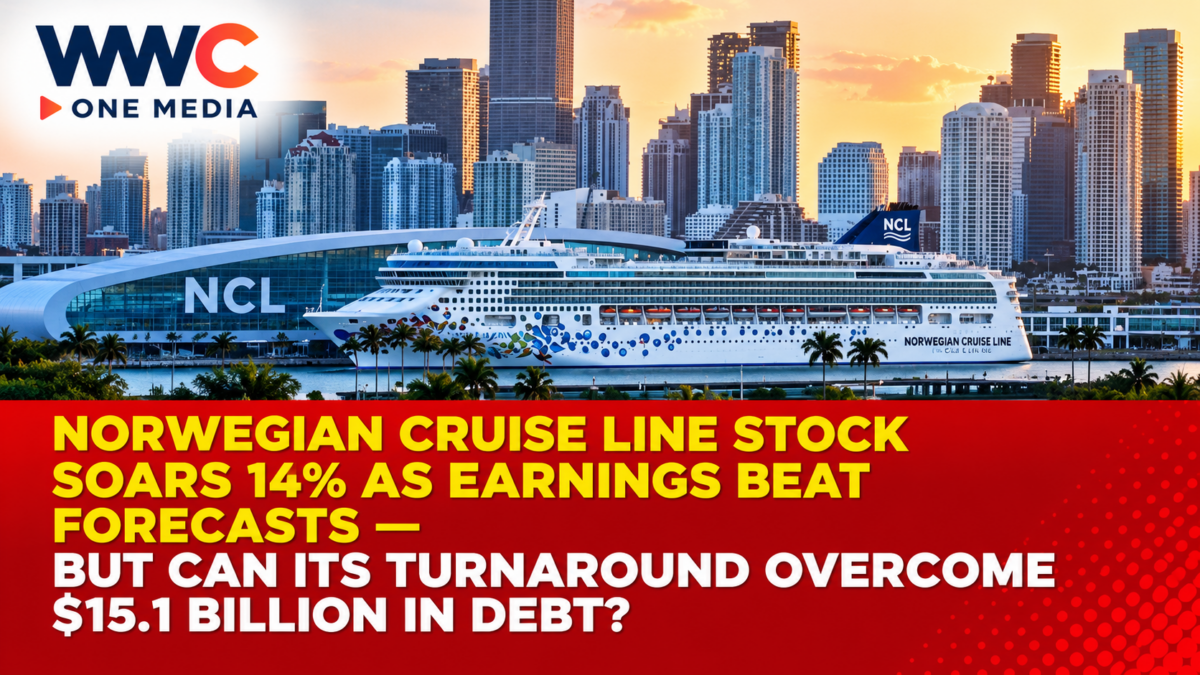
MIAMI, United States — October 30, 2026. Norwegian Cruise Line Holdings has delivered a significant victory in its effort to regain Wall Street’s confidence, reporting stronger-than-expected third-quarter earnings and raising its full-year profit guidance as travelers spend more onboard and the company improves cost control.
The cruise operator generated approximately $2.95 billion in revenue for the three months ended September 30, narrowly exceeding analysts’ expectations and the previous year’s revenue.
Net income increased to approximately $491 million, compared with $419 million a year earlier.
Adjusted earnings reached $1.12 per share, well above the company’s earlier forecast of $0.90 and Wall Street’s consensus estimate of roughly $0.93–$0.94.
Investors welcomed the improvement, driving Norwegian shares up approximately 13.7% in October 29 trading, according to MarketWatch.
But the strong market reaction masks several challenges.
Norwegian’s cruise revenue yields remain below last year’s levels, its forward bookings have not fully recovered, fuel costs are rising and the company carries approximately $15.1 billion in debt.
The biggest question is whether stronger earnings and higher passenger spending mark the beginning of a sustainable turnaround—or whether weak pricing and heavy debt could still undermine the recovery.
Norwegian finally beats Wall Street after a difficult earnings streak
Norwegian’s third-quarter performance marked an important break from a series of disappointing revenue results.
MarketWatch reported that the company ended a six-quarter streak of missing analysts’ revenue estimates.
The latest revenue total of approximately $2.95 billion slightly exceeded the $2.88 billion forecast by analysts surveyed by FactSet.
Revenue increased by only about 0.3% year over year, meaning the earnings beat did not reflect a dramatic expansion in total sales.
Instead, the stronger profitability resulted from several improvements.
Management cited better-than-expected last-minute bookings, increased onboard spending and tighter operating costs.
Adjusted EBITDA reached $937 million, exceeding the company’s guidance of $874 million by approximately $63 million.
The result suggests Norwegian is making progress in improving efficiency.
However, a quarterly earnings beat does not establish that every issue affecting the business has been resolved.
The company’s future performance still depends on consistent demand, pricing and debt reduction.
Norwegian raises full-year earnings guidance to $1.70 per share
Following the strong quarter, management increased its fiscal 2026 adjusted earnings-per-share forecast to approximately $1.70.
That represents an improvement of about $0.20 from the previous forecast of $1.50.
The company also raised its adjusted EBITDA outlook to approximately $2.55 billion.
Full-year adjusted net income is now expected to reach about $789 million.
These forecasts reflect stronger-than-expected third-quarter performance and continued cost-saving efforts.
Chief Executive John Chidsey said management is focused on improving brand positioning, marketing effectiveness and revenue management.
The company is also working to optimize how and when it sells cruise cabins.
For investors, the improved guidance indicates that management expects recent operational gains to support stronger annual earnings.
But guidance remains a projection.
Actual results could change because of booking trends, fuel prices, itinerary disruptions and other operating conditions.
Why Norwegian shares surged nearly 14%
Norwegian’s stock-market reaction reflected a combination of stronger earnings and improved expectations.
The shares initially gained approximately 8% to 10% in premarket trading.
Later in the October 29 session, MarketWatch reported a rise of approximately 13.7%.
The rally also lifted other cruise-related shares, including Royal Caribbean, Carnival and Viking Holdings.
Investors appeared encouraged that Norwegian could deliver better-than-expected results while working through operational challenges.
However, the share-price increase should not be confused with a 14% rise in company revenue or profits.
Stock prices reflect market expectations about future performance.
The rally may also have been influenced by investors adjusting positions after earlier underperformance.
For shareholders, the next challenge is whether Norwegian can deliver results strong enough to support the improved market sentiment.
Revenue yields are still falling despite better earnings
One of the most important figures in the earnings report is Norwegian’s decline in net yield.
Net yield measures revenue performance relative to cruise capacity, after specified direct costs and commissions.
It is an important industry indicator because it helps investors evaluate whether a cruise operator is generating more revenue from the capacity it offers.
During the third quarter, Norwegian’s net yield fell 6.5% on a reported basis.
In constant currency, the decline was 6.7%.
Although negative, the result was considerably better than management’s earlier forecast of an 8.9% decline.
That was an improvement of approximately 2.2 percentage points relative to expectations.
For the full year, Norwegian now expects constant-currency net yield to fall approximately 4.4%.
The figures reveal why the company’s turnaround remains incomplete.
Operating expenses are improving, but Norwegian must also rebuild revenue performance relative to available cruise capacity.
Without that progress, stronger profits could remain dependent on cost reductions rather than sustained improvements in demand and pricing.
Last-minute bookings and onboard spending rescue the quarter
Norwegian reported that late bookings performed better than expected.
These bookings occur relatively close to a scheduled sailing rather than many months in advance.
Stronger late demand helped improve revenue during the quarter.
The company also benefited from increased onboard spending.
Cruise passengers often pay additional amounts for specialty dining, beverages, excursions, internet access and other experiences.
These purchases can provide an important source of revenue beyond the initial cruise fare.
However, reliance on late bookings introduces uncertainty.
Cruise operators generally prefer to secure a substantial proportion of cabins well before departure.
That makes revenue more predictable and reduces the need for last-minute promotions.
Norwegian’s management is trying to improve its booking patterns while preserving pricing discipline.
The goal is to attract customers earlier without sacrificing too much revenue through discounts.
The 2027 booking outlook remains a concern
Norwegian reported that its forward-booked position had improved modestly since the previous earnings announcement.
However, management acknowledged that bookings for the next 12 months remained below its preferred range.
For the first half of 2027, ticket pricing is ahead of comparable levels from a year earlier, while bookings remain below the previous year’s position.
For the second half, pricing is also ahead, with booking volume broadly in line with last year.
The company expects full-year 2027 net yield to grow between 1% and 2%, with stronger improvement in the second half.
That projection provides cautious encouragement.
But it also demonstrates that the recovery is expected to take time.
If passengers remain reluctant to book early, Norwegian may need to increase promotional activity or adjust its pricing strategy.
The company is attempting to avoid exactly that outcome through more disciplined revenue management.
Norwegian still carries $15.1 billion in debt
Perhaps the most significant financial challenge is Norwegian’s balance sheet.
As of September 30, total debt stood at approximately $15.1 billion.
Net debt was approximately $14.8 billion.
The company’s net leverage ratio reached 5.5 times.
This measure compares net debt with adjusted EBITDA under the company’s stated methodology.
A high leverage ratio can limit financial flexibility because a significant portion of cash flow may be needed for interest and debt obligations.
Norwegian is working to reduce that pressure.
In October, it completed a $950-million senior notes issuance maturing in 2031, and it increased its revolving credit facility.
The new notes carry an 8.75% interest rate.
Management reported pro forma available liquidity of approximately $2.1 billion after accounting for its financing actions.
The company also said it has no significant debt maturities until 2029.
This provides time to pursue its turnaround.
But refinancing debt is not the same as eliminating it.
Norwegian must generate enough cash over the coming years to reduce leverage and maintain financial stability.
Rising fuel costs remain a serious threat
Fuel is another major challenge for Norwegian.
The company reported third-quarter fuel expenses of approximately $196 million.
The average price paid per metric ton, after hedging, rose to $819 from $744 a year earlier.
That represents an increase of approximately 10%.
Norwegian has used fuel hedging contracts to limit some of its exposure to volatile energy prices.
As of October 15, it had hedged approximately 48% of its projected 2026 fuel requirements and 42% of its 2027 needs.
These arrangements can cushion some price movements, but they do not eliminate the risk.
If oil and marine fuel prices remain elevated, future operating costs may increase.
The wider tourism industry faces similar challenges.
WWC ONE MEDIA previously examined the regional impact in Oil Price Shock Threatens Thailand’s High Season as Airlines and Tourism Face Rising Costs.
That report explored how expensive fuel can pressure airlines, tour operators and other travel businesses.
The same principle applies to cruise ships, although their fuel requirements and financial arrangements differ.
For Norwegian, protecting profitability will require balancing operating efficiency, customer demand and energy expenses.
The MV Odyssey crisis reveals how far fuel pressures can go
A recent incident involving another cruise operator highlights the potential severity of fuel-cost shocks.
The residential cruise ship MV Odyssey suspended its world voyage in Cambodia in late October after its operator cited sharply higher fuel expenses.
The disruption affected more than 200 passengers and 150 crew members.
WWC ONE MEDIA covered the development in MV Odyssey Cruise Suspends World Voyage in Cambodia, Leaving 203 Passengers Stranded After Fuel Costs Skyrocket.
The Odyssey’s residential cruising business differs substantially from Norwegian’s conventional cruise operations.
The incident therefore does not establish that Norwegian faces a comparable risk of immediate service suspension.
But it illustrates how rising fuel costs can threaten cruise businesses when financial resources and pricing flexibility are insufficient.
Larger companies may have more options for managing the pressure, including hedging, itinerary adjustments and access to financing.
Nevertheless, the underlying energy-price risk affects the industry as a whole.
Norwegian expands its private-island attractions
Norwegian is also investing in passenger experiences to differentiate itself from competitors.
In September, the company opened Great Tides Waterpark at Great Stirrup Cay, its private island destination in the Bahamas.
The attraction spans nearly six acres and includes water-based activities designed for cruise guests.
The investment is part of Norwegian’s broader effort to make its destinations more appealing and strengthen demand.
Private destinations can help cruise companies differentiate their itineraries and provide more controlled onboard and shore experiences.
However, building attractions requires capital investment.
The financial success of such developments depends on whether they attract more bookings, improve pricing or increase customer spending.
Norwegian is counting on improved passenger experiences to support stronger future revenue yields.
Singapore illustrates the growing importance of cruise tourism
The global cruise industry’s recovery has implications beyond North America and the Caribbean.
Asian destinations are also investing in cruise infrastructure and passenger experiences.
Singapore, one of Southeast Asia’s major cruise hubs, recently announced plans to incorporate more public art and cultural performances into its Marina Bay Cruise Centre.
WWC ONE MEDIA covered the initiative in Marina Bay Cruise Centre Set for a Major Arts Makeover as Local Artists Take Centre Stage.
The project aims to improve the passenger experience and strengthen the terminal’s connection with Singapore’s tourism industry.
The initiative is separate from Norwegian’s financial turnaround.
Nevertheless, both reflect the importance of providing distinctive experiences as competition for travel spending intensifies.
Cruise operators and destinations increasingly seek to attract passengers through activities, cultural experiences and convenience rather than ticket pricing alone.
Hotels and cruise companies are fighting for traveler loyalty
Norwegian’s recovery is also taking place during a broader period of transformation in global hospitality.
Hotel operators are investing in loyalty programs, booking technology and marketing tools to maintain customer relationships.
WWC ONE MEDIA recently reported on WorldHotels Unites 4,000 Hotels and 70 Million Loyalty Members in Global Shake-Up.
That initiative involves a different sector, but it highlights how travel companies compete to retain customers and encourage repeat bookings.
For Norwegian, effective marketing and customer loyalty are important because the company wants to improve its booking curve without depending excessively on discounts.
The objective is to persuade travelers to book earlier, spend more onboard and return for future voyages.
However, better marketing alone cannot resolve weak pricing or a high debt burden.
Norwegian announces finance leadership transition
The company is also preparing for a change in senior financial leadership.
Chief Financial Officer Mark Kempa is leaving after more than 25 years with Norwegian.
Current Chief Strategy Officer Meghan Montana has been named his successor, effective January 1, 2027.
The transition comes as Norwegian works to strengthen its balance sheet, manage capital spending and improve cash generation.
A smooth handover will be important because financial discipline remains central to the turnaround strategy.
The company must balance spending on ships and passenger experiences with the need to reduce debt.
Investors will be watching whether management maintains consistency in its financial targets and execution.
What Norwegian’s results mean for cruise passengers
For travelers, the latest earnings provide a mixed picture.
Strong late bookings and increased onboard spending suggest that cruise vacations remain attractive.
Investments in attractions such as Great Stirrup Cay may create additional experiences for guests.
However, weaker yields and rising fuel costs could influence future pricing and promotional decisions.
A company seeking higher revenue per passenger may adjust fares, onboard packages or discounts.
But Norwegian has not announced a universal fare increase based solely on its October 29 earnings release.
Travelers should compare the total cost of a voyage, including port charges, gratuities, excursions and optional packages.
The booking terms and itinerary matter more than broad assumptions about the company’s share-price performance.
For Filipino travelers considering overseas cruises, there is no basis in these earnings results to claim that all Norwegian packages sold in the Philippines will immediately become more expensive.
The real test will come in 2027
Norwegian’s stronger third quarter has improved investor confidence.
The company beat earnings expectations, raised annual guidance and reported progress on costs.
Its renewed focus on brand positioning and revenue management could support future improvements.
But the challenges remain substantial.
Full-year 2026 net yield is still expected to decline.
Forward bookings remain below management’s desired range.
Fuel costs have increased.
And the company carries more than $15 billion in total debt.
The most important test will therefore be whether Norwegian can deliver its forecast 1%–2% net yield growth in 2027 while generating enough cash to reduce leverage.
Investors will need to see stronger underlying pricing and booking performance, not simply continued reductions in operating expenses.
The bigger question: Is Norwegian’s turnaround finally working?
Norwegian Cruise Line Holdings has demonstrated that its recovery strategy can generate better-than-expected quarterly results.
Higher onboard spending, stronger last-minute demand and cost discipline helped lift profitability.
The company has also strengthened its liquidity position and raised its annual earnings outlook.
These are meaningful improvements.
But a sustainable turnaround requires more than one successful quarter.
Norwegian must rebuild demand across its booking calendar, improve revenue yields and reduce the financial risks associated with its debt.
Its performance will also depend on fuel prices, travel demand and the success of its new commercial initiatives.
Norwegian’s nearly 14% stock rally suggests Wall Street sees new hope in the company’s comeback. But whether that optimism is justified will depend on a harder test: turning stronger cruise demand and improved costs into lasting revenue growth, healthier cash flow and a much smaller debt burden.