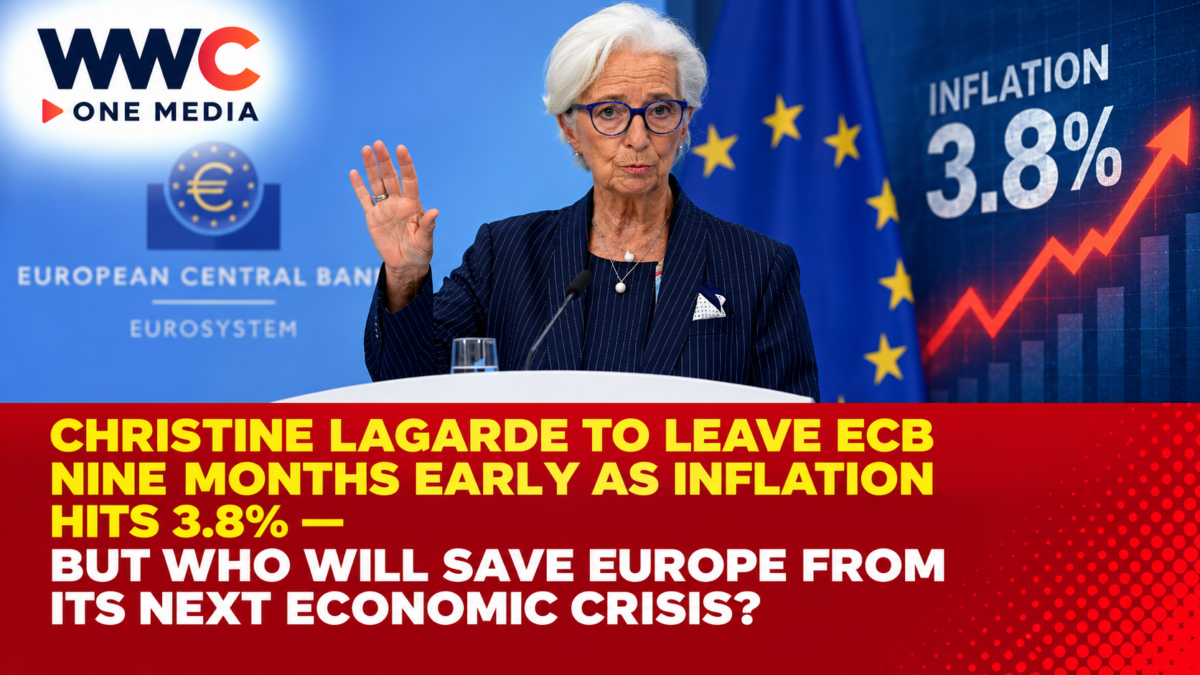
FRANKFURT, Germany — October 30, 2026. Christine Lagarde is preparing to leave the European Central Bank earlier than expected, setting the stage for a high-stakes leadership contest as Europe confronts renewed inflation, rising government borrowing costs and growing political uncertainty.
The ECB confirmed on October 29 that Lagarde will step down on February 7, 2027, rather than completing her eight-year mandate in October next year.
The announcement ends months of speculation about the future of one of the world’s most influential central bankers.
Lagarde, 70, has led the institution since November 2019, overseeing Europe’s monetary response to the COVID-19 pandemic, the inflation shock following Russia’s invasion of Ukraine and the latest surge in energy prices linked to the Middle East conflict.
Her presidency has brought major achievements, including emergency financial-market interventions, efforts to preserve eurozone stability and a return toward the ECB’s inflation target after the severe price increases of earlier years.
But her record has also attracted criticism.
Some economists argue that the ECB was too slow to recognize the persistence of inflation. Others point to communication mistakes that unsettled financial markets during the pandemic.
Now, with eurozone inflation back at 3.8% and the ECB facing another potential round of interest-rate increases, Lagarde’s departure raises a difficult question.
Will Europe’s next central bank president inherit a stronger, more credible institution—or a financial system facing another dangerous combination of inflation, debt and political pressure?
Lagarde confirms February 7 departure, ending months of speculation
Lagarde informed the ECB Governing Council and European Council President António Costa that she would leave her position on February 7, 2027.
Her term was originally due to expire on October 31, 2027.
The announcement was made before the ECB’s regular interest-rate news conference.
Lagarde explained that she wanted greater freedom to express her views on issues beyond monetary policy.
As ECB president, she is expected to avoid political involvement that could compromise the institution’s independence.
She said the restrictions associated with central bank leadership had become increasingly difficult to reconcile with her desire to engage in broader public debate.
The former French finance minister and International Monetary Fund managing director emphasized that the ECB would continue functioning normally after her departure.
The decision is an announced future departure, not an immediate transfer of authority.
Lagarde remains ECB president until February 7, unless circumstances subsequently change.
Why Lagarde wants to speak more freely
Lagarde’s explanation for leaving was unusually personal for a central bank leader.
She told reporters that the ECB’s mandate requires officials to maintain political neutrality and concentrate on monetary policy.
But she indicated that developments in the wider world had increased her desire to express views on issues outside the institution’s responsibilities.
This has prompted speculation about what she might do next.
Some reports have linked her to a possible leadership role at the World Economic Forum, which organizes the annual Davos meeting.
Others have suggested she may want to participate in broader political debate in France.
However, a future position has not been officially confirmed.
Lagarde has also denied plans to run for the French presidency.
The important distinction is that her reason for departing has been publicly explained, while her next role remains uncertain.
Her departure comes as European inflation climbs to 3.8%
The timing is especially significant because Europe is confronting another inflation problem.
Eurozone annual inflation reached 3.8% in September 2026, well above the ECB’s 2% medium-term objective.
A major contributor has been the renewed energy-price shock associated with the continuing conflict involving Iran and the United States.
Higher oil and gas prices can affect transportation, electricity, manufacturing and household expenses.
Central bankers are concerned that persistent energy-price increases may eventually influence wages and the prices of other goods and services.
But higher interest rates cannot directly increase global oil production or restore disrupted shipping routes.
That creates a difficult policy trade-off.
The ECB must prevent inflation from becoming entrenched without unnecessarily weakening economic growth.
Lagarde’s successor will face that same challenge.
ECB holds rates at 2.5% but warns of further risks
At its October 29 meeting, the ECB held its deposit facility rate at 2.50%.
The main refinancing operations rate remained at 2.65%, while the marginal lending facility rate stayed at 2.90%.
The decision followed earlier interest-rate increases in June and September.
The ECB said rising energy prices posed upside risks to inflation and downside risks to economic growth.
It also noted that underlying inflation had remained broadly stable and that wage developments had not yet shown a major response to the energy shock.
Policymakers will continue evaluating economic conditions at each meeting.
The ECB has not committed to a predetermined interest-rate path.
Nevertheless, financial markets are considering the possibility of another increase as early as December.
This makes the leadership transition especially sensitive.
Lagarde may leave the institution while the Governing Council is still determining how aggressively to respond to renewed inflation.
Lagarde’s biggest achievement: Steering the ECB through COVID-19
Lagarde became ECB president in November 2019, shortly before the COVID-19 pandemic triggered an extraordinary economic crisis.
Governments imposed lockdowns, businesses closed and financial markets faced major disruption.
The ECB responded with emergency monetary support, including large-scale asset purchases.
Its Pandemic Emergency Purchase Programme was designed to support financial conditions and prevent destabilizing increases in borrowing costs.
The emergency measures helped protect the transmission of monetary policy across the eurozone.
This was particularly important for countries with heavy government debt burdens, including Italy and other vulnerable economies.
The programme demonstrated the central bank’s capacity to act decisively during a severe crisis.
However, emergency monetary support also contributed to the longer-term debate about the limits of central bank intervention and the risks associated with prolonged low interest rates.
Her most famous communication mistake shook markets
One of Lagarde’s most widely criticized moments came during the pandemic in March 2020.
Asked about the sharp rise in borrowing-cost differences between eurozone countries, she said the ECB was not there to close bond-market spreads.
The comment unsettled investors because the widening gap between borrowing costs in different countries can threaten financial stability across the currency union.
Lagarde subsequently clarified the ECB’s commitment to preserving effective monetary-policy transmission.
The episode illustrated how a central bank president’s words can influence markets almost immediately.
Reuters and other financial analysts have cited the incident as an early communication error during her tenure.
But the mistake did not define her entire presidency.
Her subsequent approach emphasized consensus-building among the national central bank governors who make up the ECB’s Governing Council.
That political and diplomatic skill became one of her strongest assets.
The ECB’s delayed inflation response remains controversial
Another criticism concerns the ECB’s response to the inflation surge that followed the pandemic and Russia’s 2022 invasion of Ukraine.
Energy prices rose sharply, supply chains were disrupted and inflation accelerated across Europe.
The ECB initially viewed part of the pressure as temporary.
It later began raising interest rates aggressively as evidence emerged that price increases were becoming broader and more persistent.
Critics argue that policymakers should have recognized the inflation threat sooner.
Supporters counter that the early stages of the crisis involved extraordinary supply disruptions that were difficult to predict.
They also note that the ECB ultimately raised rates sufficiently to bring inflation back toward its target.
In late 2024, the bank achieved an important period of inflation stabilization.
The debate illustrates why Lagarde’s legacy cannot be judged simply by whether inflation rose or fell.
Central bankers must act using uncertain forecasts, and decisions can have consequences that emerge months later.
Lagarde improved the ECB’s internal consensus
One of the less visible achievements of Lagarde’s presidency involved the institution’s internal functioning.
The ECB Governing Council includes policymakers from countries with different economic conditions, public debt levels and political priorities.
Reaching agreement on interest rates and emergency measures can therefore be difficult.
Lagarde’s previous experience as a politician and international financial leader helped her manage these competing perspectives.
Reuters and Financial Times assessments have emphasized her ability to promote more constructive discussion among policymakers.
Her style differed from that of predecessors who relied more heavily on technical economic arguments.
Some critics initially questioned whether a former politician without conventional central banking experience could lead the ECB effectively.
Her tenure demonstrated that institutional management and diplomatic skills can also be important to monetary-policy leadership.
Europe’s government debt crisis is still a major threat
Lagarde’s successor will inherit a eurozone facing significant pressure in government bond markets.
France has become a particular source of investor concern.
Its government borrowing costs have risen sharply, reflecting worries about persistent budget deficits, public debt and political divisions.
WWC ONE MEDIA previously examined the crisis in France’s Borrowing Costs Near 5% as Central Bank Chief Sounds Alarm.
The report highlighted how rising bond yields could increase debt-servicing expenses and reduce the government’s ability to finance other priorities.
The situation matters for the ECB because sharp differences between government borrowing costs can interfere with the transmission of monetary policy.
However, the central bank is not responsible for financing national budget deficits.
Its primary mandate remains maintaining price stability.
The challenge is distinguishing disorderly financial-market movements from changes in borrowing costs that reflect genuine fiscal risks.
Lagarde leaves behind an untested financial safety mechanism
During Lagarde’s presidency, the ECB introduced the Transmission Protection Instrument.
The mechanism was designed to address unwarranted and disorderly market movements that could threaten the consistent transmission of monetary policy.
It was developed against the background of continuing concerns about government bond spreads within the eurozone.
The instrument gives the ECB a potential response to certain types of market disruption.
But its use is subject to conditions.
It is not an unlimited guarantee that any eurozone government can borrow at a particular interest rate.
Financial Times analysis notes that the mechanism had not faced a major real-world test during Lagarde’s tenure.
The next ECB president could therefore face difficult decisions about when intervention is justified.
The issue may become particularly important if French bond-market pressure continues.
Europe faces a broader debt reckoning
France is not the only European country under pressure.
Several governments are struggling with higher debt-servicing costs while facing demands for greater spending on defense, infrastructure and social programmes.
WWC ONE MEDIA explored these challenges in Europe’s Debt-Heavy Governments Bow to Bond Market Pressure — But a Bigger Fiscal Reckoning Could Be Ahead.
The report examined how higher bond yields can constrain fiscal policy.
Rising interest rates make it more expensive for governments to refinance debt.
They can also increase the cost of mortgages, business loans and other forms of credit.
The ECB must consider how monetary policy affects economic activity without allowing fiscal difficulties to dictate its interest-rate decisions.
This tension will be one of the most important challenges confronting Lagarde’s successor.
France’s presidential election complicates the succession
Lagarde’s early departure is significant for reasons beyond monetary policy.
Her decision allows European leaders to select a successor before France’s 2027 presidential election.
President Emmanuel Macron’s current term ends in 2027.
Some political commentators argue that the timing could allow the present French government to influence the ECB leadership selection before a possible change in the presidency.
Marine Le Pen’s National Rally has criticized the early departure, while other French and European politicians have raised concerns about how the timing might affect perceptions of central bank independence.
However, there is no verified evidence that Lagarde’s resignation was formally ordered by Macron or that a successor has already been selected.
The appointment follows European Union procedures involving member-state governments.
The political implications are real, but speculation about motives should not be presented as established fact.
Who could replace Christine Lagarde?
Two experienced European monetary policymakers have emerged as leading candidates.
The first is Klaas Knot, a former governor of the Dutch central bank.
Knot has extensive experience in monetary policy and has been associated with a relatively cautious approach to inflation risks.
The second is Pablo Hernández de Cos, the former governor of the Bank of Spain and current head of the Bank for International Settlements.
Both have significant international financial experience.
Their names have appeared prominently in reporting by Bloomberg, Reuters and Associated Press.
But neither has been officially appointed.
European leaders could also consider other candidates as negotiations continue.
The appointment process may involve broader negotiations over several senior ECB positions.
Three leadership changes could reshape the ECB
Lagarde’s departure is taking place alongside other important personnel changes.
Executive Board member Isabel Schnabel is leaving early to join the International Monetary Fund.
Chief Economist Philip Lane’s term is scheduled to expire in May 2027.
European governments may therefore negotiate appointments to several major positions within a short period.
That could influence the balance of policy views inside the institution.
Countries may also seek geographic representation and political agreement over the leadership package.
However, the president does not determine monetary policy alone.
The Governing Council collectively sets the ECB’s interest rates.
For markets, continuity will depend on the institution’s procedures as well as the individuals ultimately selected.
Lagarde’s legacy also includes the digital euro
Another important development during Lagarde’s presidency has been the ECB’s work on digital money.
The institution has explored a digital euro that could provide a public digital payment option.
It has also worked on central bank money arrangements intended to support tokenized financial transactions.
Supporters argue that these initiatives could strengthen Europe’s payment infrastructure and reduce dependence on foreign providers.
Critics raise questions about privacy, cost, banking competition and whether consumers need another payment system.
WWC ONE MEDIA examined related risks in Goldman Sachs, Bank of America and 19 Financial Giants Are Building a Dollar Stablecoin — What Happens Next Could Reshape Global Payments.
That report discussed concerns about privately issued digital currencies and their potential effects on bank deposits.
Stablecoins and central bank digital currencies are different instruments.
Nevertheless, both form part of the broader debate about the future of money.
The digital euro remains a developing project, not a completed replacement for cash.
Europe is moving into another global interest-rate cycle
Lagarde’s departure also comes as major central banks confront renewed inflation pressures.
The US Federal Reserve has raised rates again, while other monetary authorities are reassessing earlier expectations of easier financial conditions.
WWC ONE MEDIA reported on this shift in Global Rate Hikes Are Back in View — And Central Banks May Not Be Done Yet.
The report examined how energy prices and persistent inflation were influencing decisions in the United States, Europe and Asia.
Although central banks respond to their own economic conditions, their decisions can influence global financial markets.
Higher interest rates in major economies can affect bond yields, exchange rates, international capital flows and borrowing costs elsewhere.
For emerging economies, including the Philippines, those developments can have indirect consequences through financial markets and imported inflation.
The ECB’s leadership transition is therefore important beyond Europe.
What Lagarde’s departure means for the Philippines
European monetary policy can influence Philippine businesses and financial markets through several channels.
Changes in eurozone interest rates may affect the value of the euro, international investment flows and the cost of financing European companies.
Those developments can influence businesses trading with European partners.
They may also affect broader global bond-market sentiment.
However, ECB decisions do not directly determine Philippine interest rates.
The Bangko Sentral ng Pilipinas sets monetary policy according to domestic inflation, economic conditions and financial risks.
Any Philippine effect from the ECB’s leadership change would therefore be indirect and dependent on wider market developments.
The importance of Lagarde’s departure lies in the uncertainty surrounding Europe’s next phase of monetary policy, rather than an immediate change in Philippine borrowing costs.
Did Lagarde leave the ECB stronger than she found it?
Assessing Lagarde’s legacy requires considering both her achievements and mistakes.
She took office shortly before the pandemic and helped guide the eurozone through an extraordinary economic emergency.
She also oversaw aggressive monetary tightening as inflation surged and contributed to efforts to restore price stability.
Her consensus-building helped improve cooperation within the Governing Council.
The ECB also advanced tools intended to manage financial fragmentation and modernize Europe’s monetary infrastructure.
Yet criticism remains.
The institution was slow to recognize the persistence of the earlier inflation shock.
Lagarde made a notable communication mistake during the pandemic.
And her early departure has raised political questions about the timing of the next leadership appointment.
The renewed inflation problem makes it difficult to declare her presidency an unqualified success.
But it would also be misleading to ignore the severe crises she managed.
The bigger question: Who will lead Europe’s next monetary battle?
Christine Lagarde’s decision to leave the ECB on February 7, 2027, will close an unusually turbulent chapter in European economic history.
Her presidency has included the pandemic, historic inflation, financial-market intervention and the development of new monetary tools.
But the challenges confronting the institution remain substantial.
Eurozone inflation is above target.
Government bond markets are under pressure.
Energy costs remain volatile.
And European leaders must choose a new president during a politically sensitive period.
The next ECB chief must preserve the institution’s independence while deciding how aggressively to respond to renewed inflation without unnecessarily damaging economic growth.
Lagarde is preparing to leave behind a central bank that has survived extraordinary crises. But whether her successor can protect the eurozone from the next inflation and debt shock may determine how history ultimately judges her leadership.