
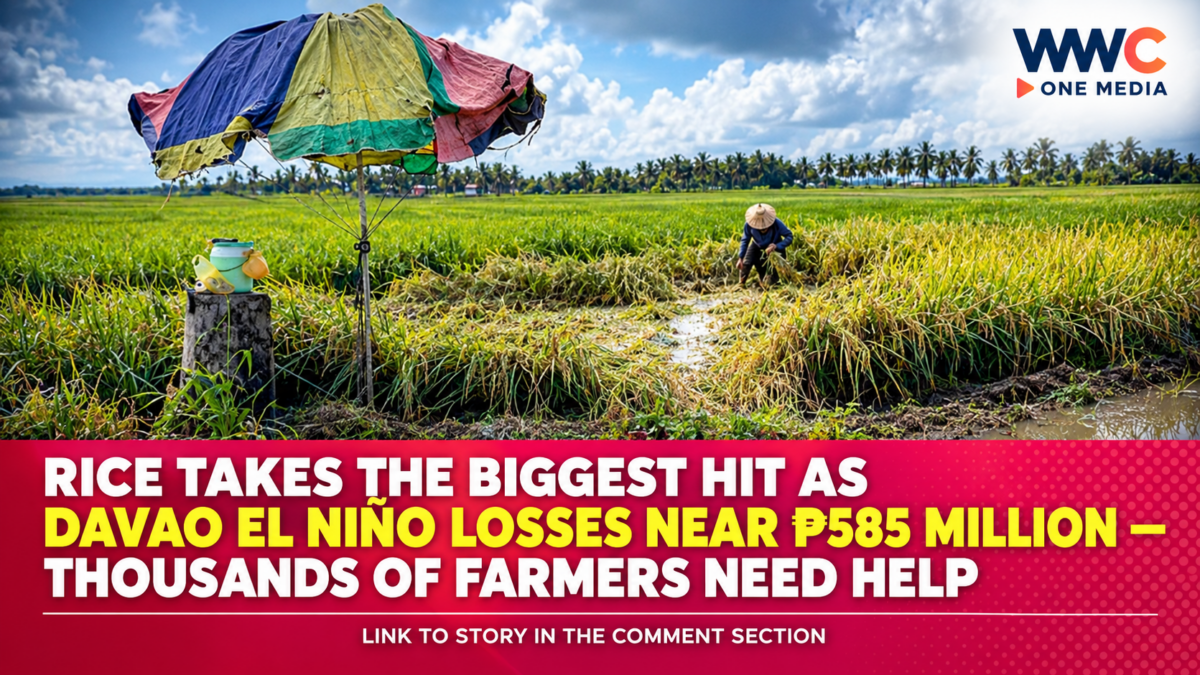
DAVAO CITY, Philippines, October 30, 2026 — Agricultural damage and production losses linked to prolonged dry conditions in the Davao Region have reached ₱584.68 million, affecting 6,205 farmers and 6,634 hectares of farmland, according to the Department of Agriculture (DA) in Davao.
The latest assessment, presented by DA-Davao disaster risk reduction and management focal person Joedel Leliza on October 28, represents a substantial increase from the agency’s previous report of around ₱400 million in losses affecting approximately 3,900 farmers.
The increase followed additional damage validation in Davao del Sur, pushing the regional total up by roughly ₱200 million.
Rice production has suffered the largest reported losses, raising concerns about farm incomes and the region’s ability to maintain agricultural output as El Niño conditions intensify. SunStar Publishing Inc.+1
Rice Accounts for ₱390 Million in Davao’s Agricultural Losses
Rice is the most heavily affected commodity, accounting for ₱390.24 million of the reported losses.
The DA’s breakdown shows:
| Agricultural sector | Reported losses |
|---|---|
| Rice | ₱390.24 million |
| High-value crops | ₱126.90 million |
| Livestock and poultry | ₱35.22 million |
| Corn | ₱32.32 million |
| Total | ₱584.68 million |
Rice losses affected 3,793 farmers and 5,362 hectares of farmland.
High-value crops accounted for the second-largest share, with fruits contributing ₱96.22 million of the reported ₱126.90 million in losses.
The figures show that the dry conditions are affecting more than staple food production. Fruit growers, corn farmers and livestock operators are also facing economic pressure. SunStar Publishing Inc.+1
Why the DA Is Using the Term ‘Moisture Stress’
Although the losses are being discussed in connection with El Niño, the DA has classified the damage as moisture stress.
Leliza explained that crop damage had already been recorded as early as January and February, before the agency could use calamity funds specifically designated for El Niño.
Moisture stress occurs when plants do not receive enough water to maintain normal growth. Prolonged water shortages can weaken crops, reduce yields and, in severe cases, destroy harvests.
The distinction is important because the agricultural damage was documented before the full onset of the weather phenomenon. It should not automatically be interpreted as evidence that every reported loss was caused exclusively by El Niño. SunStar Publishing Inc.+2
DA-Davao Prepares ₱729 Million El Niño Response Plan
To reduce further damage, DA-Davao has outlined a ₱729.11-million El Niño Action Plan covering preparation, production support and interventions in vulnerable farming areas.
The proposed allocation includes:
- ₱678.73 million to maximise agricultural production in areas considered less vulnerable to drought.
- ₱40.41 million for preparatory activities.
- ₱9.97 million to sustain production in vulnerable areas.
Davao del Norte and Davao Occidental have been identified as comparatively less vulnerable areas where the agency hopes to increase agricultural output.
Leliza said rice production in Davao del Norte is expected to increase by 20 to 30 percent during the second semester of 2026.
The strategy is intended to help maintain food supplies even as other parts of the region experience more difficult growing conditions. Philippine News Agency+1
More Seeds, Fertilizers and Water Equipment for Farmers
The agency is also procuring ₱66.34 million worth of seeds, fertilizers and plastic drums for farmers affected by moisture stress.
According to the DA presentation, the ongoing assistance batch covers approximately 12,416 farmers across the region.
The agency has also requested additional quick response funding to support farmers affected by the worsening dry conditions.
There is a difference between the amounts reported by the two government-related accounts: SunStar cited a request for ₱274.09 million, while the Philippine News Agency reported ₱268.5 million. These figures should be treated as separate reported funding requests pending clarification, rather than added together. SunStar Publishing Inc.+1
Other interventions include:
- Distribution of agricultural inputs and drought-related supplies.
- Pre-positioning of pumps for irrigated rice areas.
- Coordination with the National Irrigation Administration on water management.
- Possible crop shifting to drought-tolerant alternatives.
- Continued monitoring of farms and weather conditions.
The agency is also considering measures to protect livestock and other agricultural activities affected by prolonged dry conditions.
Farmers Urged to Collect Rainwater Before the Dry Spell Intensifies
One of Leliza’s key recommendations is for farmers to build even small water-impounding facilities while rainfall remains available.
The idea is to capture and store rainwater that can be used when prolonged dry conditions reduce water availability.
The National Irrigation Administration is also preparing to implement rotational water releases if water levels in communal and national irrigation systems fall by approximately 0.5 to 0.6 metres.
Where water shortages are expected, farmers may be advised to shift to more drought-tolerant crops, including mung beans and watermelon.
The agency has also encouraged farmers to follow its Agri Info Davao Facebook page and Agro-Climatic Advisory Portal for updated agricultural weather information and 10-day farm forecasts. SunStar Publishing Inc.+1
El Niño Threat Could Continue Into 2027
The challenges facing Davao’s farmers are part of a wider national weather threat.
PAGASA has warned that El Niño could intensify into a very strong event and persist into the first half of 2027.
The potential impact extends beyond agricultural production. Prolonged rainfall shortages can place pressure on irrigation systems, water supplies, livestock operations and electricity generation.
PAGASA’s outlook also points to expanding dry conditions across the country, making preparation particularly important for farming communities that depend heavily on seasonal rainfall.
WWC ONE MEDIA previously reported that up to 85 Philippine provinces could face dry conditions, dry spells or drought through March 2027. WWC One Media+1
Davao’s Losses Form Part of a Much Larger National Agricultural Problem
The damage in Davao is significant, but it is not an isolated regional problem.
The National Disaster Risk Reduction and Management Council reported on October 14 that El Niño-related agricultural damage across 10 regions had reached nearly ₱6.5 billion, affecting 215,386 farmers and fisherfolk.
Davao Region accounted for approximately ₱410.1 million in the NDRRMC’s earlier assessment.
That figure differs from the DA-Davao’s newer ₱584.68-million estimate because the reports were issued at different times and used different assessment updates. The figures should not be treated as contradictory final totals. Philippine News Agency+1
The growing national damage has also prompted wider discussions about emergency funding and food security.
WWC ONE MEDIA has reported on the Department of Agriculture’s support for a proposed nationwide state of calamity as El Niño threatens millions of farmers and fisherfolk, with potential agricultural losses estimated at ₱20 billion under a worst-case scenario.
Read the full report: DA backs nationwide calamity declaration as El Niño threatens 4.6 million Filipino farmers.
Could Davao’s Farm Losses Eventually Affect Food Prices?
The biggest concern is whether continued agricultural damage will reduce food production enough to put additional pressure on consumers.
Rice is particularly important because it accounts for the largest share of Davao’s reported agricultural losses.
If prolonged drought damages additional rice fields, farmers could face lower harvests and reduced income. A sustained decline in production across several regions could also increase pressure on domestic supply.
However, regional agricultural losses do not automatically mean a nationwide rice shortage. The overall impact depends on harvests elsewhere, available inventories, imports and the government’s ability to maintain distribution.
The inflation risk is nevertheless worth watching. WWC ONE MEDIA previously examined how El Niño could add pressure to Philippine inflation as food prices rise.
The Philippines is also considering larger rice imports to protect supply as weather-related risks increase. Read our report on the possibility of importing up to five million metric tons of rice.
The Bigger Question: Can Farmers Recover Before the Worst Dry Conditions Arrive?
Davao Region’s ₱584.68-million agricultural losses demonstrate how quickly prolonged water shortages can affect farmers and food production.
The DA has outlined a substantial response plan, including agricultural inputs, irrigation support, water storage and efforts to increase production in less vulnerable areas.
But the effectiveness of these measures will depend on how quickly assistance reaches farmers, whether water supplies remain sufficient and how severely the weather conditions deteriorate.
For thousands of affected farming households, the challenge is not simply surviving the current dry spell. It is protecting the next planting season and maintaining enough production to support their families.
With rice accounting for ₱390 million of Davao’s agricultural losses and El Niño expected to persist into 2027, can government interventions protect the next harvest before the damage becomes even more difficult to reverse?










