
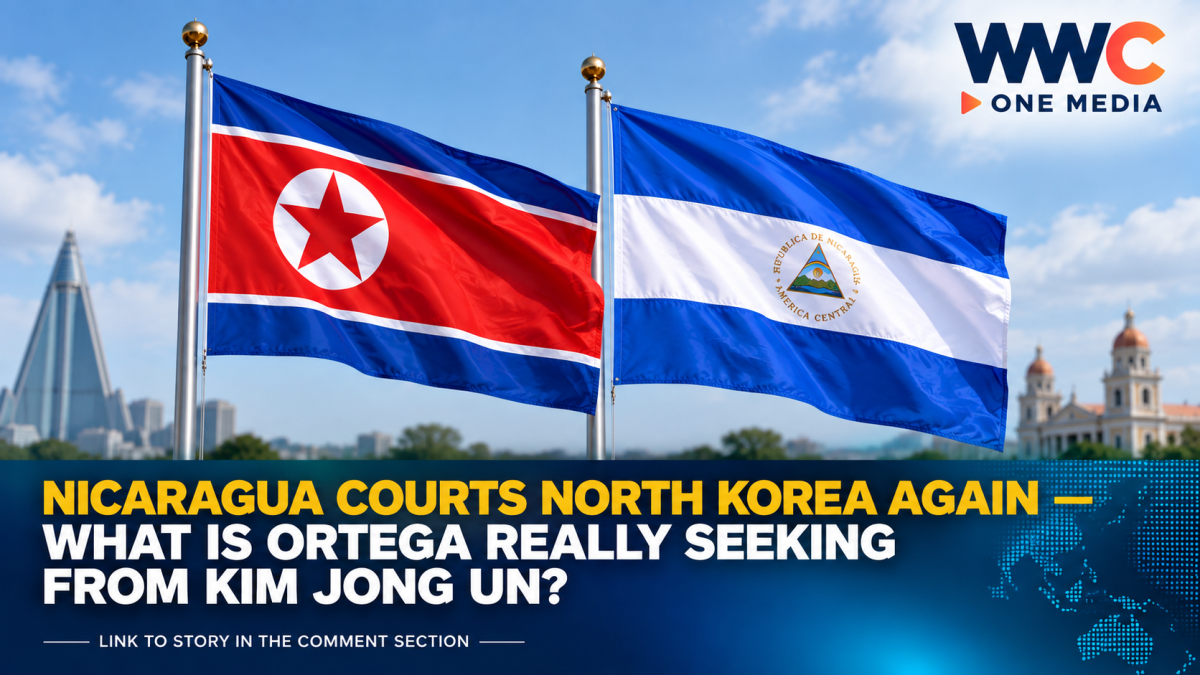
MANAGUA, Nicaragua — Nicaragua is stepping up its diplomatic courtship of North Korea, reviving and deepening a relationship that has existed for decades as President Daniel Ortega’s government looks to strengthen ties with governments that share its opposition to U.S. influence.
The latest signals come as Managua publicly celebrates its relationship with Pyongyang and reiterates its commitment to expanding bilateral cooperation. In August, Ortega and Vice President Rosario Murillo marked the 47th anniversary of diplomatic relations with North Korea, describing the relationship as one based on friendship, solidarity, sovereignty and self-determination.
The outreach is significant because Nicaragua’s relationship with North Korea has moved well beyond symbolic rhetoric in recent years. The two governments agreed to establish embassies in each other’s capitals, with Nicaragua sending Ambassador Manuel Modesto Munguía Martínez to Pyongyang.
Why Is Nicaragua Looking Toward Pyongyang?
Analysts quoted by Nicaragua’s La Prensa argue that the Ortega-Murillo government is seeking stronger relationships with governments outside the traditional Western diplomatic sphere.
A report published in April said Managua was pursuing closer relations with North Korea and several African countries as part of a broader effort to counter its diplomatic isolation and build political support internationally. Analysts cited by the newspaper suggested that the relationship could also have a military and security dimension, although claims about specific future cooperation should be treated as analysis rather than confirmed agreements.
That distinction matters: there is no verified evidence in the latest reporting that Nicaragua and North Korea have announced a new military alliance or formal defense pact.
What is clearly documented is a sustained diplomatic push.
From the Sandinista Revolution to Today’s Relationship
Nicaragua and North Korea established diplomatic relations in 1979, shortly after the Sandinista Revolution.
The relationship cooled after the Sandinistas lost power in 1990, but ties were restored after Ortega returned to the presidency in 2007. The relationship gained new momentum in the 2020s, culminating in Nicaragua’s diplomatic presence in Pyongyang.
Nicaragua’s embassy initiative was particularly notable because it came as Pyongyang began gradually restoring diplomatic contacts following the COVID-19 period. Yonhap reported in 2024 that Nicaragua’s new ambassador was preparing to take up his post in Pyongyang after the two countries agreed to open embassies.
The move gave Managua a direct diplomatic presence in one of the world’s most isolated capitals.
The Kim-Ortega Connection
The political similarities between the two governments have also attracted attention.
North Korea is governed by the Kim family dynasty under Kim Jong Un, while Nicaragua has increasingly concentrated political power around Ortega and Murillo. In 2026, Ortega announced that Nicaragua would no longer hold elections, a move that drew international criticism and further intensified comparisons between Managua and other authoritarian systems.
That political trajectory provides important context for Nicaragua’s renewed outreach to Pyongyang.
However, the comparison should not be overstated. Nicaragua and North Korea have very different economies, geopolitical positions and relationships with other countries. Their cooperation is better understood as a convergence of political interests than as evidence that Nicaragua is becoming a North Korean-style state.
Nicaragua’s Timing Is Crucial
The renewed courtship is taking place while North Korea itself is strengthening relationships with other governments that are challenging or distancing themselves from the U.S.-led international order.
North Korea’s relationships with Russia and China have become increasingly important. Reuters reported this week that Chinese President Xi Jinping and Russian President Vladimir Putin both sent messages emphasizing their strategic relationships with Pyongyang on the anniversary of North Korea’s founding.
North Korea has also deepened military cooperation with Russia, including its reported deployment of troops in support of Moscow’s war in Ukraine. Kim Jong Un recently praised North Korean personnel involved in overseas military operations.
For Managua, closer ties with Pyongyang therefore fit into a broader pattern of seeking relationships beyond the United States and its traditional partners.
Nicaragua Sends Another Message to Kim
The relationship has remained active even beyond the anniversary of diplomatic ties.
On the occasion of North Korea’s 78th founding anniversary in September 2026, Ortega and Murillo again sent a congratulatory message to Kim Jong Un, praising North Korea’s sovereignty and independence and calling for continued solidarity between the two governments and peoples.
The message reinforces the impression that Managua intends to keep Pyongyang firmly within its network of international partners.
But What Can North Korea Actually Offer Nicaragua?
This is where the story becomes more complicated.
North Korea is itself heavily constrained by international sanctions and has limited economic capacity compared with Nicaragua’s major trading partners. As a result, the relationship is unlikely to transform Nicaragua’s economy overnight.
The potential value may instead lie in political solidarity, diplomatic coordination and security-related cooperation.
La Prensa reported that analysts believe Managua could be interested in North Korean expertise in areas such as military and cyber capabilities. Those claims, however, come from analysts and former officials cited by the newspaper and should not be presented as proof that such assistance has been agreed or delivered.
That distinction is essential when assessing the rapidly developing relationship.
A Diplomatic Partnership With Bigger Geopolitical Implications
Nicaragua’s outreach to North Korea may therefore be less about trade and more about strategic positioning.
As Managua faces growing criticism from the United States, European governments and international rights organizations, Ortega and Murillo have increasingly emphasized relationships with governments willing to recognize Nicaragua’s sovereignty and resist Western pressure.
At the same time, Pyongyang has strong incentives to maintain diplomatic relationships in regions where it has historically had limited influence.
The result is a partnership that remains relatively small economically but potentially significant politically.
THE BOTTOM LINE
Nicaragua is not announcing a new alliance with North Korea, but Managua is clearly maintaining and deepening a relationship that dates back to 1979.
The opening of diplomatic missions, repeated high-level messages to Kim Jong Un and public commitments to expand cooperation show that the Ortega-Murillo government sees value in keeping Pyongyang close.
And with Nicaragua facing increasing international pressure while North Korea strengthens its own ties with Russia and China, the question is no longer simply why Managua remains friendly with Pyongyang.
Leave a Reply