
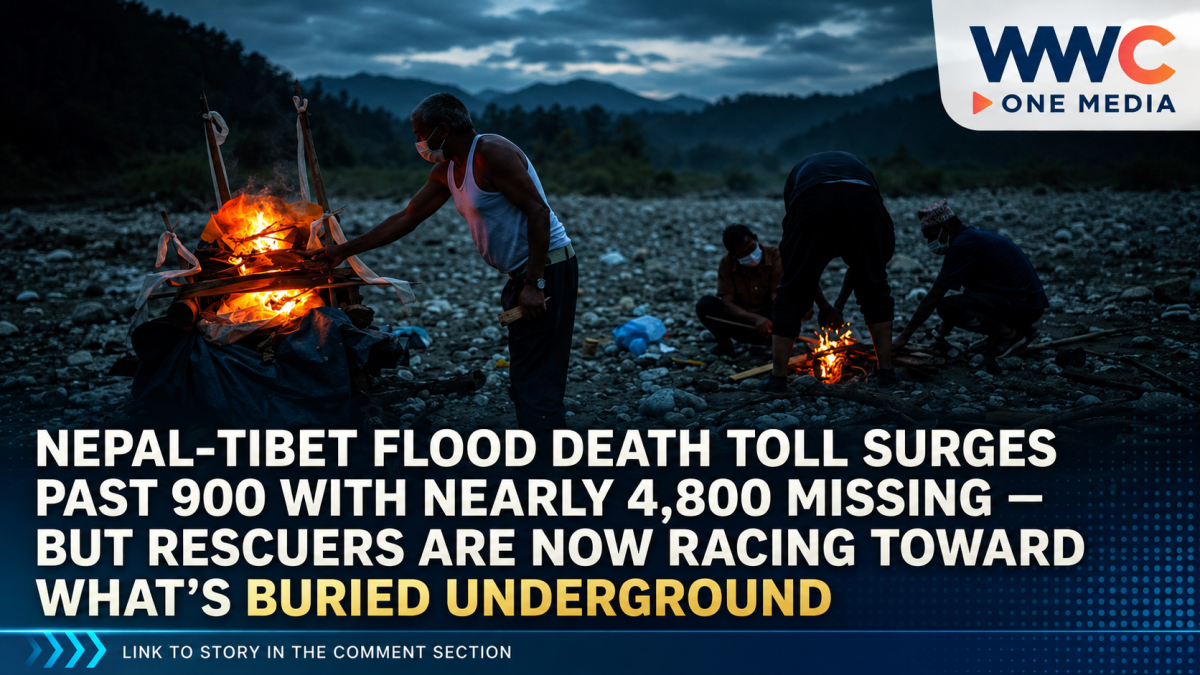
KATHMANDU — The scale of the Himalayan disaster along the Nepal-Tibet border has worsened dramatically, with the confirmed death toll climbing to at least 919 and nearly 4,800 people still unaccounted for, as rescue teams focus increasingly on what may be the crisis’s most difficult mission yet: reaching hundreds of workers believed trapped inside mud-blocked hydropower tunnels.
Nepalese authorities said Monday that 903 bodies or human remains have been recovered, while 4,247 people remain missing. Across the border in China’s Tibet Autonomous Region, authorities have reported another 16 deaths and 546 missing people, according to Chinese state media and international news agencies.
Those numbers mark a sharp increase from Sunday’s figures, when CNA reported 781 deaths and 2,502 missing in Nepal and another 16 deaths and 546 missing in Tibet. The rapidly changing totals underline how difficult it has been for officials to establish the full scale of destruction across remote valleys, damaged roads and communities that remain difficult to reach.
More than 900 hydropower workers are still missing
One of the biggest concerns is Nepal’s extensive hydropower network.
The country’s disaster authority says 933 hydropower workers are among those still unaccounted for, with rescuers concentrating on tunnels and underground facilities that were inundated or sealed by huge deposits of mud and debris.
Indian and Chinese specialists have joined Nepalese teams in the tunnel rescue effort. Reuters reported that crews have been bringing in heavy equipment, oxygen supplies and cameras as they attempt to penetrate blocked underground areas where workers may have sought shelter when the flood struck.
The stakes are extraordinary because rescuers do not yet know how many underground chambers remain intact — or whether survivors have access to breathable air, drinking water or safe spaces inside them.
More than 10,000 people rescued
Nepal has mobilised a massive emergency operation. Government figures reported Monday show more than 20,800 security personnel have been deployed, including members of the Nepali Army, Nepal Police and Armed Police Force. At least 10,451 people have been rescued, including thousands evacuated by helicopter.
The disaster has affected far more people than the official casualty count alone suggests.
The International Federation of Red Cross and Red Crescent Societies estimates that approximately 93,000 people may have been affected. It has launched a CHF25 million emergency appeal to support shelter, water, sanitation, health services and longer-term recovery.
Roads and bridges have been swept away, settlements have been buried under sediment, electricity infrastructure has been damaged and access to some mountain communities remains extremely difficult.
What caused the Nepal-Tibet catastrophe?
The disaster began on Aug. 26 high in the Himalayas near the Nepal-Tibet frontier.
Evidence examined by scientists indicates that a huge mass of rock and glacial ice collapsed around Langtang Lirung, producing an avalanche that sent water, rock, ice and mud racing through steep mountain valleys and river systems.
Early reports suggested an earthquake could have triggered the disaster. Subsequent analysis by the US Geological Survey indicated the seismic signal detected at the time was instead generated by the collapse and debris flow itself, according to CNA’s review of the event.
Scientists are still investigating precisely what destabilised the mountain.
Chinese state media has linked the collapse to glacier instability associated with long-term warming, but researchers have cautioned against attributing a single event solely to climate change before detailed analysis is complete. What scientists do agree on is that warming can accelerate glacier retreat, thaw frozen ground and weaken rock faces in high mountain regions.
The Hindu Kush Himalaya is considered particularly vulnerable as rising temperatures alter glaciers, snowpack and permafrost across some of the world’s highest terrain.
The danger did not end with the first flood
Rescue work has repeatedly been disrupted by fears of secondary floods.
The initial avalanche and debris flow created natural dams and temporary lakes along the river system. One major barrier lake began draining, reducing the immediate risk, but additional landslides have created new pools of water and forced authorities to keep downstream communities on alert.
Fresh rainfall has added another layer of danger. Rising river levels have forced both residents and emergency personnel to withdraw temporarily from vulnerable locations while engineers and rescue teams assess whether newly formed natural dams could fail.
That threat means rescuers are working against two clocks: the declining chances of finding survivors and the possibility that another surge of water could hit the same disaster zone.
Hundreds of bodies have been carried far downstream
The flood’s power has also transformed areas far from the original impact zone into recovery sites.
In Nepal’s Chitwan district, roughly 200km downstream from some of the worst-hit valleys, authorities have recovered large numbers of bodies carried through the river system. With mortuaries overwhelmed and many remains badly decomposed, officials have begun temporary burials after photographing bodies, recording identifying details and collecting DNA samples.
The process has left families facing an agonising wait as forensic teams attempt to match recovered remains with thousands of missing-person reports.
Hundreds of foreign nationals remain missing
The disaster has also become an international crisis because the Nepal-Tibet crossing lies on a major route used by tourists and pilgrims travelling toward Mount Kailash.
Nepal’s latest government figures list 592 foreign nationals among those missing on the Nepalese side, while Chinese authorities have previously said 261 foreigners from 23 countries were among those unaccounted for in Tibet.
Foreigners reported missing during the crisis have included travellers and workers from countries including India, Australia, the United States, Britain, Canada, South Korea and Japan.
Disaster raises difficult questions over early warnings
As the search enters another critical phase, attention is also turning toward whether better cross-border monitoring could have reduced the loss of life.
Reuters reported that Nepal is renewing calls for China to provide more detailed and timely data on glacier movement and upstream water conditions. Nepalese officials say stronger real-time information sharing will become increasingly important as climate-related hazards intensify in the Himalayas.
China says it has supplied Nepal with warnings concerning heavy precipitation and argues that detecting sudden collapses in remote, extremely high-altitude terrain remains technically difficult.
The challenge in this case was especially acute because the catastrophe was not preceded by the kind of intense local rainfall that conventional flood-warning systems normally monitor. Once the avalanche entered the narrow valleys, the resulting torrent moved with devastating speed, leaving communities downstream very little time to escape.
The search is now entering its most difficult stage
Nepal’s government has requested specialised international assistance for tunnel rescue, forensic identification, DNA testing, refrigerated storage and advanced equipment capable of locating people beneath debris.
Prime Minister Balendra Shah has described the catastrophe as unimaginable, while Nepalese officials have warned that reconstruction could cost billions of dollars.
For now, however, recovery is secondary to the search.
With nearly 4,800 people still officially missing across Nepal and Tibet, rescuers are continuing to dig through collapsed infrastructure, river sediment and sealed tunnels — knowing that what they discover underground could dramatically change the human toll of one of the Himalayas’ most devastating recent disasters.




Leave a Reply