
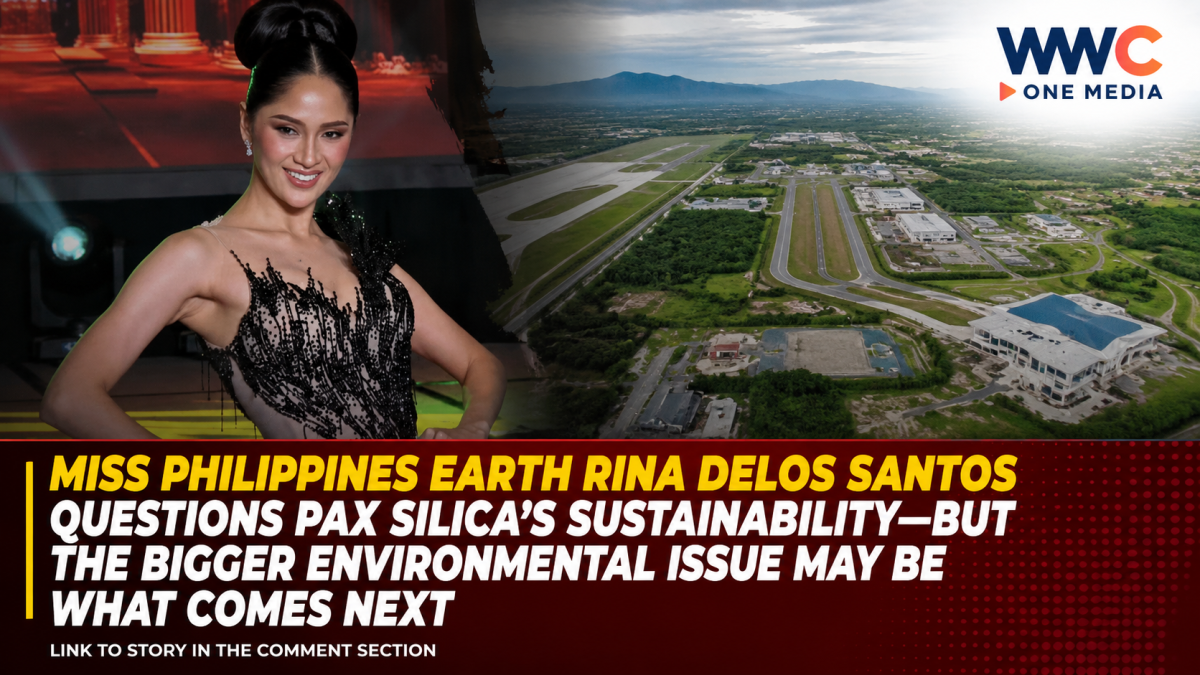
MANILA, Philippines — Miss Philippines Earth 2026 Rina Andrea Delos Santos is putting the spotlight on one of the country’s most closely watched technology and infrastructure proposals, questioning whether the planned Pax Silica hub in New Clark City, Tarlac can genuinely be considered sustainable.
Her position comes as the proposed US-led initiative faces increasing scrutiny over its potential demands for water, electricity, land and natural resources, as well as questions about its long-term environmental impact.
Delos Santos, an environmental advocate and community tour guide from Ballesteros, Cagayan, has built her platform around sustainable tourism and environmental stewardship. Her advocacy makes her criticism of the project particularly significant as the Philippines prepares for a major expansion of its role in the global semiconductor and artificial intelligence supply chain.
What is Pax Silica?
Pax Silica is a US-led international initiative designed to strengthen supply chains for semiconductors, artificial intelligence, critical minerals and other strategic technologies.
The Philippines is among the countries participating in the initiative, with the government proposing a major AI and advanced manufacturing hub in New Clark City.
The project is envisioned to cover roughly 1,620 hectares, with semiconductor manufacturing, advanced technology industries and critical-mineral processing among the activities being considered.
Government officials have promoted Pax Silica as a potential driver of investment, employment and higher-value manufacturing.
The Bases Conversion and Development Authority has said the project could eventually generate substantial economic activity and employment, while the Philippine government sees it as an opportunity to move beyond exporting raw or minimally processed resources.
But the project’s environmental footprint has become one of its biggest points of controversy.
Why environmental groups are raising concerns
One of the central questions involves the enormous amounts of electricity and water that could be required by AI infrastructure and advanced manufacturing.
A recent analysis published through the Asia News Network, citing work by Philippine Daily Inquirer contributor Dr. Teodoro C. Mendoza, said the envisioned Pax Silica development could require as much as 3 gigawatts of power and 39 billion liters of water annually under the scenarios being discussed.
GMA News has likewise reported concerns over how the project could sustain its water requirements, particularly because semiconductor and AI-related facilities can require significant quantities of water and reliable electricity.
Those requirements have raised questions about whether Central Luzon has enough water and energy capacity to support the proposed industrial expansion without creating additional pressure on communities, agriculture and existing infrastructure.
Senator Imee Marcos has also called for a Senate investigation into the project’s projected water and electricity requirements and its possible long-term environmental effects.
A crucial development: No project-specific environmental assessment yet
The environmental debate took another turn this week.
During a House of Representatives budget hearing, DENR Secretary Juan Miguel Cuna said no environmental impact assessment has been applied for or processed specifically for Pax Silica.
Cuna also said that the Department of Environment and Natural Resources does not yet have a sufficiently clear project description that would allow officials to properly evaluate its environmental effects.
This distinction is important.
While the proposed site falls within the broader New Clark City development, an existing environmental compliance certificate covering the larger master plan does not necessarily constitute an environmental assessment of the specific Pax Silica facilities that may eventually be constructed.
That means many of the project’s precise environmental impacts remain subject to further assessment as the development takes shape.
Government: safeguards will be in place
The Philippine government has pushed back against concerns that Pax Silica will automatically result in environmental destruction or displacement.
Malacañang has said President Ferdinand Marcos Jr. wants the project to protect Philippine interests, comply with existing laws and include safeguards for the environment and affected communities.
The BCDA has also sought to correct what it described as misconceptions surrounding the proposal, saying the planned Pax Silica innovation ecosystem would occupy designated buildable areas within the New Clark City master plan.
The government’s argument is that Pax Silica is not simply about building AI data centers. Instead, it is intended to create a broader ecosystem involving advanced manufacturing, semiconductors, critical minerals, energy and other industries connected to the global technology supply chain.
The economic promise—and the environmental trade-off
Supporters see Pax Silica as an opportunity for the Philippines to capture more value from the semiconductor and technology industries.
PNA reported that the initial development phase could cover approximately 500 hectares, with site development being eyed within three to five years. Officials have also projected that the initiative could contribute to a dramatic expansion of Philippine exports over the longer term.
But critics argue that economic benefits should not come at the expense of water security, agricultural land, electricity affordability, ecological stability or local communities.
That debate is particularly relevant because the proposed project is located in Central Luzon, an area that already supports major agricultural and industrial activities.
Why Rina Delos Santos’ criticism matters
Delos Santos is not approaching the issue simply as a celebrity.
The newly crowned Miss Philippines Earth 2026 has consistently positioned herself as an environmental advocate.
Before winning the crown, she worked as a community tour guide and developed an advocacy around sustainable tourism. GMA News reported that she views tourism as a way to preserve heritage, protect the environment and create meaningful connections with communities.
Her winning answer at the Miss Philippines Earth 2026 coronation also centered on environmental stewardship.
“As a community tour guide,” Delos Santos said during the competition, she was ready not only for the crown but also for the environmental and global responsibility that came with it.
That background gives added weight to her concerns about whether large-scale technological development can genuinely coexist with environmental protection.
The question now is bigger than Pax Silica
The debate surrounding Pax Silica is increasingly shifting from whether the project can create jobs and investment to how those benefits will be balanced against environmental costs.
There is little disagreement that semiconductors, AI and advanced manufacturing could provide significant economic opportunities for the Philippines.
The harder question is whether the country can build that future while protecting the resources and communities on which Filipinos already depend.
For now, the government says safeguards will be required. Critics want more transparency and stronger environmental scrutiny. And with DENR confirming that a project-specific environmental impact assessment has not yet been processed, one major part of the debate remains unresolved.
For Delos Santos, the issue ultimately comes down to whether development can live up to the sustainability principles that the Philippines increasingly promotes.
And as Pax Silica moves closer to implementation, the environmental questions surrounding the project may become just as important as the economic promises attached to it.



Leave a Reply