
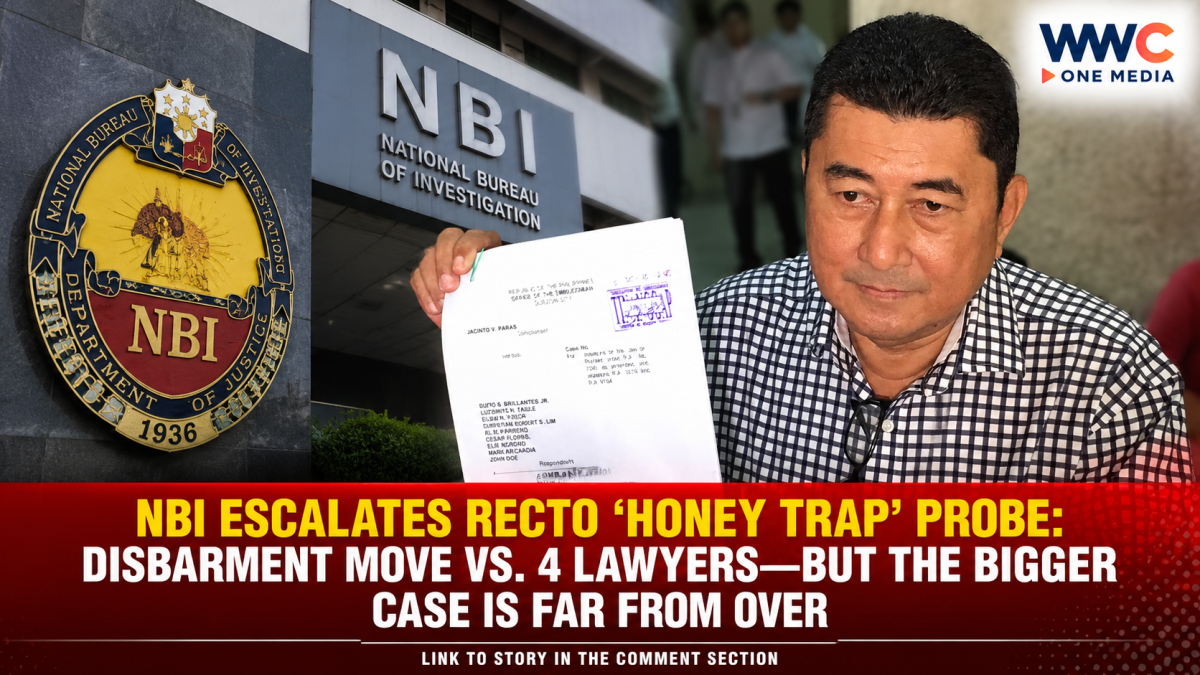
MANILA, Philippines — The National Bureau of Investigation (NBI) has moved to widen the legal fallout from the alleged “honey trap” plot targeting Executive Secretary Ralph Recto, with the bureau pursuing possible disbarment proceedings against four lawyers allegedly linked to the scheme.
The development comes after the NBI filed a qualified human trafficking complaint against seven individuals before the Department of Justice (DOJ), including Batangas 1st District Rep. Leandro Leviste, former Negros Oriental lawmaker Jacinto “Jing” Paras, a talent manager identified as “Alias Ken,” and four lawyers from the Rondain and Mendiola Law Firm.
The four lawyers were identified as Ruy Alberto S. Rondain, Orlando E. Mendiola, Patrick L. Criaga, and Josemilio Manuel Z. Apostol.
NBI says evidence supports trafficking complaint
NBI Director Melvin Matibag said investigators had completed their evidence-gathering and found what they considered sufficient basis to pursue qualified human trafficking charges.
The bureau cited testimonial evidence, CCTV footage, statements attributed to people involved and other supporting documents in building its case.
According to the NBI’s investigation, the alleged operation involved recruiting women who would supposedly be used to fabricate accusations of sexual misconduct and illegal drug use against Recto.
The alleged objective, investigators said, was to damage the executive secretary’s reputation through a staged controversy.
The NBI’s criminal complaint was formally lodged with the DOJ’s National Prosecution Service on September 4.
Four lawyers face a separate professional threat
While all seven respondents were included in the qualified human trafficking complaint, the NBI also announced a separate move concerning the four lawyers.
Matibag said the bureau would consider filing disbarment complaints against the lawyers, while an ethics complaint against Leviste could also be brought before the House of Representatives Committee on Ethics and Privileges.
The distinction is important: Paras is among the respondents in the trafficking complaint, but the planned disbarment proceedings concern the four lawyers.
The professional case could place the lawyers’ licenses to practice law at risk if the appropriate disciplinary proceedings ultimately establish violations of professional rules.
DOJ now examining the trafficking complaint
The case has since moved beyond the NBI.
Justice Secretary Frederick Vida said on September 10 that the DOJ was evaluating the qualified human trafficking complaint and had 10 days to determine whether it would proceed to preliminary investigation or be returned to the NBI.
That means the NBI’s filing does not automatically establish criminal liability.
The allegations remain allegations unless and until they are proven through the proper legal proceedings.
How the alleged honey trap was uncovered
The investigation reportedly began after the NBI arrested the talent manager known as “Alias Ken” on July 28 during a separate human trafficking operation.
According to the NBI’s account, Ken later provided information about an alleged plan involving women he managed.
Investigators said the women were supposedly being recruited to make false statements accusing Recto of forcing them to use illegal drugs and engage in sexual activity.
Ken allegedly told investigators that he met Paras and the lawyers in July to discuss the plan, while the lawyers were allegedly involved in preparing statements that could be used against Recto.
The allegations have been repeatedly denied by those implicated.
Paras has described the accusations as fabricated, while Leviste’s camp has denied involvement. One of the lawyers, Mendiola, said he would comment after reviewing the criminal complaint.
Leviste remains outside the Philippines
The controversy has also taken an international turn.
The NBI has sought an immigration lookout bulletin order covering Leviste, Paras and the other respondents. The bureau said Leviste remained outside the Philippines and had been seen in France after previously traveling to Hong Kong and Switzerland.
The NBI has said it wants the lookout measure to help ensure that respondents remain available for legal proceedings.
However, an immigration lookout order is not the same as a warrant of arrest, and the respondents remain entitled to due process.
What happens next?
The immediate focus is now on the DOJ.
The department must determine whether the NBI complaint has sufficient basis to move into a formal preliminary investigation. At the same time, the proposed disciplinary proceedings against the four lawyers could create another legal front separate from the criminal trafficking case.
For now, the case remains at the complaint and investigation stage.
But with the NBI’s trafficking complaint already before the DOJ—and possible disbarment proceedings looming over four lawyers—the alleged Recto “honey trap” controversy is entering a potentially more consequential phase.
No court has yet found Leviste, Paras, the four lawyers, or the other respondent guilty of the allegations. All respondents remain entitled to due process and the presumption of innocence.




Leave a Reply