
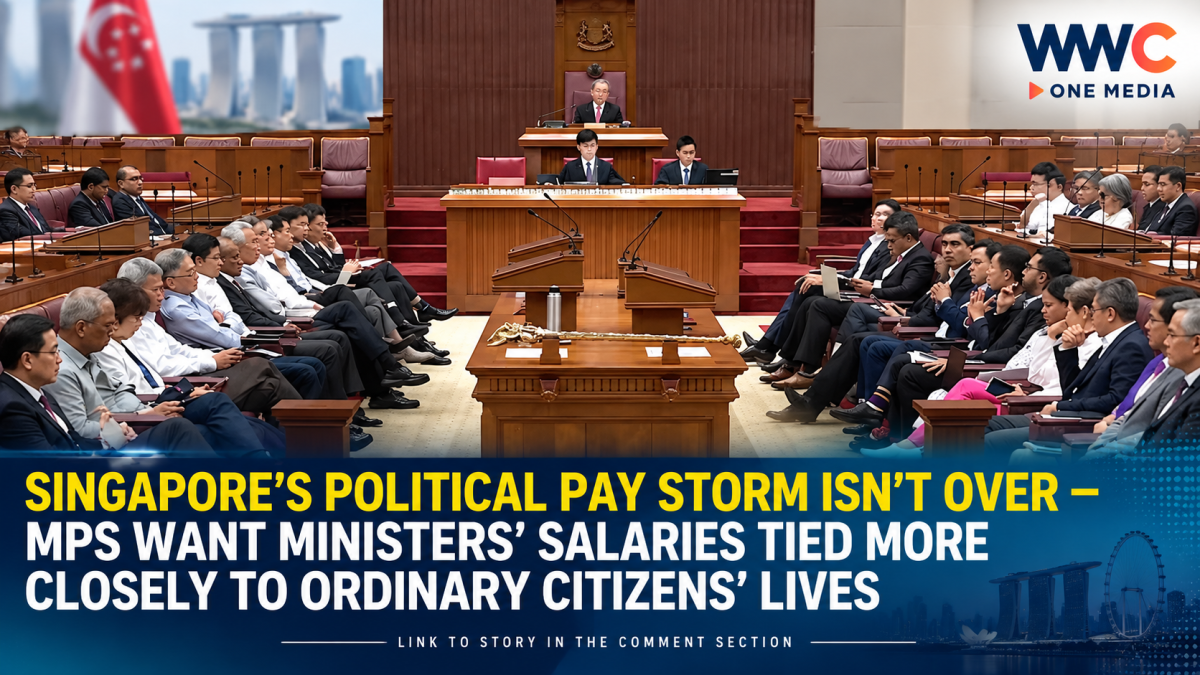
SINGAPORE — Singapore’s decision to revise the salaries of its political leaders has sparked a deeper debate in Parliament — and the argument is no longer simply about how much ministers should earn.
The bigger question now is how their pay should be structured, how transparent it should be, and whether political leaders should share more directly in the economic fortunes of ordinary Singaporeans.
During a parliamentary debate on September 10, Nominated Members of Parliament (NMPs), People’s Action Party (PAP) MPs and Workers’ Party (WP) chief Pritam Singh raised concerns and proposals surrounding Singapore’s newly revised political salary framework. The debate lasted more than four hours and followed the government’s announcement that political office holders would receive an immediate salary adjustment of up to 9 per cent.
But several lawmakers made it clear: the debate over political salaries may be about to become a debate over political accountability itself.
Should Ministers Earn More Only When Singaporeans Prosper?
One of the strongest proposals came from NMP Azhar Othman, who suggested a major restructuring of how ministers are paid.
Instead of placing most of a minister’s remuneration in a fixed salary, Azhar proposed increasing the variable component to 55 per cent of annual pay, leaving 45 per cent as fixed compensation.
More importantly, he argued that the variable component should be heavily and transparently linked to national outcomes that Singaporeans experience directly — including real median income growth, unemployment and housing affordability.
The underlying message was powerful: political leaders should not merely oversee national outcomes — their compensation should also rise and fall with them.
If the country performs well, leaders should benefit. But if Singapore faces economic difficulties, ministers should also feel part of the national sacrifice.
Other NMPs pushed for longer-term goals to be incorporated into ministerial performance assessments, raising questions about whether annual or short-term performance measures are sufficient for judging political leadership.
The Workers’ Party Supports Immediate Adjustments — But Wants a Different Formula
The Workers’ Party did not reject every aspect of the government’s proposal.
WP chief Pritam Singh supported the increase in MPs’ allowances and the government’s decision to limit the immediate adjustment for political office holders to up to 9 per cent during the current term.
However, Singh argued that Singapore should adopt a different formula for determining ministerial salaries in the longer term.
He also called for greater transparency regarding ministers’ actual remuneration — an issue that Prime Minister Lawrence Wong indicated the government was prepared to consider further.
Wong said the government could provide more information about where ministers fall within their salary ranges and how variable payouts are determined, potentially using broad remuneration bands.
That could become one of the most significant outcomes of the debate.
Singapore has long promoted transparency in its political salary system, but lawmakers are now asking whether publishing the framework alone is enough if the public cannot clearly see how individual ministers’ final compensation is determined.
Why Is Singapore Raising Political Salaries Now?
Singapore’s political salary framework has remained unchanged for around 15 years, despite previous reviews.
An independent committee reviewed the system in 2017 and recommended adjustments, but the government chose not to implement them. A further scheduled review in 2023 was later deferred amid global economic uncertainty.
Prime Minister Lawrence Wong said the government could no longer indefinitely maintain a framework in principle while repeatedly delaying its implementation.
He acknowledged that political salaries are an emotional and sensitive issue because the amounts involved are significantly higher than what most citizens earn.
But Wong argued that the debate should not be reduced to a question of money alone.
According to the government, the central issue is whether Singapore can continue attracting capable individuals into political leadership and public service.
The government has maintained that competitive salaries are necessary to attract top talent and reduce the financial opportunity cost of entering politics. Singapore’s political salary system also aims to minimise incentives for corruption by ensuring senior political leaders receive competitive and transparent compensation.
Singapore’s Prime Minister Could Eventually Earn S$3.6 Million
The debate has attracted international attention because Singapore already has some of the world’s highest-paid political leaders.
Under the revised framework, Prime Minister Lawrence Wong’s benchmark annual salary could eventually rise from S$2.2 million to S$3.6 million.
However, the government is not immediately moving political office holders to the full revised salary benchmarks.
Instead, political office holders will initially receive adjustments of up to 9 per cent from October 15, depending on responsibilities and performance, with the broader framework phased in over time.
Wong has also pledged to donate the increase in his salary to charity for the next five years.
Reuters and the Associated Press reported that the issue has reignited public debate over whether Singapore’s political compensation system remains appropriate at a time when citizens are also dealing with concerns about living costs and economic pressures.
The Government Says High Pay Is About Leadership, Not Privilege
Singapore’s government has consistently defended its approach by arguing that political leadership should remain competitive with opportunities available in the private sector.
In his ministerial statement, Wong said political salaries must be high enough to attract individuals of the necessary calibre while still incorporating a substantial discount to reflect the ethos of public service.
He also noted that political salaries had been held back for years while compensation in the private sector, civil service and judiciary continued to rise. According to Wong, some senior permanent secretaries now earn more than ministers.
Supporters of the system argue that Singapore’s approach helps attract highly qualified professionals who might otherwise remain in the private sector.
But critics and lawmakers questioning the framework are asking something equally important:
Should attracting talent be the only benchmark — or should political compensation be more directly connected to the lives of the people being governed?
A Debate About More Than Salaries
The September 10 debate revealed that there is some agreement across Singapore’s political spectrum on the need for adjustments during the current term.
The deeper disagreement concerns the future.
Should ministers’ salaries continue to be benchmarked primarily against high private-sector earnings?
Should a larger share of their pay depend on measurable national outcomes?
Should long-term goals carry greater weight than short-term performance?
And how much should the public know about what individual ministers actually receive?
These questions could shape Singapore’s political salary framework for years to come.
The government argues that competitive compensation is necessary to secure strong leadership for a small and highly competitive country.
Critics are not necessarily disputing the need to attract capable leaders.
Instead, the emerging argument is becoming more nuanced — and potentially more politically significant.
Singaporeans may accept that good leadership has value. But Parliament is now asking whether the rewards of political leadership should be more visibly tied to the results that citizens experience themselves.
That is why this debate may not end with a 9 per cent adjustment.
It may eventually redefine what Singapore expects from its political leaders — and what those leaders must deliver before earning more.
Because the question confronting Parliament now is no longer simply: How much should a minister earn?
The more difficult question is: What should a minister have to deliver to deserve it?


Leave a Reply