
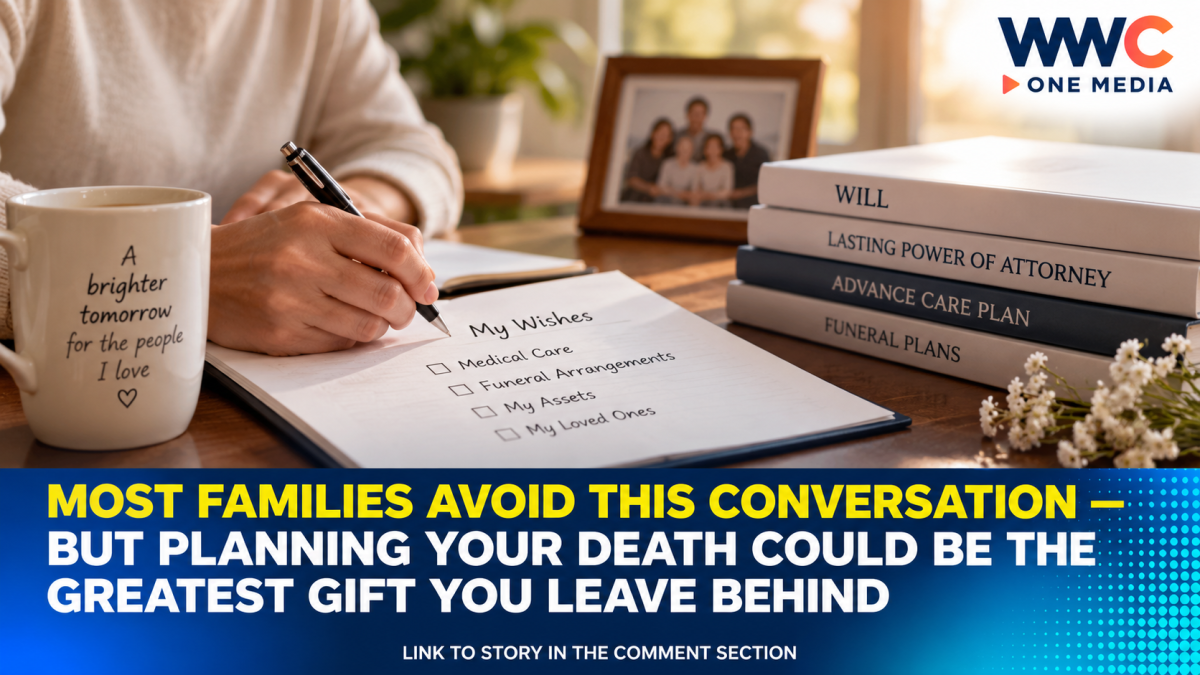
Talking about death is uncomfortable. Planning your own funeral can feel even more unsettling.
But in Singapore, an increasing number of people are doing exactly that — deciding in advance how they want to be cared for, what should happen to their assets, and even what their funeral should look like.
The shift is being driven by an ageing population, changing attitudes toward funerals and a growing recognition that leaving everything until the final moment can place an enormous emotional and practical burden on loved ones.
And experts say the real issue isn’t simply preparing for death.
It’s making sure the people left behind don’t have to guess what you wanted.
Why more people are planning their own funerals
For generations, conversations about death have often been avoided because they are associated with fear, grief or bad luck.
But that attitude is gradually changing.
CNA reported that funeral directors in Singapore have seen more people — including some who are young and healthy — making advance arrangements for their own funerals. One funeral director told CNA that requests for pre-planned funerals had become much more common compared with previous decades.
Some people are doing it because they are seriously ill. Others simply want to make decisions while they are healthy and still able to communicate their wishes.
The reasoning is surprisingly practical.
A family dealing with a death is already facing grief. Adding dozens of urgent decisions about ceremonies, burial or cremation, finances and paperwork can make an already devastating period even harder.
Planning ahead can remove some of that uncertainty.
It isn’t only about the funeral
One of the biggest misconceptions about end-of-life planning is that it means choosing a casket, flowers and a venue.
It’s much broader than that.
Singapore’s government-backed MyLegacy platform encourages people to consider several parts of end-of-life planning, including making a will, deciding who can make decisions if they lose mental capacity, documenting healthcare preferences, planning funeral arrangements and organizing important documents.
That means a comprehensive plan can involve:
- A will outlining how assets should be distributed
- Advance care planning covering healthcare preferences
- A Lasting Power of Attorney or other appropriate legal arrangements
- Medical directives where applicable
- Funeral and burial or cremation preferences
- Important financial and personal documents
- Clear instructions for the people who may eventually have to act on your behalf
The goal is not to predict exactly when death will happen.
It is to make decisions before circumstances make those decisions difficult or impossible.
The unexpected lesson from one Singaporean’s experience
CNA previously profiled Calvin Pang, a healthy 37-year-old who had already begun planning his own funeral.
His motivation came partly from experiencing the deaths of his parents and seeing firsthand how advance planning could help a family.
His father had arranged matters including insurance and CPF nominations before his death.
Pang subsequently prepared his own will, advance care plan, advance medical directive and Lasting Power of Attorney, alongside funeral planning.
His philosophy was simple: planning was not about expecting death.
It was about taking responsibility for what happens when he can no longer make the decisions himself.
That distinction is important.
End-of-life planning is ultimately about control while you still have it.
Advance care planning could become one of the most important conversations
Medical decisions can become especially difficult when a person becomes unable to communicate.
Singapore’s Ministry of Health describes Advance Care Planning (ACP) as a way to communicate a person’s values, beliefs and healthcare preferences to loved ones and healthcare professionals.
MyLegacy similarly describes ACP as an ongoing process rather than simply a form to complete. It involves reflecting on what matters to you, discussing those wishes with a nominated healthcare spokesperson, documenting them and reviewing them as circumstances change.
That can help families avoid being forced to make major decisions without knowing what their loved one would have wanted.
And those conversations don’t have to wait until someone is seriously ill.
Singapore’s MyLegacy guidance says advance care planning is intended for adults who have the capacity to make their own decisions, including people who are healthy.
A will is not just for wealthy families
Another common misconception is that estate planning is something only wealthy people need.
Singapore’s MoneySense financial education platform explicitly challenges that idea.
Estate planning can help determine who receives your assets, who manages them and who may care for dependants. It can also help reduce delays, disputes and uncertainty after death.
A will can specify beneficiaries, guardians for children and the person responsible for carrying out the instructions.
But there is an important catch: not every asset is necessarily controlled by a will.
For example, Singapore’s MoneySense guidance notes that CPF savings are not distributed through a will and require a separate CPF nomination if someone wants to designate beneficiaries according to their wishes.
That is why simply writing a will may not be enough for a complete estate plan.
Even funeral planning is changing
The traditional image of a funeral is also evolving.
CNA found that younger generations are increasingly interested in personalized ceremonies that celebrate the life of the person who died rather than simply following a standardized format.
Some families are choosing more personalized music, decorations, photographs and tributes.
Others are moving away from elaborate ceremonies altogether.
The underlying trend is the same:
People increasingly want their final farewell to reflect who they actually were.
And planning those choices in advance gives individuals a voice in the process.
There is also a financial reason to plan early
Funeral arrangements can involve numerous decisions and optional services.
A 2023 study by Singapore’s Competition and Consumer Commission found that funeral arrangements can be highly customizable, with costs affected by factors such as the casket, embalming, religious rites, wake location, duration and catering.
The commission recommended greater transparency, including written terms and conditions and sufficiently detailed invoices.
That makes advance planning potentially useful from a financial perspective as well.
Instead of asking grieving relatives to make rapid purchasing decisions, families can discuss preferences and budgets beforehand.
Singapore’s ageing population makes the issue harder to ignore
The need for these conversations is becoming more urgent as Singapore ages.
CNA reported that annual deaths in Singapore were expected to rise from around 24,000 in 2021 to about 40,000 by 2040.
At the same time, more older people are living alone or reaching the end of life with limited family support.
A separate CNA report published in July 2026 found that charities, social workers and funeral providers are increasingly stepping in to help people who die without family members able to arrange their final affairs. One organization handled 330 pro bono funeral cases in 2025, more than three times its 2021 figure of 106.
That development highlights a larger social problem.
What happens when there is nobody who knows what you wanted?
The hardest part may be starting the conversation
Experts interviewed by CNA have repeatedly pointed to the same obstacle: death remains difficult to discuss.
But avoiding the subject doesn’t make the practical decisions disappear.
Eventually, someone may have to decide:
Who should handle your finances?
Who should speak to doctors if you cannot?
What happens to your property?
What happens to your savings and insurance?
What kind of funeral would you want?
Where should important documents be found?
And perhaps the most difficult question:
What would you want if you could no longer speak for yourself?
These are not necessarily conversations about dying.
They can also be conversations about how you want to live — and how you want your family to cope when you’re no longer able to guide them.
Planning for death may actually be an act of love
The most powerful argument for advance planning isn’t financial.
It’s emotional.
CNA’s reporting highlighted how people who plan ahead often see it as a way to spare their families from having to make difficult decisions during a period of grief.
Singapore’s MyLegacy similarly says advance planning can make things easier for families while helping ensure that a person’s wishes are respected.
That may be the biggest reason to start the conversation.
You don’t have to plan everything in one day.
Start with a conversation.
Write down what matters.
Review your financial and legal documents.
Tell someone you trust where important records are kept.
Discuss your healthcare preferences.
Then update the plan when your circumstances change.
Because the uncomfortable truth is simple:
Nobody knows exactly when they will need an end-of-life plan. But once it is needed, it may already be too late to create one.
WWC ONE MEDIA M.J.E




Leave a Reply