
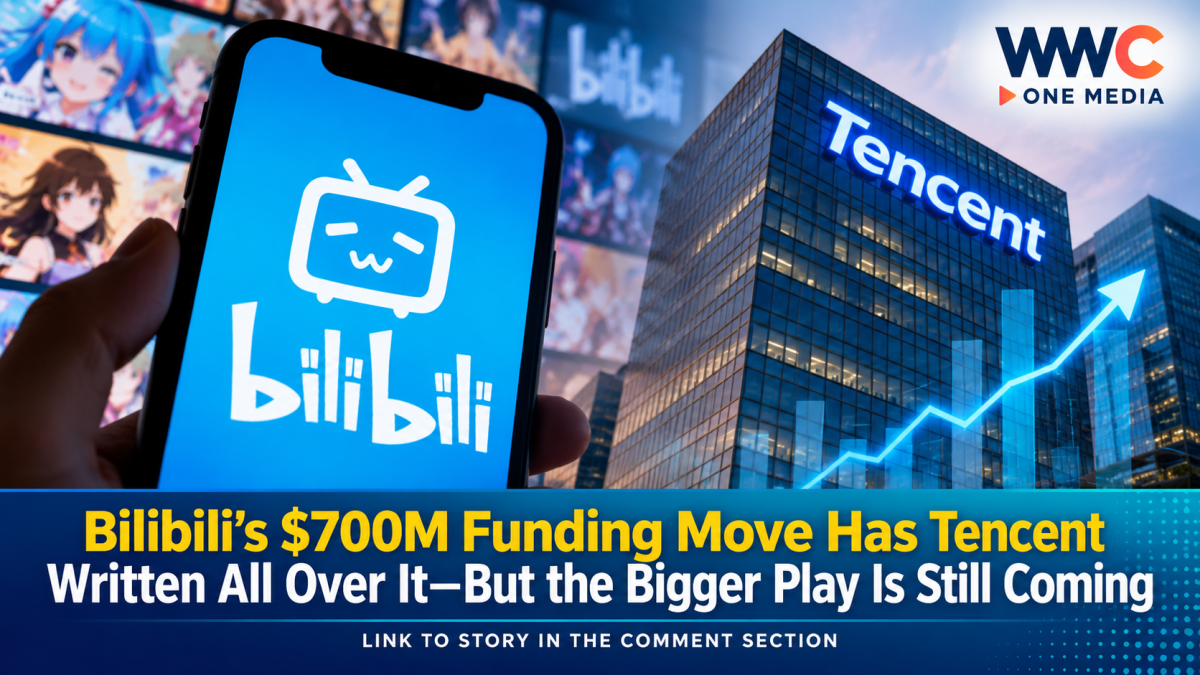
Bilibili is turning to the capital markets for $700 million in convertible senior notes, with longtime investor Tencent committing $200 million—as the Chinese video platform looks to strengthen its artificial intelligence capabilities while buying back shares.
The transaction, initially announced as a proposed offering on September 4, has since been priced. Bilibili said the notes will mature on September 15, 2031, while Tencent will subscribe for $200 million of the issue and the remaining $500 million will be sold to other institutional investors.
The move puts Bilibili at the intersection of three major corporate priorities: AI investment, capital management and its relationship with Tencent.
Tencent puts another $200M behind Bilibili
Tencent has agreed to subscribe for $200 million of Bilibili’s convertible notes through a subsidiary, on the same terms as the notes being marketed to other investors.
That commitment is significant because Tencent is also carrying out a separate transaction involving its Bilibili holdings.
Under the broader deal, Tencent is selling approximately $400 million worth of Bilibili Class Z shares through a secondary placement. Bilibili, meanwhile, plans to repurchase approximately $200 million of shares from Tencent as part of a larger share-buyback program.
In other words, Tencent is simultaneously raising cash from part of its Bilibili stake while putting $200 million back into Bilibili through the convertible notes.
That makes the transaction considerably more complex than a straightforward debt offering.
Bilibili is betting big on AI
Bilibili said proceeds from the notes will help finance AI-driven growth, including improvements in content comprehension, recommendation and content creation.
The company also intends to use AI to deepen user engagement and improve productivity and operating efficiency.
That strategy reflects the broader shift among China’s internet companies, where artificial intelligence has increasingly become a central investment priority.
For Bilibili, the opportunity is particularly relevant because its business depends heavily on understanding users, recommending content and keeping audiences engaged on its platform.
The company is therefore positioning AI not simply as a technology upgrade, but as a potential driver of content discovery, creator tools and operating efficiency.
The notes carry no regular interest
The $700 million securities are senior, unsecured convertible notes and will not bear regular interest, according to Bilibili’s announcement.
Investors will instead have the ability to convert the notes into Bilibili Class Z ordinary shares under the terms of the securities.
Following pricing, the initial conversion rate was set at 50.3374 Class Z shares per $1,000 principal amount, equivalent to an initial conversion price of approximately HK$155.79 per Class Z share.
That represented a conversion premium of approximately 28.3% over Bilibili’s HKEX closing price of HK$121.40 on September 4.
The structure allows Bilibili to raise substantial capital without paying conventional cash interest on the notes, although conversion could ultimately increase the number of shares outstanding.
Bilibili also plans a $300M share buyback
At the same time, Bilibili’s board has authorized a special share-repurchase program of up to $300 million.
Approximately $100 million is earmarked for the repurchase of shares connected with the convertible-note transaction, while another $200 million will be used to repurchase Bilibili shares held by Tencent.
The company said these transactions are designed, among other things, to help mitigate potential dilution associated with the convertible notes.
Bilibili has also priced a concurrent equity placement involving approximately 6.98 million Class Z shares, while Tencent separately offered approximately 26.37 million Class Z shares at HK$115.38 per share.
Importantly, Bilibili said it will not issue new shares or receive proceeds from the Tencent secondary placement; Tencent receives the proceeds from its share sale.
Why the Tencent angle matters
Tencent has long been a major shareholder and strategic partner of Bilibili, making its participation particularly noteworthy.
The latest transaction effectively reshapes part of Tencent’s exposure to Bilibili: Tencent is selling a substantial block of existing shares while subscribing for $200 million of convertible debt, while Bilibili simultaneously buys back $200 million worth of Tencent-held shares.
The arrangement, however, is not entirely final. The Tencent notes subscription and Tencent-related repurchase are subject to specified conditions, including shareholder approval.
Bilibili said it expects to convene an extraordinary general meeting, where the Tencent repurchase requires approval by at least three-fourths of votes cast by disinterested shareholders present.
What investors will be watching next
The immediate question is no longer whether Bilibili can raise the money—the notes have been priced—but how effectively the company can turn that capital into growth.
Investors will be watching several things:
- Whether Bilibili’s AI investments translate into stronger user engagement and monetization
- How the share repurchases affect the company’s outstanding share count
- Whether future conversion of the notes creates meaningful dilution
- How Tencent’s reduced shareholding affects the company’s ownership structure
- Whether Bilibili can maintain growth while continuing to invest heavily in technology and content
Reuters reported that Bilibili sees the current market environment as an opportunity to raise capital on attractive terms while simultaneously funding repurchases and strengthening its AI capabilities.
For Bilibili, the $700 million deal is therefore about more than simply raising cash.
It is a calculated financial maneuver combining debt financing, AI investment, share repurchases and a major restructuring of Tencent’s position.
And the part investors may be watching most closely is what happens after the money starts working: whether Bilibili’s AI bet can produce the growth needed to justify the billions of dollars now being positioned behind its next phase.
WWC ONE MEDIA J.M.S




Leave a Reply