
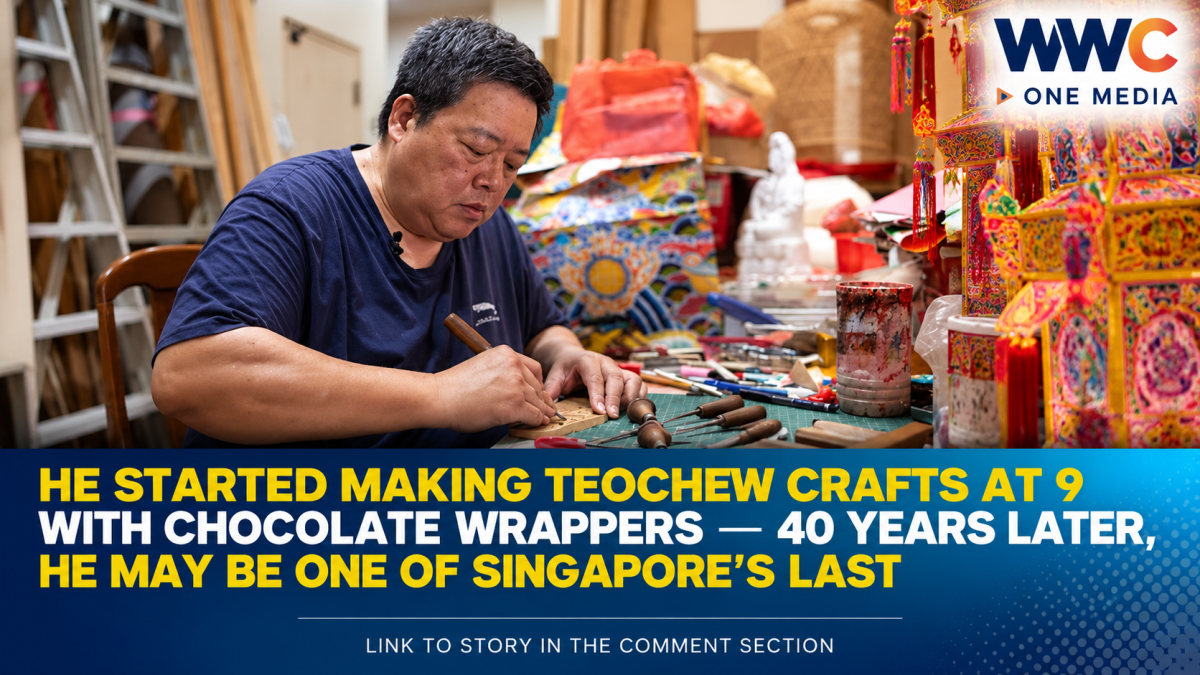
At just nine years old, Francis Tan Kwee Chye had no master, no formal training and no expensive tools.
He had scraps of wood, a penknife, a camera — and even discarded chocolate wrappers.
More than four decades later, the 50-year-old Singaporean has turned that childhood obsession into a lifelong craft, handmaking traditional Teochew wood carvings, lanterns and paper effigies while trying to preserve skills that are becoming increasingly difficult to pass on.
From a curious boy to a self-taught craftsman
Tan grew up at Sean Hua Zee Temple, where traditional religious objects and Chinese opera-related crafts were part of his surroundings.
His fascination began in Primary 3. Without YouTube, online tutorials or formal instruction, he photographed existing craft pieces, studied their proportions and attempted to recreate them himself.
Gold foil was too expensive, so he improvised with chocolate wrappers.
By around age 12, he had moved into wood carving. He collected unwanted wooden pallets from nearby factories and used a penknife because he did not have proper carving tools.
His first major carving was a sea lion, a piece he still keeps decades later as a reminder of how far he has come.
The unusual path that eventually became his career
Tan did not immediately turn his passion into a profession.
After his O-Levels, he studied drafting at the Institute of Technical Education and subsequently worked as a draftsman before moving into construction.
But traditional crafts never disappeared from his life.
He continued making pieces on the side, using discarded materials from construction sites and gradually building a small customer base.
Eventually, in his early 40s, he left construction and committed himself to craft work full time.
His work now includes wood carving, temple lanterns, paper effigies and restoration of deity statues, among other specialised pieces.
And despite decades of experience, Tan remains largely self-taught.
He learned by observing finished objects, experimenting, making mistakes and absorbing occasional advice from experienced craftsmen.
His most extraordinary commissions aren’t necessarily the biggest
One of Tan’s most emotionally demanding projects came from a family mourning the death of their daughter.
The family wanted two handmade joss-paper replicas of a portable fan after reportedly dreaming that their deceased daughter had asked for them.
Tan had only photographs to work from.
He spent about six months experimenting before completing the replicas, which were accompanied by a paper power bank and cable.
For Tan, the project became more than a commercial commission.
He viewed the detailed work as a way of showing respect to the deceased and helping the family fulfil what they believed was their loved one’s wish.
He has also recreated modern objects such as running shoes and dumbbells using traditional paper-craft techniques.
This isn’t just one man’s struggle
Tan’s story reflects a much larger challenge facing traditional craftsmanship in Singapore.
Singapore’s National Heritage Board has documented the decline of traditional Chinese paper-offering businesses. Its heritage records note that the number of Chinatown shops making paper offerings fell from around 10 in the 1980s to only two or three, with the remaining businesses moving elsewhere. The trade also faces long hours, low profit margins and difficulty attracting younger apprentices.
Singapore’s official heritage resources classify the making of Chinese paper offerings as intangible cultural heritage, describing techniques that include cutting, folding, punching, crushing, shaping and pulling bamboo and paper into intricate forms.
The challenge is not limited to paper offerings.
The National Heritage Board’s Craft X Design initiative has specifically sought to connect traditional craft practitioners with contemporary designers, helping heritage crafts reach new audiences and markets. Its 2024–2025 programme lists Francis Tan himself as a participating wood-carving practitioner.
That is significant because Tan’s story is no longer simply about preserving old objects. It is about finding ways for traditional skills to remain relevant in a modern economy.
Why Teochew craftsmanship matters
Teochew culture has deep historical roots in Singapore.
The Singapore Chinese Cultural Centre’s Culturepaedia notes that Teochew communities played major roles in traditional industries ranging from gambier and pepper cultivation to fishing, farming, rice trading, textiles, porcelain and other specialised trades. Some of those industries have since disappeared or dramatically declined.
Other traditional Teochew cultural practices are also facing generational challenges.
A 2026 heritage feature on Teochew iron-rod puppetry, for example, highlighted how younger members of one Singapore family are working to keep the centuries-old art form alive.
Tan’s own work sits within that broader struggle: what happens when the people who know how to make something disappear before anyone learns how to make it?
‘Somebody has to do this’
Tan estimates that many traditional craftsmen still working in Singapore are already in their 60s or older. At 50, he believes he may be among the younger practitioners left in his particular field.
He has conducted workshops and encountered younger people interested in learning from him.
But he has not yet taken on an apprentice.
For Tan, enthusiasm alone isn’t enough. He wants to understand a potential student’s character and commitment before passing on the knowledge.
Meanwhile, mass-produced alternatives sold through e-commerce platforms are putting additional pressure on handmade crafts.
A piece that can take Tan up to a week to make may sell for only around S$100, making it difficult for traditional craftsmanship to compete purely on price.
And what could disappear isn’t simply the physical objects.
It is the knowledge behind them — the meaning of colours, motifs, shapes and symbols that craftsmen like Tan have accumulated through decades of practice.
A tradition that may outlive its craftsman
Tan says he intends to continue working for as long as his strength and eyesight allow.
Even if he eventually retires, he does not imagine completely walking away from the craft.
For him, these aren’t merely old-fashioned objects.
They are art, memory and culture — preserved one handmade piece at a time.
WWC ONE MEDIA M.J.E




Leave a Reply