
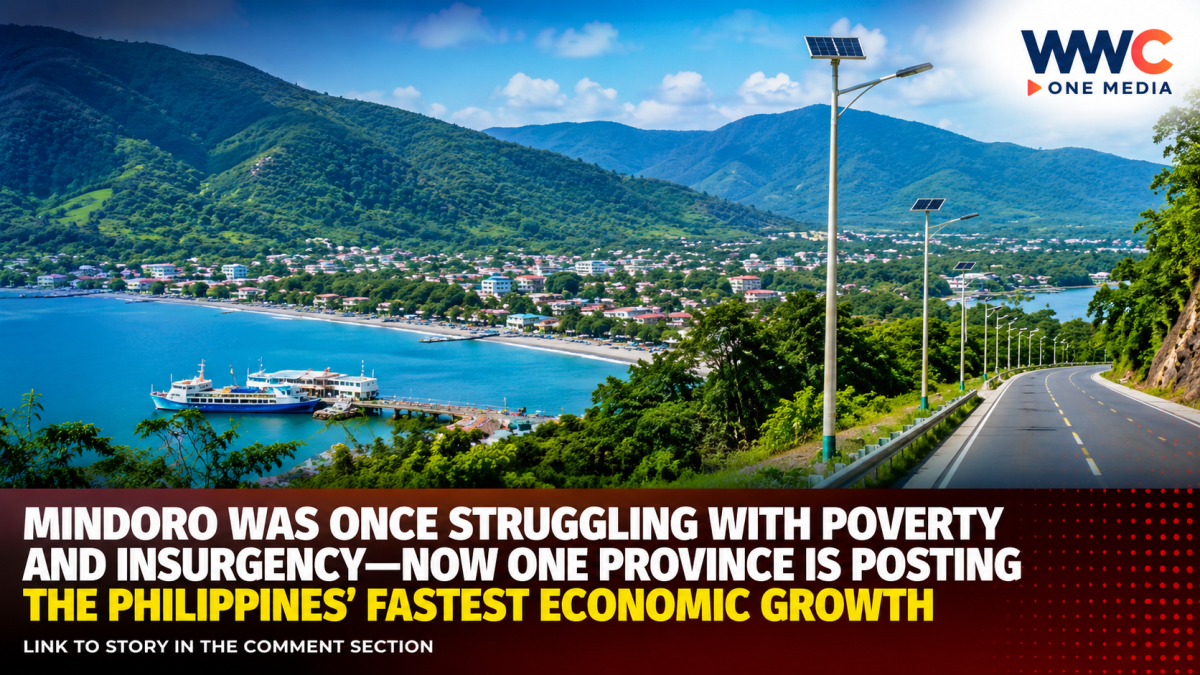
For years, Mindoro has faced a difficult combination of poverty, inadequate infrastructure, persistent power problems and security challenges.
But a striking change is now taking shape.
Occidental Mindoro emerged as the fastest-growing provincial economy in the Philippines in 2025, posting an 11.2% year-on-year growth rate—the only province or highly urbanized city in the country to record double-digit growth that year. The figure was reported by the Philippine Statistics Authority (PSA) in its latest Provincial Product Accounts.
That performance is particularly significant because Occidental Mindoro grew just 2.1% in 2024, meaning the province’s growth accelerated dramatically in a single year.
The transformation, however, is bigger than one economic statistic.
It points to how improvements in electricity, infrastructure, agriculture, MSMEs, investment and connectivity can begin changing the economic prospects of an entire province.
The power problem may have been the turning point
Occidental Mindoro had long been associated with severe and recurring electricity interruptions, earning it the reputation of the country’s “brownout capital.”
Local officials and business leaders have argued that resolving the power crisis helped remove one of the biggest obstacles to investment and economic activity.
Occidental Mindoro Rep. Leody Tarriela credited improvements in the province’s electricity situation, along with infrastructure and private-sector investments, for helping create conditions for stronger economic activity. The province has also seen investment in agriculture, transportation and other infrastructure.
A 7.4-megawatt solar power plant in San Jose is among the developments cited alongside private investments in cold storage facilities, hospitals, diagnostic centers, schools, shipyards and other businesses.
The significance is straightforward: when businesses can rely on electricity, roads and other basic infrastructure, the cost and risk of operating can fall—and that can encourage more economic activity.
Agriculture is still at the heart of Mindoro’s economy
Mindoro’s transformation is also closely tied to agriculture.
MIMAROPA recorded an 18% increase in rice production during the first half of 2025, with Occidental Mindoro posting the region’s largest provincial increase at 62%. Its palay production climbed to 127,931 metric tons from 78,737 metric tons a year earlier.
Oriental Mindoro remained the region’s largest rice producer, producing 185,739 metric tons during the same period.
The agricultural gains matter because stronger farm production can support food security while creating income throughout rural communities.
Government irrigation investments have also been helping farmers reduce production costs. In Occidental Mindoro, beneficiaries of the National Irrigation Administration’s Solar Pump Irrigation Project reported savings from reduced diesel requirements for irrigation.
MSMEs are becoming another engine of growth
Small businesses are another important part of the story.
The Department of Trade and Industry reported that the number of MSMEs it supported in Occidental Mindoro increased from 2,428 in 2024 to 2,720 in 2025.
That matters because MSMEs provide employment and generate local economic activity, particularly outside major urban centers.
A more recent example illustrates how these programs can translate into livelihoods.
In Sablayan, a handicraft business that began as a small pandemic-era livelihood venture has expanded to provide income opportunities for 22 community members after receiving assistance through DTI’s Negosyo Serbisyo sa Barangay program.
These may appear to be small individual success stories, but multiplied across communities, they can contribute to a much broader economic transformation.
But the poverty story needs a closer look
The economic comeback should not be interpreted as meaning that poverty has already been defeated.
Official poverty statistics show that significant challenges remain.
In Oriental Mindoro, poverty incidence among families was 14.1% in 2023, equivalent to about 31,000 poor families. Among individuals, poverty incidence stood at 20.6%.
The province’s poverty situation has improved substantially over the longer term compared with earlier years, but the numbers also demonstrate why economic growth must translate into sustained employment, higher household incomes and better access to essential services.
Meanwhile, the latest PSA release establishes that Occidental Mindoro’s 11.2% growth in 2025 is an economic-growth statistic—it does not by itself prove that poverty fell by the same magnitude. The poverty and economic-growth indicators measure different things and should not be conflated.
That distinction is crucial.
Development and peace are increasingly connected
Economic development in Mindoro is also intertwined with the long-running security challenge in parts of the island.
In 2025, the Philippine Information Agency reported that the MIMAROPA Regional Peace and Order Council was pushing for strategic infrastructure in conflict-prone areas, particularly improved road networks that could support both economic development and peace-building efforts.
Better roads do more than move people.
They allow farmers to bring products to markets, improve access to schools and hospitals, connect communities to government services and make previously difficult areas more accessible to legitimate economic activity.
That creates a cycle in which infrastructure can support both development and stability.
Oriental Mindoro is also showing resilience
The economic story isn’t limited to Occidental Mindoro.
Oriental Mindoro’s provincial economic data show continued expansion, with its GDP increasing from ₱114.89 billion in 2023 to ₱120.97 billion in 2024, while the services sector remained the largest contributor to the provincial economy.
The province also maintained strong agricultural production and recorded a rice sufficiency level of 209.65%, according to its 2025 Provincial Economic Situationer.
Its local government units also recorded combined annual income of ₱6.15 billion in 2025, another indication of expanding fiscal capacity.
Yet the same report identifies continuing challenges, including the need to attract more private investment, generate employment and revive tourism activity.
In other words, Mindoro’s economic transformation is a work in progress—not a finished victory.
The bigger lesson from Mindoro
The most compelling part of Mindoro’s story may not be the 11.2% number itself.
It is what appears to be happening around it.
Power improvements + infrastructure + agriculture + MSMEs + investment + connectivity = stronger economic activity.
The PSA’s latest national provincial accounts show that 76 of the country’s 82 provinces and all 33 highly urbanized cities recorded economic growth in 2025. But Occidental Mindoro stood apart as the only local economy to break the 10% mark.
The challenge now is ensuring that rapid economic expansion becomes inclusive and durable.
For Mindoro, the real test will be whether growth produces more stable jobs, raises household incomes, strengthens farmers and small businesses, attracts responsible investment and continues improving basic services.
Because an economic turnaround is ultimately measured not only by GDP.
It is measured by whether ordinary families can feel the difference.
And Mindoro’s latest numbers suggest that, after years of difficult challenges, that transformation may finally be gaining momentum.

Leave a Reply