
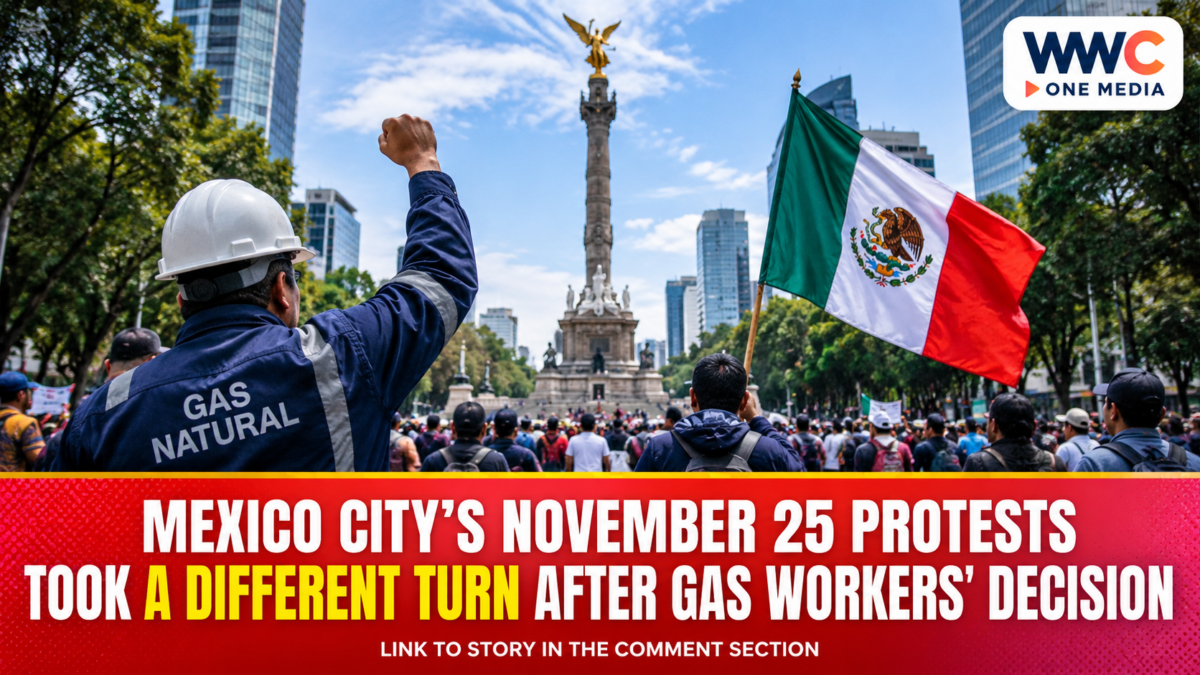
Mexico City’s November 25, 2026, public demonstrations placed two distinct issues in focus: the continuing demand to end violence against women and a dispute involving Mexico’s gas-distribution sector. A planned gas-sector road action was reportedly redirected toward a government dialogue, changing the mobility picture that had been anticipated before the date.
The developments matter beyond the day’s traffic. They illustrate how public demonstrations can bring different forms of pressure into the same urban space: demands for rights and accountability, and calls for government action on economic and working conditions.
November 25 is observed internationally as the International Day for the Elimination of Violence against Women. The United Nations established the observance through General Assembly Resolution 54/134, placing the issue within a global framework of prevention, protection and accountability. Digital Library+1
November 25 is more than a date on the protest calendar
The annual observance is rooted in the need to address violence against women as a public and institutional concern, rather than an issue confined to private life.
The United Nations’ 2026 message called for justice for survivors, stronger prevention and institutional accountability. Those priorities provide the wider context for demonstrations held around the date in different countries. DPPA+1
In Mexico City, the date is associated with public mobilization and calls for action on violence against women. The significance of those demonstrations should not be reduced to the number of people on the streets or the amount of traffic affected. Their central purpose is to keep attention on safety, access to justice and the responsibilities of public institutions.
For readers following how public demonstrations affect transport and daily routines, WWC has previously examined how a planned transport strike can affect commuters.
The gas-sector dispute shifted toward dialogue
A separate issue involved the Gremio Gasero Nacional, an organization representing participants in Mexico’s gas-distribution sector.
The group had announced a planned mobilization for November 25. The demands described in contemporaneous coverage included concerns about alleged extortion, operating margins and commissions, competition, and the time required to complete vehicle-related administrative procedures.
A government announcement attributed to Mexico’s Secretaría de Gobernación, or SEGOB, said the group’s representative, Enrique Medrano Meza, agreed to suspend the planned blockades and road closures after being invited to a dialogue meeting scheduled for 12:30 p.m. on November 25. The announcement was reported publicly, but the original government communiqué was not accessible for independent examination during this verification. infobae+1
That distinction matters. A commitment not to block roads is not the same as a final settlement of the group’s complaints. Nor does an invitation to a meeting establish that the parties reached an agreement on the issues raised.
The appropriate description, pending the original record and any meeting outcome, is that the planned road action was reportedly suspended in favor of dialogue.
Why the dispute matters to the wider public
Gas distribution is part of the everyday supply chain for households and businesses that rely on liquefied petroleum gas. Disputes involving distributors can therefore raise questions about operating conditions, service continuity and the relationship between businesses and regulators.
The group’s reported concerns also point to a broader policy question: how can authorities address complaints about enforcement, commercial conditions and administrative processes while protecting consumers and maintaining reliable service?
Those questions cannot be answered simply by counting vehicles at a demonstration. They require details about the complaints, the agencies responsible for addressing them and any concrete commitments made during negotiations.
The issue has parallels with labor disputes in other countries, where workers and industry groups use public pressure to seek government attention. WWC has previously covered labor groups pressing authorities over wage concerns. The circumstances differ, but both situations show why the substance of a group’s demands matters more than the disruption threatened by a protest.
Public demonstrations and the right to move freely
Demonstrations create a practical challenge for large cities. Authorities must protect the right to peaceful assembly while also managing roads, public transport and access to essential services.
These responsibilities should not be treated as mutually exclusive. Clear communication about routes, timing and expected crowd sizes can help commuters plan without undermining the right to protest.
The gas-sector episode also shows why public notices need to be updated when plans change. A road closure listed in an early advisory may no longer be expected after organizers agree to a different course of action. Readers should distinguish between an initial demonstration announcement and a later official traffic update.
WWC has also reported on police deployment during a transport strike in Cebu City, illustrating the public-safety considerations that can accompany large demonstrations.
What happens next
The next meaningful development in the gas-sector dispute is whether the dialogue with SEGOB produced documented commitments, a timetable for addressing the group’s concerns or further meetings with relevant energy authorities.
That outcome should be established through an official communiqué, meeting record or statement from the participating institutions. Until then, the reported suspension of blockades should not be described as a resolution of the dispute.
For the November 25 women’s-rights mobilizations, the broader measure of progress is not whether demonstrations caused traffic delays. It is whether public attention leads to concrete action on prevention, survivor support, access to justice and institutional accountability.
The two issues are distinct, but they share an important public lesson: demonstrations can draw attention to problems, while lasting outcomes depend on what institutions do after the crowds disperse.
Frequently asked questions
Why is November 25 observed internationally?
It is the International Day for the Elimination of Violence against Women, established by the United Nations General Assembly through Resolution 54/134. Digital Library
Why did gas distributors plan a demonstration in Mexico City?
The demands described in public reporting included complaints about alleged extortion, operating margins and commissions, competition and administrative procedures. These details still require confirmation against the group’s original statement. infobae+1
Were the planned gas-sector road blockades cancelled?
Contemporaneous reports reproduced a SEGOB announcement saying the group’s representative committed to suspending blockades and road closures after an invitation to dialogue. The original communiqué and any subsequent agreement still need direct verification. infobae+1
Did the government resolve the gas distributors’ complaints?
That has not been established by the material independently verified here. A meeting invitation or suspension of a protest does not, by itself, prove that the underlying complaints were resolved.
What is the purpose of the November 25 demonstrations?
The international observance calls attention to ending violence against women, securing justice for survivors and strengthening prevention and institutional accountability.










