
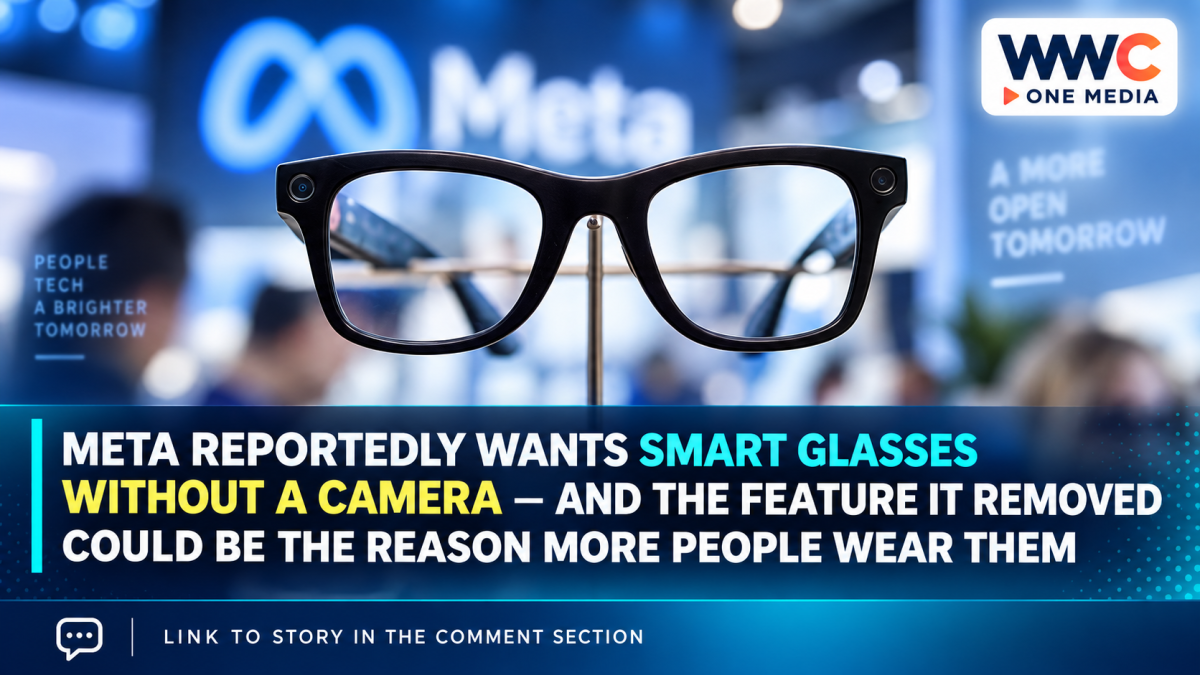
MENLO PARK, California — Meta has spent years trying to convince consumers that putting a camera on their face can be normal.
Now it may be preparing to sell smart glasses that deliberately leave the camera out.
The Facebook and Instagram parent is reportedly planning to release a new pair of camera-free AI smart glasses this fall, according to The Information, as Meta confronts growing unease over wearable cameras that can record people from a first-person perspective.
The glasses are internally code-named Luna and could be unveiled at Meta’s annual Connect conference on September 23 or 24, with shipments targeted for October, according to people familiar with the project cited by The Information. Meta did not immediately comment on the report, and Reuters said it could not independently confirm the plans.
If Luna reaches consumers as described, however, it would represent an important shift in Meta’s wearables strategy.
The company would essentially be asking a new question:
What if the feature that made smart glasses powerful — the camera — is also the feature stopping more people from wearing them?
Six microphones, speakers and Meta AI — but no camera
According to The Information, Luna would retain much of what makes current Meta glasses useful while removing their most controversial hardware.
The reported model includes six microphones, built-in open-ear speakers and a physical button for quickly activating Meta AI.
Users would therefore be able to talk to Meta’s AI assistant, ask questions, listen to audio and interact with the company’s newer AI services without pulling out a phone.
The glasses are also reportedly designed with slimmer arms than existing Meta smart glasses, potentially making them look closer to conventional eyewear.
Two frame styles are reportedly being prepared for launch.
But removing the camera involves a major trade-off.
Meta’s existing AI glasses can use visual information from the wearer’s surroundings. A user can ask what they are looking at, translate visible text, identify objects or obtain other contextual assistance.
Without a camera, Luna would lose that visual input.
Its AI experience would therefore be much more dependent on voice, audio and information already available through Meta’s services.
That limitation may be precisely the point.
Luna would not necessarily replace Meta’s camera-equipped glasses.
It could become the less intrusive alternative for people who like the idea of wearable AI but do not want — or do not want to be seen wearing — a camera on their face.
The timing is no coincidence
Smart glasses are suddenly moving from technology novelty toward mainstream consumer electronics.
Meta and EssilorLuxottica sold more than 7 million smart glasses during 2025, according to figures reported earlier this year.
The market has accelerated further in 2026.
Counterpoint Research estimates global smart-glasses shipments grew 212% year on year during the first half of 2026, with Meta accounting for approximately 84% of shipments.
IDC separately said display-less smart-glasses shipments surged 167% in the first quarter of 2026, reaching roughly 2.25 million units in just three months. IDC expects the category to reach around 13.6 million units for full-year 2026.
In other words, Meta is not trying to rescue a failed product category.
It is trying to expand one it already dominates.
And a camera-free option could open that market to people who have resisted the technology for privacy or social reasons.
Privacy has become smart glasses’ biggest weakness
Meta’s existing glasses include a small outward-facing light intended to alert people when the wearer is taking a photograph or recording video.
The company calls it the capture LED.
Meta says the light has no conventional off switch, and current models automatically disable the camera when they detect that the LED has been covered. The company announced additional safeguards this year designed to detect physical tampering with the indicator.
Meta argues those protections are necessary because wearable technology needs the trust not only of the person wearing it but also of everyone standing nearby.
That distinction is crucial.
A smartphone is usually obvious when somebody raises it and points its camera at another person.
Smart glasses can look much closer to ordinary eyewear.
That means a person may not immediately know that a camera is facing them.
And people have already found ways to misuse them
The privacy debate is no longer theoretical.
Recent Wired reporting documented cases in which people said they were recorded on dates without meaningful consent using Meta glasses, with footage later appearing online.
Another emerging backlash has produced software specifically designed to alert people when Meta smart glasses are nearby.
A developer-created application called ZuckOff, for example, uses Bluetooth signals to detect compatible glasses in the vicinity. It cannot determine whether the glasses are actively recording, but its existence demonstrates how uncomfortable some consumers have become with always-present wearable cameras.
Meta has responded by strengthening its anti-tampering systems and removing advertisements or listings that promote methods of defeating the recording indicator.
A camera-free product would approach the problem from another direction entirely.
Rather than trying to make the camera more trustworthy, Meta could simply eliminate it.
Meta already expanded its glasses lineup in June
Luna would arrive only months after Meta made another major push into eyewear.
In June, Meta and EssilorLuxottica introduced a broader Meta Glasses collection with 26 styles, prescription-lens compatibility and prices beginning at $299. The range is powered by Meta AI using the company’s Muse Spark technology.
That launch followed the success of Ray-Ban Meta products and the more premium Ray-Ban Display glasses.
Reuters reported in June that Meta accounted for roughly three-quarters of global smart-glasses shipments in 2025, according to IDC data available at the time.
Newer Counterpoint figures now put Meta’s share even higher during the first half of 2026.
That gives Meta something rivals do not yet have:
scale.
It can experiment with multiple versions of smart eyewear rather than trying to make one device satisfy every customer.
One pair can prioritize photography.
Another can include a display.
Another can target athletes.
And Luna could target people who mainly want an AI assistant in their ears.
Meta is effectively building an AI-glasses ladder
Meta’s growing lineup increasingly resembles the smartphone market, where customers choose among devices based on price and capabilities rather than deciding simply whether to buy a phone.
At one end are relatively affordable AI glasses without displays.
At the other are more sophisticated models incorporating visual displays and gesture controls.
A camera-free Luna could occupy another distinct category:
AI audio glasses that look and behave more like ordinary eyewear.
That could matter in offices, schools, healthcare settings, private homes and other places where camera-equipped glasses may create discomfort even when nobody is recording.
It could also make the device lighter, slimmer or cheaper, although The Information’s report did not establish a final retail price.
Google is coming for the same market
Meta’s timing matters for another reason.
Competition is finally arriving.
Google announced in May that AI-powered glasses built around Android XR and Gemini would launch in fall 2026, working with eyewear companies including Warby Parker and Gentle Monster.
Google plans two broad categories.
The first consists of audio-oriented AI glasses designed for everyday use.
The second adds in-lens displays for information such as navigation and captions.
Google’s announced products can also use cameras for functions such as taking photographs and giving Gemini visual context.
That creates an intriguing difference.
As Google prepares to put Gemini into camera-equipped eyewear, Meta may be preparing a competing product whose defining feature is not having a camera at all.
The winner may depend partly on what consumers decide they actually want from wearable AI.
Maximum intelligence requires more sensors.
But socially acceptable glasses may require fewer.
Meta is spending billions to find the answer
Smart glasses may be growing rapidly, but Meta’s broader hardware operation remains enormously expensive.
Meta’s Reality Labs lost $8.65 billion during the first six months of 2026, while generating $833 million in revenue.
For the second quarter alone, the division posted an operating loss of $4.62 billion on $431 million of revenue. Meta said higher AI-glasses sales helped Reality Labs revenue grow, while lower Quest headset sales partly offset that improvement.
Meta has warned investors that full-year Reality Labs losses in 2026 are expected to remain roughly comparable with the approximately $19.2 billion operating loss recorded in 2025.
Those figures include much more than glasses — Reality Labs encompasses Meta’s broader virtual- and augmented-reality investments — but they illustrate how much money the company is spending to create the next major computing platform.
CEO Mark Zuckerberg has repeatedly argued that glasses could become an ideal interface for AI because they can remain with users throughout the day.
The success of Meta’s eyewear gives that argument more credibility than it had several years ago.
But profitability is another question.
Removing the camera creates a fascinating contradiction
Meta has spent years arguing that the camera is what allows its glasses to understand the world around the wearer.
It enables the AI to see what the user sees.
It powers photography.
It enables visual translation.
It lets someone ask questions about an object directly in front of them.
Luna would intentionally sacrifice all of those advantages.
But that sacrifice could make the product appealing to an entirely different audience.
Some buyers may not want to photograph everything.
They may simply want to ask an AI a question, listen to music, dictate a message, make a call or receive information without wearing earbuds or holding a phone.
And the people around them may feel more comfortable if they know there is physically no camera capable of recording them.
That makes Luna less powerful in one sense — and potentially much easier to wear in another.
One major caveat remains
For now, Luna is still a reported product, not an officially announced Meta device.
Meta has not confirmed its name, price, specifications, release date or availability.
The Information says a Connect unveiling and October shipment are being targeted, but product plans can change before launch. Reuters explicitly said it had not independently verified the report.
That distinction matters, especially days before a major hardware conference where leaks and internal prototypes frequently circulate.
But if Meta does unveil Luna, the product could signal something more significant than another pair of glasses.
For years, the smart-glasses industry assumed that adding more sensors would make eyewear better.
Meta may now be testing the opposite theory.
Sometimes the feature that convinces people to wear a new technology is the one you remove.




Leave a Reply