
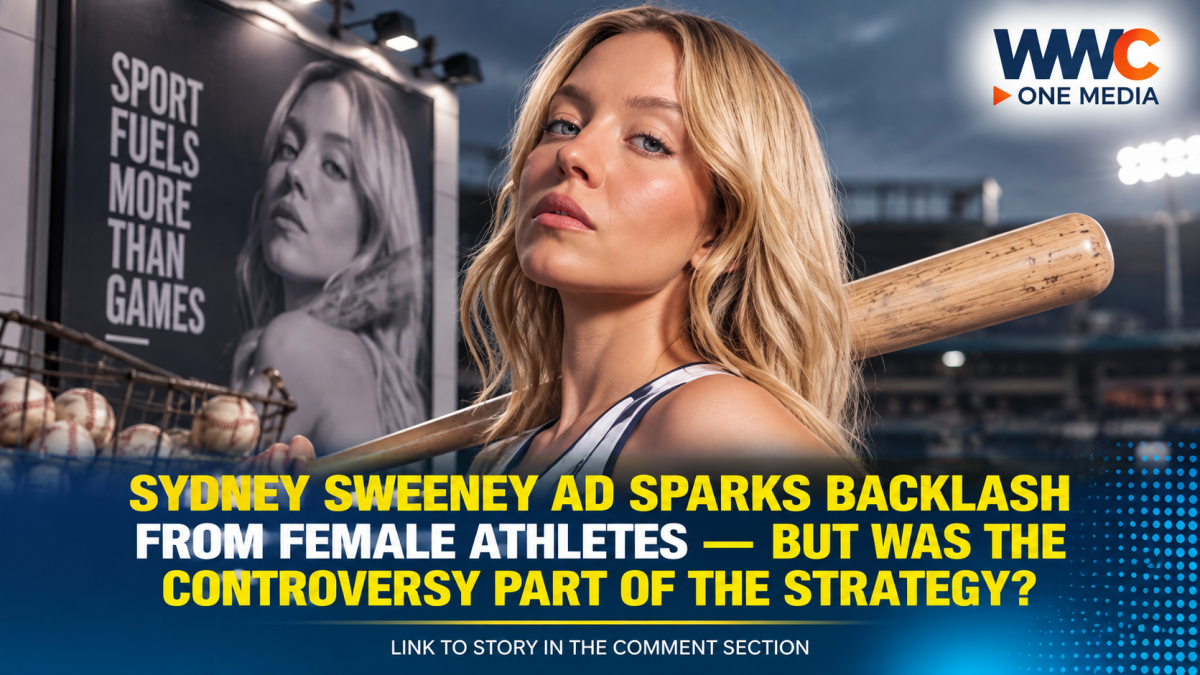
LOS ANGELES — Sydney Sweeney is at the center of another major advertising controversy after appearing in a provocative September 2026 campaign for sports-prediction company Novig.
The campaign quickly went viral, but its attention-grabbing approach has also triggered criticism from prominent female athletes, who argue that the advertisement reduces women in sports to their appearance rather than highlighting athletic ability and achievement.
Why the Campaign Sparked Backlash
The advertisement places Sweeney in sports-themed settings while using deliberately provocative imagery. Within days, the campaign had reportedly been viewed more than 22 million times, turning the advertisement into a major social-media talking point.
Several athletes objected publicly.
Olympic swimmer Ariarne Titmus, sprinter Amy Hunt and other athletes criticized the campaign, arguing that women athletes have spent years working to have their performances taken seriously and that advertising built around sexualized imagery can undermine that progress.
The criticism has therefore expanded beyond Sweeney herself into a broader debate about how women and women’s sports are represented in commercial advertising.
Was the Controversy Intentional?
That remains an open question, but there are indications that controversy and attention were part of the campaign’s appeal.
Marketing experts interviewed by Northeastern University’s news outlet described the campaign as an example of advertising designed to provoke a strong reaction and generate conversation. Business Insider also reported that Novig’s social-media mentions increased sharply following the campaign’s release.
Novig chief executive Jacob Fortinsky has defended the creative direction, while reports say Sweeney herself pitched the partnership. Sweeney also took an equity stake in the company, giving her a financial interest beyond simply appearing in the advertisement.
That combination makes the campaign particularly notable: Sweeney is not merely the face of the advertisement but reportedly has a business relationship with the company behind it.
Viral Attention Doesn’t Automatically Mean Success
The campaign has clearly achieved one marketing objective: people are talking about it.
But advertising experts caution that attention and commercial effectiveness are not necessarily the same thing. A campaign can generate millions of views while still creating questions about brand reputation, audience fit and whether the attention translates into sustained customer engagement.
This distinction is important because the current controversy involves a sports-related commercial context, where the response from female athletes could affect how the brand is perceived by audiences beyond the initial viral moment.
Sweeney Has Been Here Before
This is not Sweeney’s first experience with an advertising controversy.
In 2025, her American Eagle campaign featuring the tagline “Sydney Sweeney Has Great Jeans” generated widespread debate over its use of “genes” and “jeans” wordplay. Critics argued that some of the imagery and language carried racial or eugenic undertones, while others viewed the controversy as an example of deliberately provocative marketing.
The campaign nevertheless generated substantial commercial attention. Reuters later reported that American Eagle benefited from the buzz surrounding the Sweeney campaign, although the precise relationship between the advertisement and the company’s subsequent financial performance should not be overstated.
That earlier experience provides context for why observers are questioning whether Sweeney’s latest controversy is simply another publicity-driven campaign.
A Bigger Debate About Women, Sports and Advertising
The latest backlash also reflects a larger conversation about the treatment of women in sports media.
Female athletes have increasingly pushed for recognition based on performance, professionalism and achievement. Critics of the Novig campaign argue that advertising built around sexual appeal works against that effort.
Others have defended Sweeney’s right to participate in provocative commercial work and argue that femininity and athleticism do not have to be mutually exclusive.
Those competing views have helped turn what began as an advertisement into a wider debate about agency, representation, commercialization and the image of women in modern sports culture.
The Real Question: Publicity or Backfire?
There is clear evidence that the campaign generated extraordinary attention. What remains less certain is whether that attention will produce lasting benefits for the company.
For Sweeney, meanwhile, the episode reinforces her status as an unusually high-profile advertising figure whose campaigns can become cultural stories in their own right.
The controversy may ultimately prove to be a carefully calculated publicity strategy—or simply an example of a campaign that generated a reaction its creators did not fully anticipate.
Either way, the debate surrounding the advertisement is unlikely to disappear as quickly as the original commercial.
WWC ONE MEDIA G.A




Leave a Reply