
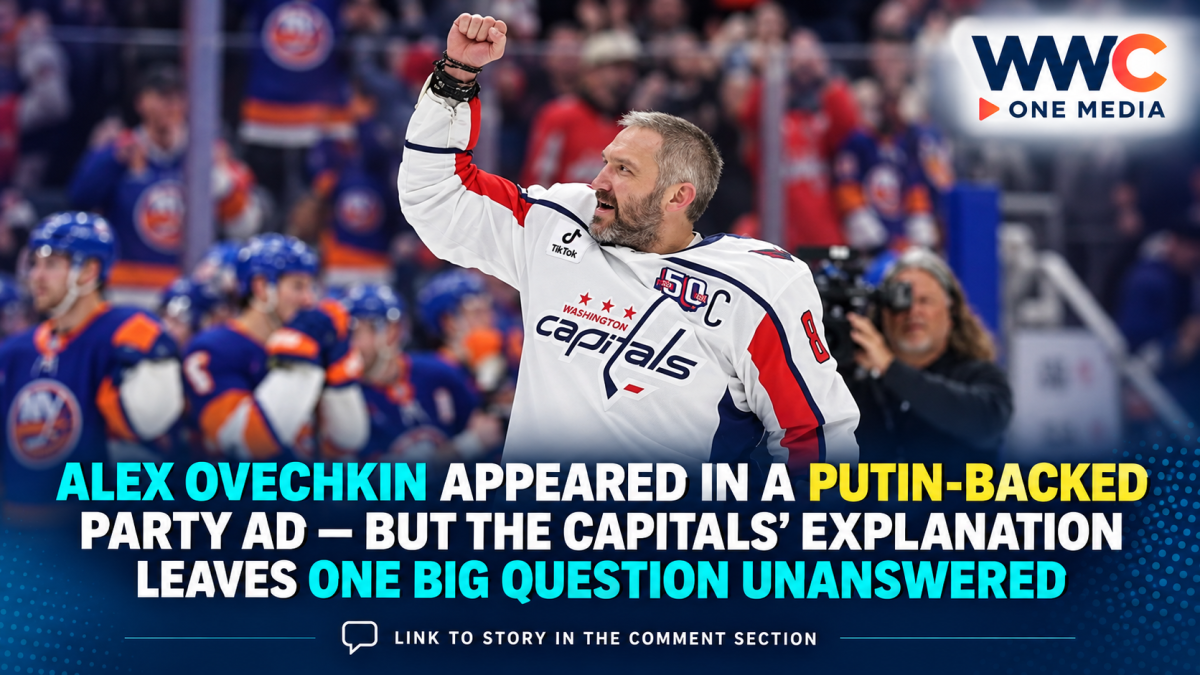
WASHINGTON — Alexander Ovechkin is about to begin his 22nd NHL season as the league’s all-time leading goal scorer, but days before Washington Capitals training camp opens, the conversation surrounding one of hockey’s biggest stars has shifted far beyond the rink.
Ovechkin appeared in a campaign video for United Russia, the country’s governing party that backs President Vladimir Putin, ahead of Russia’s September 18-20 parliamentary election. In the video, the Washington captain is shown standing behind Russian Foreign Minister Sergey Lavrov alongside other public figures.
The Capitals confirmed Tuesday that Ovechkin was asked to take part while spending the offseason in his native Russia.
Team spokesperson Sergey Kocharov said Ovechkin is a Russian citizen who lives with his family in Moscow during the offseason and intends to live there after his NHL career. According to the team, Ovechkin was “asked by his country to participate in a video campaign” while in Russia this summer.
That explanation establishes how the appearance came about from the Capitals’ perspective.
What it does not establish is why Ovechkin agreed, whether he had reservations, or whether any pressure was involved.
Neither Ovechkin nor his representatives had provided Reuters with a separate comment addressing those questions when the report was published.
The video surfaced just before Russia’s parliamentary election
The timing makes the appearance politically significant.
Russia is scheduled to hold elections for the 450-seat State Duma from September 18 through 20, its first parliamentary election since Russia launched its full-scale invasion of Ukraine in February 2022. United Russia remains the dominant party in the Russian political system and supports Putin.
Reuters describes Russia’s current political environment as tightly controlled, with genuine opposition heavily constrained and the authorities exercising extensive influence over political competition. Voting is also planned in Russian-controlled Ukrainian territories, a practice rejected by Ukraine and its allies.
That context means Ovechkin’s presence carries meaning beyond an ordinary celebrity appearance.
He is arguably the most internationally recognizable active Russian athlete — and one of the most famous Russian sports figures in North America.
Ovechkin does not speak in the segment highlighted by reports
An important detail can easily get lost in the controversy.
Reporting from Reuters, AP and The Washington Post describes Ovechkin as appearing in the video behind Lavrov, rather than delivering the central spoken political message himself.
The Washington Post reported that Lavrov recites lines emphasizing unity and resistance to those who threaten Russia, while Ovechkin and other prominent figures appear behind him.
That does not make Ovechkin’s participation politically meaningless. Appearing in an election advertisement can itself function as an endorsement or campaign asset.
But it is more precise than suggesting he personally delivered the advertisement’s political message.
The Capitals stopped short of criticizing or defending the campaign
Washington’s response was notably focused on Ovechkin’s circumstances and his role with the team.
After explaining that he had been approached while living in Russia during the offseason, the Capitals emphasized his status as the longest-tenured athlete in Washington, D.C., and said both Ovechkin and the organization were focused on the coming NHL season and his community impact.
The statement did not address United Russia’s policies, the election campaign or Russia’s war in Ukraine.
It also did not say whether the Capitals knew about the appearance before the advertisement became public.
The NHL referred questions about the matter to the Capitals, according to the Associated Press.
That leaves Ovechkin himself as the person best positioned to explain his decision.
He is expected to face reporters as the Capitals open training camp.
This is not Ovechkin’s first association with Putin
Ovechkin’s political history is one reason the video has attracted attention.
In 2017, he launched a public initiative called Putin Team, expressing support for Putin ahead of Russia’s 2018 presidential election. At the time, Ovechkin said he supported his country.
Reuters also notes that Ovechkin has maintained a photograph of himself with Putin as his Instagram profile image.
Those facts have long complicated the public image of an athlete who has spent his entire NHL career in Washington while remaining strongly identified with Russia.
But his public rhetoric changed after Russia launched its full-scale invasion of Ukraine in February 2022.
In 2022, Ovechkin called for peace
Asked about the invasion shortly after it began, Ovechkin publicly called for an end to the fighting.
He also said Putin was his president while describing himself as an athlete rather than a political figure.
Since then, Ovechkin has generally spoken much less publicly about Russian politics than he did before the war.
The Washington Post describes him as having stepped back from overt political involvement after 2022.
The United Russia campaign appearance therefore puts him back into a political spotlight he had largely avoided during recent NHL seasons.
Dominik Hasek sharply criticized the appearance
Among the most prominent critics is Dominik Hasek, the Czech Hockey Hall of Fame goaltender and two-time Stanley Cup champion.
Hasek criticized both Ovechkin and former Soviet and NHL star Viacheslav Fetisov, who also appeared in the campaign material. He argued that participating amounted to support for Russia’s conduct in Ukraine.
That is Hasek’s interpretation, not an established statement of Ovechkin’s intent.
Ovechkin has not publicly said that his appearance was intended as support for Russia’s military actions, and the Capitals’ explanation focuses only on the fact that he was asked to participate while in Russia.
Keeping those two points separate is important.
The criticism is real.
So is the absence, so far, of a detailed explanation directly from Ovechkin.
The timing could hardly be more awkward for Washington
Ovechkin turns 41 on September 17 and is preparing to begin what will be his 22nd NHL season.
In July, he signed a one-year, $4.25 million contract to remain with the Capitals.
The extension continued one of modern professional sports’ longest relationships between a superstar and a single franchise.
Washington selected Ovechkin first overall in the 2004 NHL Draft, and he made his league debut in 2005.
He later captained the Capitals to their first Stanley Cup championship in 2018.
And then came the record that once appeared untouchable.
Ovechkin is now the NHL’s all-time goals leader
Ovechkin passed Wayne Gretzky to become the NHL’s career goals leader in April 2025, scoring goal No. 895 and breaking a record that had stood for more than three decades.
He has since increased that total to 929 regular-season goals in 1,573 games, according to Reuters.
That sporting status is relevant to the political controversy because Ovechkin is not simply another Russian player appearing in a campaign.
His NHL success has given him extraordinary visibility in both Russia and the United States.
He is simultaneously a Russian sporting icon and one of the most important players in the history of a team based in the U.S. capital.
That dual identity has always made his public relationship with Putin unusually scrutinized.
His position is different from that of many Russian NHL players
There are dozens of Russian players across North American professional hockey, but Ovechkin occupies an unusual position because of his fame and his previous public advocacy for Putin.
Most Russian NHL players have not created a political movement carrying Putin’s name.
Most do not have Ovechkin’s international profile.
And none currently possesses his status as the NHL’s all-time leading goal scorer.
That makes every political appearance more consequential from a public-relations standpoint.
It also means sweeping assumptions about other Russian players based on Ovechkin’s conduct would be inappropriate.
This is specifically about Ovechkin’s own documented history and participation.
Russia’s war in Ukraine remains the essential backdrop
The controversy cannot be separated from the war.
Russia launched its full-scale invasion of Ukraine in February 2022, and fighting continues more than four years later.
The conflict has transformed how Russian athletes, businesses and cultural figures are treated internationally.
Sports organizations have repeatedly faced difficult questions about whether Russian and Belarusian athletes should compete internationally, under what flags and under what conditions.
For Ovechkin, however, the situation is particularly complicated because his relationship with Putin predates the invasion by years.
That is why critics view his latest campaign appearance through a different lens from that applied to an athlete whose connection to Russian politics is simply nationality.
But the Capitals’ statement creates another unresolved issue
The phrase that may receive the most scrutiny is the team’s statement that Ovechkin “was asked by his country” to participate.
That wording is broad.
It does not identify who specifically contacted him.
It does not explain the circumstances of the request.
It does not say whether participation was optional in practical terms.
And it does not say what Ovechkin understood the final video would be used for.
Available reporting does not establish those answers, so presenting any of them as fact would be speculation.
This is where Ovechkin’s own explanation could materially change public understanding of the episode.
One video has reopened a debate Ovechkin had largely kept off the ice
For several seasons, the hockey story had increasingly overwhelmed the political one.
Ovechkin chased Gretzky.
He broke the record.
Washington celebrated one of the greatest careers in NHL history.
At 41, he signed another contract and prepared for season No. 22.
Then a campaign advertisement recorded during his summer in Moscow appeared days before training camp.
It reconnected two parts of Ovechkin’s public life that had become easier to discuss separately: the hockey legend in Washington and the Russian sporting icon with a documented history of supporting Putin.
The Capitals have now explained how they say he came to be in the advertisement.
But they have not answered the question only Ovechkin can fully address:
Why did he choose to appear in it?




Leave a Reply