
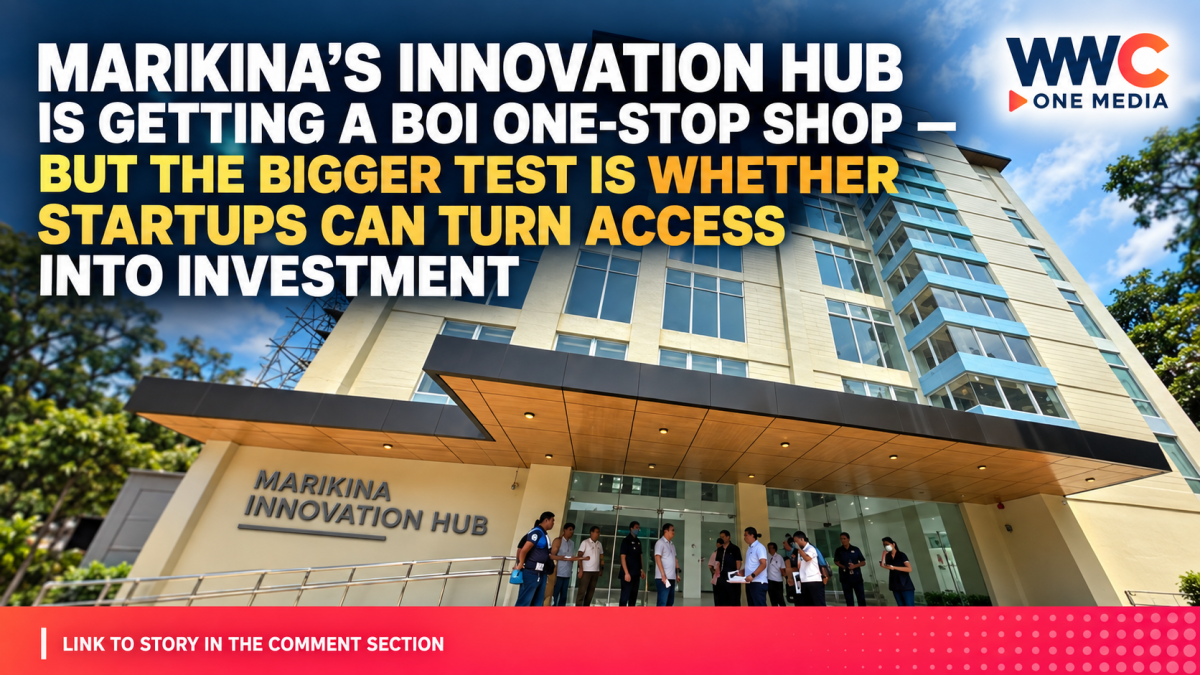
MARIKINA CITY — Filipino entrepreneurs trying to navigate government requirements may soon be able to access key investment services without making another trip to Makati or jumping between multiple agency websites.
The Board of Investments and National Development Company have signed a memorandum of understanding to establish a government One-Stop Shop through a self-service digital kiosk at the Philippine Innovation Hub–Marikina Enterprise Center.
The objective sounds straightforward:
put investment information, online government services and channels for investor inquiries inside a facility already filled with startups, MSMEs, innovators and business-development programs.
But there is a much bigger strategy behind the kiosk.
The government is increasingly trying to turn the Marikina facility into a place where an entrepreneur can move from an idea, to incubation, to government compliance, to investment — without having to navigate each part of that journey alone.
And that makes the latest BOI-NDC agreement less about one computer terminal than about whether the Philippines can finally make its startup support system work as an integrated ecosystem.
First, an important correction: the Marikina hub already exists
Some headlines describing the new agreement as BOI and NDC “establishing” a Marikina investment hub can give the impression that a completely new facility is about to be constructed.
That is not quite what happened.
The Philippine Innovation Hub–Marikina Enterprise Center was inaugurated on April 29, 2025 at the NACIDA Compound in Marikina City. NDC’s 2025 annual report describes it as a five-story innovation facility designed to support startups and entrepreneurs through incubation and acceleration programs.
Earlier government planning documents put the building at approximately 6,500 square meters.
So the major Sept. 2026 development is not the birth of the hub.
It is the addition of a more direct BOI government-services layer inside it.
That distinction matters for an accurate news story.
What exactly are BOI and NDC putting in Marikina?
Under the memorandum of understanding, the two agencies will establish a Digital Government Service Kiosk functioning as a One-Stop Shop within the innovation hub.
BOI will provide access to its:
- online services;
- information portals;
- investment-related systems;
- digital resources;
- and online channels where investors and other stakeholders can submit inquiries.
BOI is also responsible for keeping the content and service links functional and updated.
NDC, meanwhile, will provide the physical space and handle basic infrastructure requirements such as:
electricity, connectivity, facility support, maintenance and operational needs.
BOI Investments Assistance Center Executive Director Bobby Fondevilla described the kiosk as a platform for promoting ease of doing business and integrating investment information directly into the Marikina hub.
In practical terms, the government is putting an investment-assistance doorway directly where entrepreneurs are already being trained and incubated.
The bigger idea was actually part of the hub from the beginning
A one-stop government facility was not an afterthought.
When the Philippine Innovation Hub was launched in 2025, its design already included plans for:
incubation and acceleration programs, coworking areas, shared facilities, retail spaces and a government one-stop shop.
NDC procurement documents went even further.
They described dedicated areas where government agencies could support startups with licenses and compliance requirements, along with facilities for workshops, multimedia production, business meetings, technology development and entrepreneurship programs.
The new BOI-NDC agreement therefore appears to be putting a concrete operating component behind a service model envisioned when the building was designed.
That may sound bureaucratic.
For a startup founder, however, government navigation can be one of the least glamorous but most important parts of building a company.
Because getting funding is only one part of becoming a real business
Startups often attract attention for fundraising rounds, product launches and new technology.
But scaling a company usually requires something much more mundane:
registrations,
permits,
tax compliance,
licenses,
investment incentives,
business-location decisions,
and communication with government agencies.
BOI is the Philippines’ principal investment-promotion agency and provides assistance covering investment registration, incentives, location support and facilitation with other government bodies.
It is also the government’s single point of entry for strategic investments under Executive Order No. 18’s Green Lane mechanism, which is intended to accelerate the processing of high-impact projects across government agencies and local governments.
Putting BOI access inside Marikina’s startup hub creates the possibility of exposing smaller and younger businesses to the same investment-facilitation machinery used by much larger companies.
Whether that translates into materially faster approvals is what ultimately matters.
BOI is already processing hundreds of billions in investments
The agreement is also arriving while BOI is handling a substantial investment pipeline.
The agency reported ₱461.84 billion in approved investments during the first half of 2026, up 21% from ₱382.24 billion during the comparable period a year earlier.
Those approvals covered 124 projects expected to create 14,415 direct jobs.
Separately, BOI said projects certified through the government’s Green Lane system reached ₱351.02 billion during January to June, with nearly 40,000 projected jobs.
Renewable energy accounted for the overwhelming majority of that Green Lane investment value.
Those numbers are not directly attributable to the Marikina hub.
They show the scale of the investment system that entrepreneurs using the kiosk are being connected to.
The hub itself has much bigger ambitions than a help desk
When the innovation center opened, the government said its goal was to provide support to entrepreneurs from ideation through global expansion.
Its initial target was to serve roughly:
50 MSMEs and 50 to 75 startups during the first year.
Over five years, the target rises to approximately:
500 MSMEs and 500 to 750 startups.
NDC planning documents describe an even larger strategic ambition: to help seed new companies, move selected startups toward Series A and Series B financing and ultimately increase the Philippines’ chances of producing internationally competitive high-growth companies.
The hub is therefore being designed not merely as office space.
It is supposed to be part incubator, part business center, part government interface and part connection point to capital.
It is already hosting real startup activity
That vision has moved beyond a ribbon-cutting.
The Philippine Innovation Hub hosted Philippine Startup Week 2025, bringing together founders, investors, corporations, government agencies and academics.
In August 2026, Marikina Polytechnic College held a startup demo day there involving 14 ventures from its ReSOLES Technology Business Incubator, focusing particularly on entrepreneurship and innovation linked to footwear and leathercraft.
The hub has also hosted social-enterprise accelerator activities and startup demonstrations.
Those events matter because Marikina is traditionally identified with manufacturing — particularly shoes and leather products.
The government’s broader goal appears to be to preserve that entrepreneurial identity while expanding it into technology, creative industries, digital services and higher-growth startups.
Marikina’s footwear legacy is part of the strategy
Marikina did not become the location by accident.
Government documents describe the facility as supporting sectors including:
footwear, creative industries, technology, culinary innovation and other emerging enterprises.
The hub therefore represents an attempt to bridge two economies.
One is Marikina’s longstanding manufacturing and craftsmanship base.
The other is a newer economy centered on software, digital platforms, innovation, research and venture-backed companies.
If the model works, a traditional MSME and a technology startup could theoretically use the same building for business support while requiring very different kinds of assistance.
That is much more ambitious than a conventional startup incubator.
And NDC has money on the investment side
The National Development Company is not merely providing office space.
It is also responsible for the government’s Startup Venture Fund, established under the Innovative Startup Act to provide equity financing to qualified Philippine startups.
The program is designed to support companies from the seed stage through Series B through co-investment arrangements with accredited private venture-capital partners or investments in VC funds.
NDC has already made startup investments.
Its portfolio includes SolX Technologies, a digital energy-management business, and Humble Sustainability, a circular-economy company.
That makes the Marikina hub unusually interesting.
Entrepreneurs inside one facility may potentially gain access to:
training,
mentorship,
workspace,
government services,
investor information,
and pathways toward venture funding.
The challenge is connecting those pieces effectively.
NDC is also backing a biotech company in Marikina
Another NDC project illustrates how the city is already attracting innovation outside its traditional industries.
NDC invested ₱70 million in Manila HealthTek in 2024 to support the completion of a molecular diagnostic and medical-device manufacturing facility in Marikina.
NDC describes Manila HealthTek as a biotechnology company focused on molecular diagnostics and portable testing technologies.
That investment is separate from the new BOI kiosk.
But it illustrates the broader policy direction:
the government wants Marikina to host not merely MSME training but actual technology commercialization and production.
The Philippines has a startup funding problem the hub cannot solve by itself
This is where expectations should remain realistic.
A government kiosk can make information easier to access.
It cannot automatically create venture capital.
It cannot guarantee a company’s product will succeed.
It cannot remove every permitting delay at another government agency.
And it cannot turn a weak business model into an investable company.
That is why NDC’s own startup programs rely partly on private-sector co-investment.
Under the Startup Venture Fund, NDC generally does not invest alone; eligible startups require a qualified co-investment partner under the program framework.
That structure recognizes a central reality of startup ecosystems:
government can reduce friction and provide capital, but private investors still have to believe that the business can grow.
Digital access also does not automatically mean one-click government
The phrase “One-Stop Shop” can create expectations that every permit and government process will suddenly be completed at a single kiosk.
The current agreement does not support that interpretation.
PNA describes the facility as a self-service digital kiosk providing access to BOI portals, services, information systems and inquiry channels, supported by greater interagency coordination.
It does not say every SEC, BIR, LGU, environmental, construction or industry-specific permit can be fully issued from that machine.
Some business approvals still depend on separate government bodies and local governments.
A more accurate description is:
a centralized digital access point for BOI and investment-related government assistance.
That is useful.
But it is not the same thing as eliminating the entire Philippine permitting system.
The government has been trying to attack that bigger problem separately
BOI has been pursuing broader reforms beyond Marikina.
In June, the agency brought together the Department of Energy, Department of Human Settlements and Urban Development, Department of the Interior and Local Government and Anti-Red Tape Authority to work on simplifying locational clearances for strategic investments.
The agencies discussed standardized procedures and clearer responsibilities between national government bodies and LGUs.
That matters because delays often occur not because investors cannot find the right website, but because different agencies impose overlapping requirements or interpret rules differently.
A kiosk can make the front door easier to find.
Interagency reform is what determines how complicated the hallways remain once an investor walks through it.
That makes the Marikina project a useful experiment
The BOI-NDC partnership creates a relatively contained environment in which government can test a more integrated model.
Entrepreneurs are already in the building.
Startup programs already operate there.
NDC is already involved in financing.
BOI will now provide investment-service access.
Private investors and corporations attend events there.
Academia and government agencies are already participating in programs.
If those components begin producing measurable results — businesses incorporated, investments secured, incentives obtained, permits accelerated and startups successfully scaling — Marikina could offer a template for similar facilities elsewhere.
If entrepreneurs still have to leave the hub and navigate the same fragmented bureaucracy afterward, the kiosk risks becoming little more than another screen pointing users toward websites they could have accessed from home.
That is why implementation will matter more than the signing ceremony.
The Philippines wants to compete for much larger technology investments too
The timing also fits a broader shift in Philippine industrial policy.
BOI is currently promoting the country as a destination for AI infrastructure, data centers, renewable energy and advanced manufacturing.
In May, BOI discussed energy and digital-infrastructure investments with companies in the United Arab Emirates tied partly to the Philippines’ growing push into AI-related industrial development.
The government’s 2026 Strategic Investment Priority Plan similarly expands support for high-impact and emerging industries.
That creates a pipeline problem.
Large foreign investors need infrastructure and government facilitation.
But the country also needs local companies capable of becoming suppliers, technology partners and innovators inside those industries.
Startup hubs like Marikina are an attempt to strengthen that domestic side of the ecosystem.
The real measure will not be how many people touch the kiosk
For BOI and NDC, it would be easy to measure activity:
number of visitors,
number of inquiries,
number of portal sessions,
number of entrepreneurs attending programs.
Those numbers may look impressive.
But they are not the outcomes that matter most.
The stronger measures will be:
How many startups successfully raise capital?
How many MSMEs formalize and expand?
How quickly can entrepreneurs resolve government requirements?
How many companies reach commercial scale?
How many jobs are created?
How many Philippine technologies reach export markets?
And how many businesses survive after government incubation support ends?
Those are harder numbers to produce.
They are also the numbers that determine whether the Philippine Innovation Hub becomes a genuine economic institution rather than simply another government facility.
Marikina now has most of the pieces
The ingredients are increasingly visible.
A five-story innovation center.
Incubators and startup programs.
Coworking and shared facilities.
A national Startup Venture Fund.
Industry and academic partners.
An expanding network of entrepreneurs.
And now direct BOI digital investment services.
The government has therefore moved beyond simply saying Filipino startups need support.
It is attempting to assemble that support physically in one location.
But entrepreneurship cannot ultimately be manufactured by government decree.
The hub can make business easier.
NDC can co-invest.
BOI can open doors.
Mentors can provide advice.
Entrepreneurs still have to turn all of that access into companies customers and investors actually want.
And that is why the most important thing about Marikina’s new One-Stop Shop is not the kiosk itself.
It is what happens to the businesses after they log off.
WWC ONE MEDIA M.J.E

Leave a Reply